Wide Load Sign: Meaning, Size, Laws and Requirements
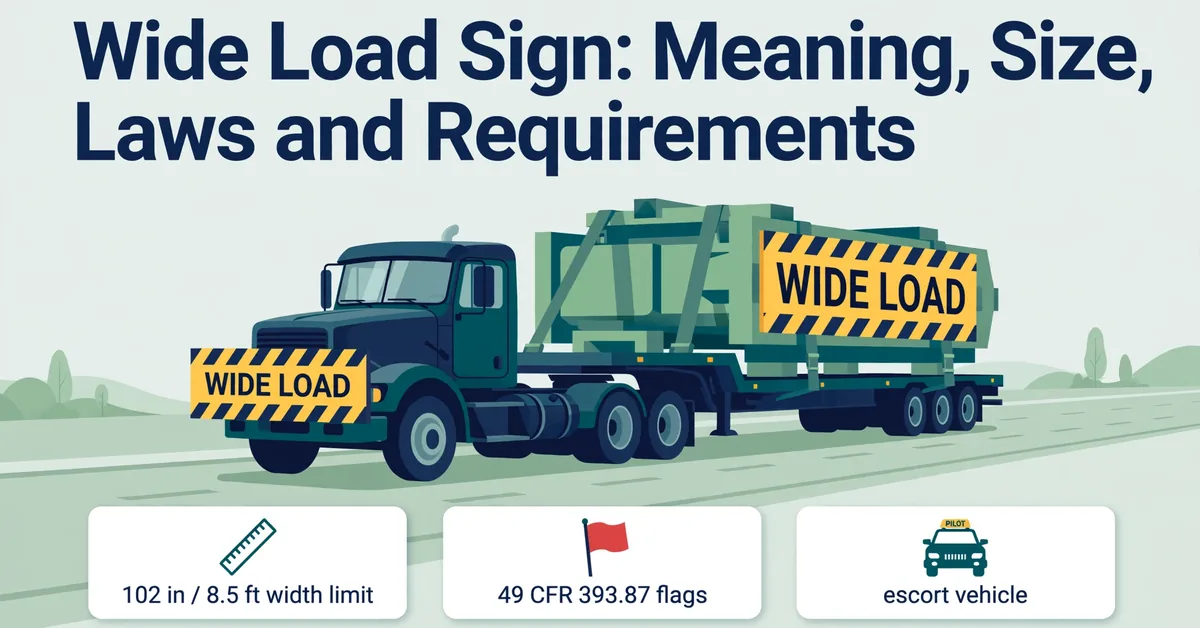
A wide load sign warns other road users that a truck or its cargo may exceed ordinary vehicle-width limits or require additional space on the road. In the United States, the correct sign wording, dimensions, placement, and supporting safety equipment depend on state regulations, the type of movement, and the oversize permit, not on one universal federal banner specification.
If you have seen a yellow-and-black banner on a heavy-haul truck, its purpose is straightforward: alert approaching and following traffic to unusual vehicle dimensions. Understanding the difference between a wide load and an oversize load, the federal width baseline, and state-specific signage requirements can help motorists respond safely and help carriers avoid preventable compliance problems.
Wide Load Sign: Quick Reference
Before choosing a banner: Sign dimensions, wording, placement, and escort requirements depend on the applicable state rules and permit. An 84-inch-wide by 18-inch-high banner with black lettering on yellow is a documented format in Oregon for a specified WIDE LOAD sign used on towing or hauling vehicles. It is not a nationwide requirement for every truck or load. Always verify the current rules for your route.
| Requirement | What you need to know |
|---|---|
| Sign wording | May be WIDE LOAD or OVERSIZE LOAD, depending on the applicable rule and permit |
| Banner dimensions | State-specific; Oregon provides an 84 × 18-inch example for a specified hauling-vehicle sign |
| Lettering | Required letter height and stroke width depend on the jurisdiction and sign type |
| Placement | Front, rear, or both, according to the applicable rules and permit |
| Warning flags | Federal and state rules may require flags to mark projecting cargo |
| Pilot or escort vehicles | Required for some movements, depending on load dimensions, route, and permit |
| Permit | Check the relevant state permits and movement conditions before departure |
For a broader explanation of commercial vehicle width standards, consult the Federal Highway Administration’s vehicle size regulations (https://ops.fhwa.dot.gov/freight/sw/permit_report/index.htm).
The Legal Foundation: Federal and State Rules
A wide load sign is one part of a larger safety and compliance system. Depending on the movement, that system may include warning flags, clearance lights, amber warning lights, pilot cars, route restrictions, and a state-issued oversize or overwidth permit.
Federal regulations establish certain commercial vehicle safety and size requirements. States administer many oversize movement permits and determine additional requirements for signs, escorts, lighting, and operating conditions.
One important distinction is that federal law does not establish one universal banner size for every oversize haul. The federal projecting-load rule, 49 CFR § 393.87 (https://www.ecfr.gov/current/title-49/subtitle-B/chapter-III/subchapter-B/part-393/subpart-I/section-393.87), addresses warning flags on qualifying commercial motor vehicles. State laws and permit conditions determine many of the additional signage requirements.
Federal width limit versus a permitted load
The federal commercial motor vehicle width baseline on the National Network and reasonable access routes is generally 102 inches, or 8 feet 6 inches. Hawaii has a separate 108-inch allowance in the federal framework. Certain devices, including specified mirrors and safety equipment, are excluded from width measurement under the applicable rules.
These provisions do not mean that every vehicle exceeding 102 inches is automatically illegal in every circumstance. Authorized permits, exemptions, vehicle classifications, and route-specific rules matter. However, exceeding the ordinary width limit is an important reason to investigate whether an overwidth permit and additional safety equipment are required.
The FHWA’s Federal Size Regulations for Commercial Motor Vehicles explain the federal framework and its limitations. For a particular trip, check the actual state regulations and permit rather than relying on a general summary.
Canada also commonly uses an 8-foot-6-inch width reference, but provincial rules, exemptions, and permit conditions apply. A US carrier crossing the border must verify the requirements for the actual province and route instead of assuming that a US permit or banner is sufficient.
Federal warning flags for projecting loads
Under 49 CFR § 393.87, qualifying commercial motor vehicles must display red or fluorescent orange warning flags when cargo projects more than 4 inches beyond either side of the vehicle or more than 4 feet beyond the rear. Each flag must be at least 18 inches square.
For rear projections, the federal rule specifies one flag at the extreme rear when the projection is 2 feet wide or less, and two flags when the projection is wider than 2 feet. These requirements concern warning flags; they do not replace any separate state banner, lighting, or permit requirements.
Read the full federal warning-flag regulation to confirm its applicability to the vehicle and load. State rules may impose additional requirements.
The OVERSIZE LOAD Banner
A yellow banner with black lettering reading “OVERSIZE LOAD” is widely used to identify vehicles or loads operating beyond ordinary legal dimensions. “WIDE LOAD” more specifically identifies a movement involving excess width.
The terms overlap in everyday conversation, but they are not necessarily interchangeable under every state’s rules. The wording required for a particular trip depends on the jurisdiction, the type of movement, and the permit.
Consider a truck carrying a prefabricated building section. The cargo might exceed the permitted width, length, height, or several dimensions at once. The banner tells other road users to expect unusual vehicle dimensions, but it does not replace required flags, lights, permits, or escorts.
Standard sign specifications
Many drivers recognize large yellow-and-black banners, but appearance alone does not establish legal compliance. The dimensions, lettering, background, and mounting position must match the applicable requirements.
For example, Oregon’s 2026 Traffic Section Sign Policy and Guidelines specifies a WIDE LOAD sign measuring 84 inches wide by 18 inches high, with 10-inch lettering, for a defined towing or hauling vehicle application (https://www.oregon.gov/odot/Engineering/Pages/Sign-Policy.aspx). That policy applies to vehicles transporting loads that are wide only and under 80 feet long. It also specifies a yellow background with black lettering.
This is a useful example of a state-specific hauling-vehicle sign, not a universal federal minimum. Other jurisdictions may specify different dimensions, letter heights, stroke widths, or wording. Requirements for a pilot vehicle can also differ from those for the main hauling vehicle.
Before purchasing a banner, check the current state rule and permit. The sign must be legible, securely mounted, and visible from the direction of approaching traffic. A banner with the right colors can still be noncompliant if it is too small, obscured, or improperly installed.
Front versus rear sign requirements
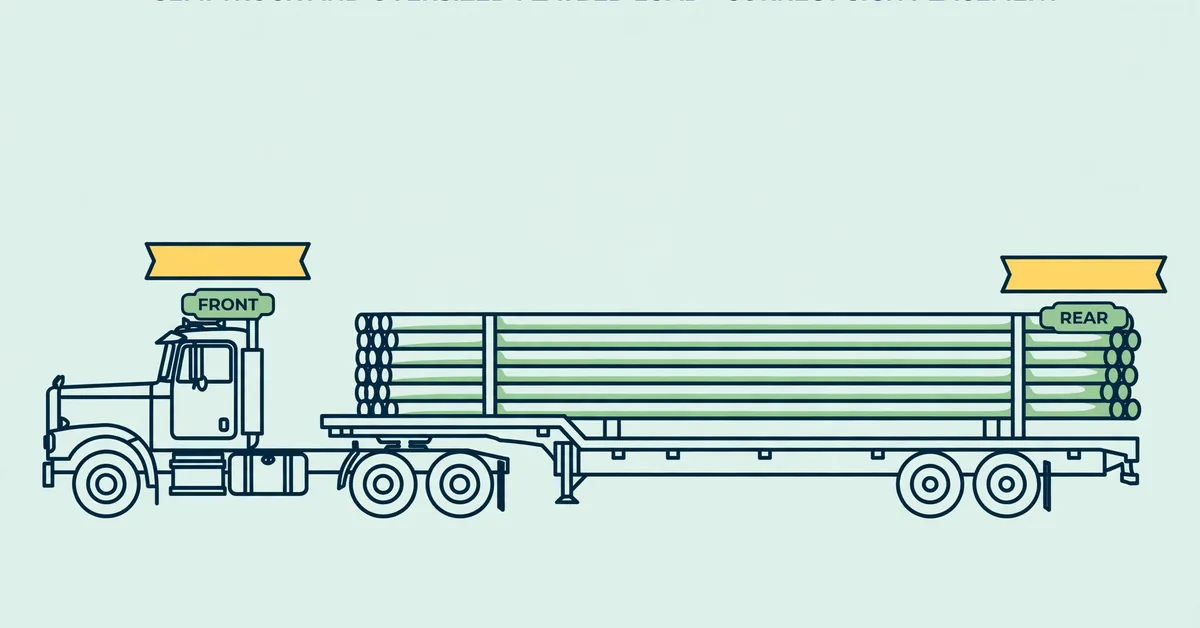
Many permitted movements require a warning sign facing approaching traffic and another facing traffic behind the load. The exact requirement depends on the state, load configuration, vehicle combination, and permit.
The front sign may be mounted on the towing vehicle or another authorized front position. The rear sign may be required on the load or last vehicle in a combination. Do not assume that one banner on the tractor satisfies every requirement.
The sign must not be hidden behind cargo, equipment, a tarp, or another attachment. Check that required lamps, reflectors, and license plates remain visible. When a vehicle is no longer operating under conditions that require the banner, some jurisdictions require it to be removed, covered, retracted, or turned away from traffic.
Oversize Load Signage Requirements by Width Category
The following table is a practical guide, not a nationwide legal schedule. Sign triggers, flag locations, warning lights, and escort requirements vary by state and permit. Width is only one factor; length, height, cargo projections, route restrictions, and roadway geometry can also affect the requirements.
| Load or situation | What to check |
|---|---|
| At or below 8 ft 6 in | Confirm the applicable width standard and whether another dimension requires a permit |
| Over 8 ft 6 in | Determine the state’s overwidth permit rules and applicable signage requirements |
| Wide or overdimensional load | Check the exact sign, flag, and lighting requirements for the jurisdiction and permit |
| Very wide loads | Confirm pilot or escort requirements, extremity markings, and route-specific restrictions |
| Cargo projecting beyond the vehicle | Check the federal warning-flag rule and any additional state requirements |
| Night or restricted-hour movement | Verify the permit’s travel window and required lighting or reflectivity |
There is no reliable nationwide width-category table that can replace a state’s actual rules. For instance, Texas’s escort requirements distinguish between permitted loads exceeding 14 feet and 16 feet wide, and those exceeding 16 feet, with escort placement depending on the width and road type. These are Texas-specific escort thresholds, not universal banner-size triggers.
Review the current TxDMV Escort and Equipment Requirements (https://www.txdmv.gov/motor-carriers/oversize-overweight-permits/escort-requirements) before applying those thresholds to a Texas trip.
Pilot Car Signage Requirements
A pilot car, also called an escort vehicle, warns other motorists and helps guide a permitted load through hazards such as narrow bridges, tight turns, overhead obstructions, and unusual traffic patterns.
Depending on the jurisdiction and load dimensions, a permitted movement may require one or more escorts, warning signs on those vehicles, amber lights, and two-way communication with the hauling driver.
An escort sign is not automatically interchangeable with the main truck’s sign. States may prescribe separate dimensions, wording, and mounting positions for pilot vehicles.
Texas escort-vehicle sign example
Texas provides a concrete example of why the vehicle position matters. Under the published TxDMV Escort and Equipment Requirements, an escort flag vehicle must display an “OVERSIZE LOAD” or “WIDE LOAD” sign on the roof or at the front and rear, as specified by the applicable rule.
For the covered Texas escort-vehicle application, the sign requirements include:
- Length: 5 to 7 feet.
- Height: 12 to 18 inches.
- Letter height: 8 to 10 inches.
- Letter stroke: At least 1.41 inches.
- Colors: Yellow background with black lettering.
- Visibility: Visible from the front and rear while escorting the permitted load.
- Use: The sign must not be used at other times.
These specifications are a Texas escort-vehicle example. They should not be presented as the required dimensions for every main truck banner or as a national standard.
Before departure, confirm the requirements for each escort and hauling unit, including any required height pole, warning flags, lighting, radio communication, and permit documentation.
State-Specific Signage Variations
State rules can differ significantly. A banner accepted for one trip may not meet the requirements of another jurisdiction, even if the cargo and truck appear similar.
Florida’s administrative rules address the movement of overweight and overdimensional vehicles. Texas publishes separate escort and equipment requirements. Oregon provides specific sign designs and dimensions in its traffic-sign policy.
Carriers moving across state lines should check the permit conditions for each jurisdiction rather than relying on a banner that was accepted on a previous trip.
Example: checking a state’s permit rules
Start with the official FHWA oversize/overweight permit contacts and state information to locate relevant federal size guidance and identify the need to consult state authorities. Then visit the appropriate state agency for current permit instructions.
For a Texas trip, consult the TxDMV Escort and Equipment Requirements. Check the actual permit and current state rules for sign dimensions, required wording, escort thresholds, permitted travel times, and restrictions on displaying the sign when the load no longer requires it.
The FHWA Manual on Uniform Traffic Control Devices (MUTCD) (https://mutcd.fhwa.dot.gov/) is the official federal source for national standards governing traffic control devices on public roads. The current edition is the 11th Edition with Revision 1. The MUTCD is important for understanding highway signs, signals, and traffic-control standards, but it should not be treated as a universal specification for commercial oversize-load banners. Check the applicable state rules and permit for those requirements.
Oregon: continuous-background signs
Oregon’s 2026 Traffic Section Sign Policy and Guidelines specifies that mesh or other materials that do not provide a continuous background are not permitted for its specified WIDE LOAD sign. The policy also addresses reflective material for hauling vehicles using the sign between sunset and sunrise.
This requirement is tied to Oregon’s specified sign and policy. Do not assume that the same material restriction applies identically in every state. Before buying a mesh, vinyl, or other banner, check the current sign policy for the state where it will be used.
How Big Must an Oversize Load Sign Be?
A sign measuring 84 by 18 inches with 10-inch lettering is one documented format, but it is not legally correct for every US state, vehicle position, and permit.
Oregon’s 2026 sign policy provides this dimension for a specified hauling-vehicle WIDE LOAD sign. Texas’s published escort-vehicle requirements, by comparison, specify a length of 5 to 7 feet, a height of 12 to 18 inches, and lettering 8 to 10 inches high for the covered escort-vehicle application.
These examples demonstrate why it is important to identify the jurisdiction and vehicle position whenever exact dimensions are quoted. Do not automatically apply the main truck’s sign specifications to a pilot car or use an escort sign specification as the national rule.
A banner also needs a suitable material and mounting system. A rigid sign may be appropriate for repeated heavy-haul use, while a flexible banner may suit another permitted setup. The key is to choose a compliant, durable sign that remains visible throughout the trip.
Vinyl, mesh, and reversible signs
Vinyl banners provide a continuous background and are commonly available with grommets, rope ties, or bungee attachments. Mesh materials allow airflow and may reduce wind loading, but they may not meet every state’s background requirements.
As noted above, Oregon’s 2026 sign policy does not permit mesh or other materials that fail to provide a continuous background for its specified WIDE LOAD sign. Verify whether a proposed material meets the requirements of the actual jurisdiction and sign application.
Reversible signs can show “WIDE LOAD” on one side and “OVERSIZE LOAD” on the other. They are useful only when the wording on the displayed side satisfies the current rule and permit. Reversibility is a convenience, not a waiver: drivers must display the correct message and ensure that the sign remains legible and secure.
Where Does the Sign Go?
The main sign is commonly mounted at the front of the towing vehicle and at the rear of the load or last unit, where required. The front-facing message alerts oncoming traffic; the rear-facing message warns drivers approaching from behind.
State rules may specify mounting height, exact position, visibility, and whether the sign must sit on the load itself in a particular configuration. Escort vehicles may have separate placement rules.
Before moving, inspect the sign from the direction in which other drivers will approach it. Make sure the cargo does not block the words, the banner is not angled away from traffic, and the fasteners are secure. Confirm that required lights, reflectors, and license plates remain visible.
If a sign becomes loose or unreadable in transit, stop at a safe location and correct the problem before proceeding when required by the permit or applicable law.
What other drivers should do when they see a wide load sign
For ordinary motorists, a wide-load banner is a cue to create space and avoid sudden maneuvers. Slow down smoothly, leave extra following distance, and do not attempt to squeeze alongside a load that occupies part of an adjacent lane.
Avoid following an escort vehicle too closely, and watch for signals from authorized pilot or traffic-control personnel.
If the load approaches from the opposite direction on a narrow road, be prepared to slow or stop where safe. Do not pull onto an unstable shoulder, enter oncoming traffic, or assume you must stop in every situation. Follow lawful directions from traffic-control personnel and prioritize a safe, predictable response.
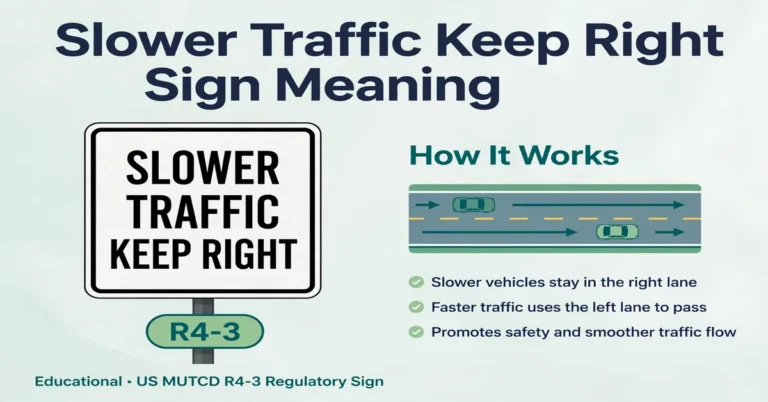
For related driving knowledge, see our road sign practice test and our guide to the slower traffic keep right sign.
Pre-Trip Wide Load Sign Compliance Checklist
Before departing with an oversize or overwidth load, review the entire movement rather than checking only the banner. A correct sign cannot compensate for a missing permit, incorrect route, or required safety equipment that is not installed.
Use this checklist as a starting point, then follow the specific conditions in the permit and the applicable regulations.
- Confirm the permit. Check that the load, vehicle combination, route, travel dates, and operating times match the authorization.
- Verify the sign wording. Confirm whether the applicable rules require WIDE LOAD, OVERSIZE LOAD, or another approved message.
- Check sign dimensions. Verify the required length, height, letter height, and stroke width for the relevant vehicle position.
- Confirm sign placement. Install front, rear, and escort-vehicle signs wherever required.
- Inspect the background and material. Make sure the sign meets applicable color, visibility, and reflectivity requirements.
- Secure all mounting hardware. Check brackets, fasteners, straps, grommets, and other attachments.
- Check projecting cargo. Determine whether federal or state rules require warning flags and confirm their locations.
- Inspect lights and reflectors. Verify that required warning lights and clearance lamps work and remain visible.
- Confirm escort arrangements. Check the number and placement of pilot vehicles, communication equipment, and any required height poles.
- Review the route. Verify bridge restrictions, overhead clearances, road closures, construction, and other permit-specific conditions.
- Check travel restrictions. Confirm daylight or nighttime conditions, rush-hour restrictions, weekend rules, and any required time windows.
- Keep documentation available. Make sure the driver can access the permit and other required records.
- Recheck before departure. Walk around the entire vehicle and load to identify any obstruction or equipment problem.
If the route crosses several states, repeat the regulatory check for each jurisdiction. A permit and sign arrangement approved in one state do not automatically satisfy the requirements of the next.
Permits, Travel Times, and Restricted Routes
A load exceeding ordinary legal dimensions may require a state oversize or overwidth permit. The permit can specify the approved route, operating hours, escort vehicles, warning equipment, and other movement conditions.
A permit issued for one state does not automatically authorize the same movement in another state. Similarly, a correctly displayed sign does not legalize an otherwise unauthorized trip.
Some jurisdictions restrict oversize movements at night, during rush hours, on weekends or holidays, or along particular roadways. The exact conditions depend on the state, load dimensions, route, and permit. Review every state crossed, including any required route changes, before departure.
Allow extra travel time rather than assuming the same schedule applies throughout a multistate trip. If road conditions or an unexpected obstruction make the approved route unsafe or unusable, follow the applicable permit procedures and contact the responsible authority when necessary.
What Happens If the Sign Is Missing or Incorrect?
There is no single nationwide fine that applies to every wide-load-sign violation. The outcome depends on the jurisdiction, the precise violation, the permit conditions, and any associated safety issues.
Possible consequences include a citation, monetary penalty, a requirement to correct equipment before continuing, or a delay or out-of-service order when the applicable enforcement rules allow it.
Be cautious with claims that every missing sign automatically triggers a fixed $250–$1,500 fine. Such ranges appear in commercial guidance, but they should not be presented as a universal federal penalty schedule for wide-load banners.
If you need an exact penalty, consult the applicable state statute, administrative rule, permit condition, or official enforcement schedule. Make sure the penalty relates to the actual violation rather than a different oversize, flag, or permit offense.
Preventing a violation through a pre-trip inspection is usually simpler than resolving one during a roadside stop.
Canada: Overdimensional Loads and the D Sign
Canadian rules are provincial and territorial, so the precise signage requirement depends on the route and permit.
In Manitoba, the current Vehicle Weights and Dimensions on Classes of Highways Regulation, M.R. 155/2018 states that a permit may require an overdimensional vehicle to carry a “WIDE LOAD,” “LONG LOAD,” “OVERSIZE LOAD,” or “D” sign.
When the permit requires one of these signs, the regulation requires it to follow the applicable specifications and be mounted conspicuously. Manitoba also sets out sign designs in its schedules.
The D sign is therefore a jurisdiction-specific option, not a universal replacement for “WIDE LOAD” across Canada. Operators should confirm the province’s required sign design, dimensions, escort rules, and route conditions before crossing the border.
The familiar 8-foot-6-inch width reference is useful context, but it does not replace provincial legal checks.
New Zealand: “Wide Load Follows” and Pilot-Vehicle Warnings
New Zealand uses a different warning system in which pilot vehicles may carry roof-mounted signs reading “WIDE LOAD FOLLOWS” when leading a wide load, or “WIDE LOAD AHEAD” when following it.
The official NZ Transport Agency Waka Kotahi guidance on vehicle-mounted signs explains how oversize vehicles and pilot vehicles warn other road users. The guidance also describes flashing warning lights and advises drivers who encounter these vehicles to slow down and be prepared to pull over or stop when necessary.
These phrases and procedures are part of New Zealand’s warning system. They should not be presented as universal US wide-load-sign requirements. Always apply the rules of the country and road where the vehicle is operating.
A related sign resource on SquareRootSigns.com is our guide to the green arrow traffic sign, which helps readers understand a different type of road signal without confusing it with an oversize-load warning.
FAQ: Wide Load Sign
1. When is a wide load sign required?
A sign is required when the applicable state rule or permit conditions call for it. The trigger may depend on width, length, height, the type of movement, or other circumstances. Check the permit and current rules for every state on the route. Exceeding the common 8-foot-6-inch width baseline is an important reason to investigate permit requirements, not a complete answer to every signage question.
2. What size does a wide load sign need to be?
An 84-by-18-inch banner with black lettering on yellow is a documented format for a specified Oregon hauling-vehicle sign, often with 10-inch lettering. However, state requirements differ, and escort vehicles may have separate dimensions. Confirm the required size and wording for the front of the truck, rear of the load, and any escort vehicle before purchasing a sign.
3. Can I use a reversible wide load and oversize load sign?
Yes, a reversible sign can be practical if the displayed wording, dimensions, colors, and mounting meet the rules for the trip. Check the permit before choosing which side to show. Reversibility does not make noncompliant dimensions or wording acceptable, and some jurisdictions may require the sign to be covered or removed when the load no longer needs it.
4. What is the difference between a wide load and an oversize load?
A wide load is a type of oversize load whose relevant excess dimension is width. “Oversize load” is broader and may refer to excessive width, length, height, or other dimensions under the applicable rules. A wide load can therefore be oversize, but not every oversize load is necessarily wide.
5. What are the penalties for not displaying the required sign?
Penalties depend on state law, the permit, and the circumstances. A violation may lead to a citation, fine, equipment correction, or delay, and serious or related violations can result in further enforcement. There is no single fine amount that applies to every US state and every sign violation.
6. Do I need a sign at both the front and rear?
Many jurisdictions require front and rear signs, but the exact rule can depend on the load dimensions, vehicle configuration, and permit. Multitrailer combinations may have specific placement requirements. Check the state rules and permit, then ensure each required sign is visible from the appropriate direction and does not obstruct required lights or license plates.
7. Are wide load signs required in Canada?
Canadian requirements vary by province and permit. Manitoba’s regulation, for example, allows a permit to require a “WIDE LOAD,” “LONG LOAD,” “OVERSIZE LOAD,” or “D” sign. Do not assume that a sign approved for a US route automatically meets the requirements of every Canadian province.
8. What does “Wide Load Follows” mean?
In New Zealand, a pilot vehicle may display “WIDE LOAD FOLLOWS” to warn that a wide load is traveling behind it. A sign reading “WIDE LOAD AHEAD” may be used on a pilot vehicle following the load. These are part of New Zealand’s warning system and should not be confused with a universal US requirement.
Conclusion: Choose the Right Wide Load Sign Before You Haul
A wide load sign helps warn other road users, but the correct banner is only one part of a compliant oversize movement. Its wording, dimensions, placement, and supporting equipment depend on the jurisdiction, vehicle position, cargo dimensions, and permit conditions.
Before your next haul, confirm the required sign with the responsible state agency, review the permit for every state on the route, and inspect the complete setup, including warning flags, lights, and escort equipment where required. Use official regulations rather than relying solely on a seller’s product description or a general online size guide.
The safest approach is simple: verify the rules, install the correct equipment, and recheck everything before departure. That preparation can help prevent avoidable delays and make the movement more predictable for both the hauling crew and other road users.

Jack Harrison is a contributor at Square Root Signs, sharing creative ideas, useful information, and engaging content to help readers discover something valuable with every visit.