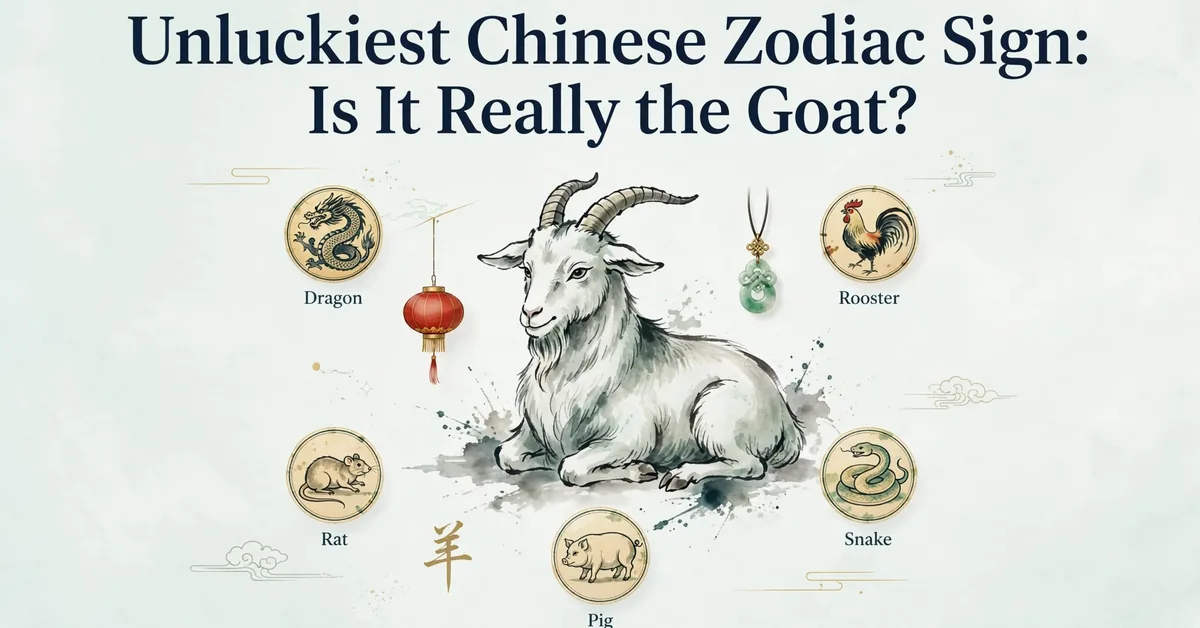
Unluckiest Chinese Zodiac Sign: Is It Really the Goat?
The Goat, also called the Sheep or Ram, is the Chinese zodiac sign most famously associated with bad luck in a traditional Chinese folk saying. However, Chinese astrology does not establish one universally unluckiest animal, and a zodiac sign cannot determine a person’s destiny.
The belief comes from folklore, cultural symbolism and historical attitudes toward personality and fortune. Understanding the Goat’s reputation requires looking beyond horoscope predictions to Chinese New Year, traditional beliefs about auspicious animals, and the real social effects of superstition. This guide explores all 12 zodiac signs, the Goat’s birth years, the reputations of the Rooster and Snake, and traditional ways people seek good fortune,while separating cultural beliefs from verifiable facts.
Is There a Luckiest or Unluckiest Chinese Zodiac Sign?
The Goat is the strongest candidate when the question concerns a sign with a longstanding negative cultural reputation. The Dragon, by contrast, is especially popular and associated with power, prosperity and success. China Highlights discusses both reputations, while emphasizing that there is no rational way to establish one permanently luckiest or unluckiest sign.
It helps to distinguish three different questions: Which animal is considered auspicious? Which animal has a negative folk reputation? And which sign is supposedly destined to experience misfortune? Traditional beliefs may offer answers to the first two, but they cannot establish the third. Luck rankings should therefore be understood as cultural interpretations, not factual assessments of people’s lives.
Why the Dragon is often considered lucky
The Dragon has a particularly prestigious position in Chinese cultural symbolism. It is associated with authority, strength, prosperity and imperial power. China Highlights notes that Dragon years are highly coveted, and birth numbers have historically increased during some Dragon years as families sought the auspicious symbolism associated with the animal.
Popularity is not proof that Dragon-born people experience more success. Birth patterns can reflect cultural expectations, family planning and social pressures. A Dragon’s reputation tells us about the meaning assigned to the animal, not the future of an individual born under it.
How cultural beliefs influence zodiac reputations
Cultural beliefs about the zodiac influence how people think about personality, compatibility and fortune. These beliefs are shaped by folklore, historical events, literary traditions and family customs. They can affect real decisions, from birth timing to marriage prospects.
At the same time, these are interpretations rather than measurements. No systematic evidence shows that people born under one animal sign experience consistently better or worse outcomes than those born under another. Recognizing the cultural origin of a reputation helps readers appreciate the tradition without treating it as a prediction.
How the 12 Chinese Zodiac Signs Are Traditionally Viewed
The table below summarizes selected popular cultural associations for each animal. These are illustrative examples drawn from commonly discussed traditions, not an authoritative ranking of luck from first to twelfth. Different sources may emphasize different qualities, and no traditional source establishes a single agreed-upon order.
| Zodiac sign | Common cultural association |
|---|---|
| Rat | Resourcefulness, intelligence and adaptability |
| Ox | Diligence, patience and stability |
| Tiger | Courage, strength and authority |
| Rabbit | Gentleness, harmony and compassion |
| Dragon | Power, prosperity, prestige and auspiciousness |
| Snake | Wisdom and intuition; sometimes mystery or difficulty |
| Horse | Energy, independence and ambition |
| Goat/Sheep | Kindness and creativity; a prominent negative folk reputation |
| Monkey | Intelligence, wit and adaptability |
| Rooster | Hard work and precision; a difficult fate in some readings |
| Dog | Loyalty, honesty and protection |
| Pig | Generosity, abundance and good fortune |
This table summarizes selected popular associations rather than ranking actual luck. The Snake, for example, appears among the conventionally luckiest or most popular signs in some overviews, even though some horoscope interpretations describe its life as challenging. The apparent contradiction demonstrates why there is no single, agreed-upon ranking.
The Goat’s mixed reputation
The Goat illustrates how one animal can carry both positive and negative associations. On the positive side, the Goat is connected with gentleness, creativity, compassion and aesthetic sensibility. The Chinese character for sheep/goat appears in words associated with beauty and auspiciousness.
On the negative side, the folk saying “nine out of ten Goats are inadequate” has given the Goat a reputation for misfortune. This saying is a superstition rather than a documented finding. Its influence comes from repetition and social acceptance, not from evidence about the lives of Goat-born people.
Why there is no reliable luck ranking
A reliable ranking would require a clear definition of luck, a representative sample of people born under each sign, and a method for comparing their life outcomes while controlling for other factors. No traditional or modern source provides this. What exists instead are cultural preferences, symbolic associations and folk sayings.
The absence of a ranking is itself informative. It shows that the question “which sign is unluckiest” assumes a precision that the tradition does not support. A more answerable question is which sign has the strongest negative folk reputation,and the evidence points to the Goat.
Why Is the Goat or Sheep Associated With Bad Luck?
The Sheep or Goat is the eighth animal in the conventional 12-year Chinese zodiac cycle. The Chinese character for sheep/goat can refer broadly to sheep or goat, which is why English-language sources use different animal names. The animal also has positive cultural associations with kindness, beauty and auspiciousness, making the negative reputation especially interesting.
TravelChinaGuide describes the Sheep as a symbol of goodness and kindness and connects its favorable associations to Chinese words and characters. Its cultural background is not exclusively negative. The belief that Goat-born people are inherently unlucky is one particular strand of folklore, not a complete description of what the animal represents in Chinese culture.
What does “nine out of ten Goats are inadequate” mean?
A frequently cited Chinese folk saying is “nine out of ten Goats are inadequate.” It is used to suggest that most people born in a Goat year will experience an incomplete, difficult or unfortunate fate. English translations vary, so the wording should not be treated as a precise statistical claim.
The expression is a superstition, not a documented calculation showing that nine out of ten Goat-born people experience misfortune. It has circulated in cultural discussions about the Goat’s reputation, and China Highlights explicitly describes it as an outdated belief with real social consequences. Its significance lies in the influence that a saying can have when people accept it as a prediction.
The social effects of the Goat superstition
A negative belief can influence decisions even when there is no reliable evidence supporting it. China Highlights reports that Goat-born people have been stereotyped as followers rather than leaders and that the superstition has affected Chinese society. Such beliefs can influence how families think about birth timing, marriage prospects and a child’s future.
This is an example of a self-reinforcing social expectation: if a family believes a particular birth year is undesirable, it may treat people born in that year differently. The resulting prejudice can have genuine consequences, but those consequences do not prove the original prediction was true. A stereotype can shape a person’s opportunities without accurately describing that person’s abilities or destiny.
Positive symbolism associated with the Goat
The Goat’s positive symbolism deserves equal attention. In Chinese culture, the sheep/goat is associated with filial piety, gentleness and peace. The animal appears in traditional art and literature as a symbol of kindness and good character.
These positive associations complicate the “unluckiest” label. A sign described as gentle, creative and compassionate does not fit a simple narrative of misfortune. The coexistence of positive symbolism and negative superstition shows how folk beliefs can emphasize one strand of tradition while overlooking others.
Personality of Those Born in the Year of the Goat
Goat-born people are often described as gentle, artistic, compassionate and peace-loving. They may value emotional security and close relationships, preferring calm, harmonious environments. Their sensitivity can make them perceptive and empathetic, though it may also leave them feeling overwhelmed in conflict-heavy situations.
Some descriptions contrast these strengths with weaknesses such as indecisiveness, worry and a tendency to avoid direct confrontation. These personality sketches are popular interpretations rather than scientific findings. People born in the same birth year have different lives, temperaments and opportunities, so the description should not be mistaken for a prediction.
Strengths traditionally associated with the Goat
Positive interpretations describe Goat-born people as creative, generous, sincere and attentive to others. They may have strong aesthetic sensibilities and appreciate art, music and peaceful surroundings. Their kindness and thoughtfulness can make them loyal friends and supportive partners.
These qualities are not evidence that Goats are destined for misfortune. Creativity and gentleness can be assets in many areas of life. The belief that such traits make someone weak or unsuccessful reflects a particular cultural judgment, not a proven relationship between personality and destiny.
The “followers, not leaders” stereotype
One negative interpretation describes Goats as followers rather than leaders, suggesting that they lack ambition or decisiveness. China Highlights mentions this stereotype while characterizing the underlying belief as outdated. The description may reflect cultural preferences for assertive leadership rather than a real limitation shared by Goat-born people.
Leadership styles vary widely. Some leaders are assertive, while others lead through cooperation, creativity or careful deliberation. Describing a whole birth-year group as incapable of leadership is a sweeping generalization. It is better understood as a cultural stereotype than as a description of individual ability.
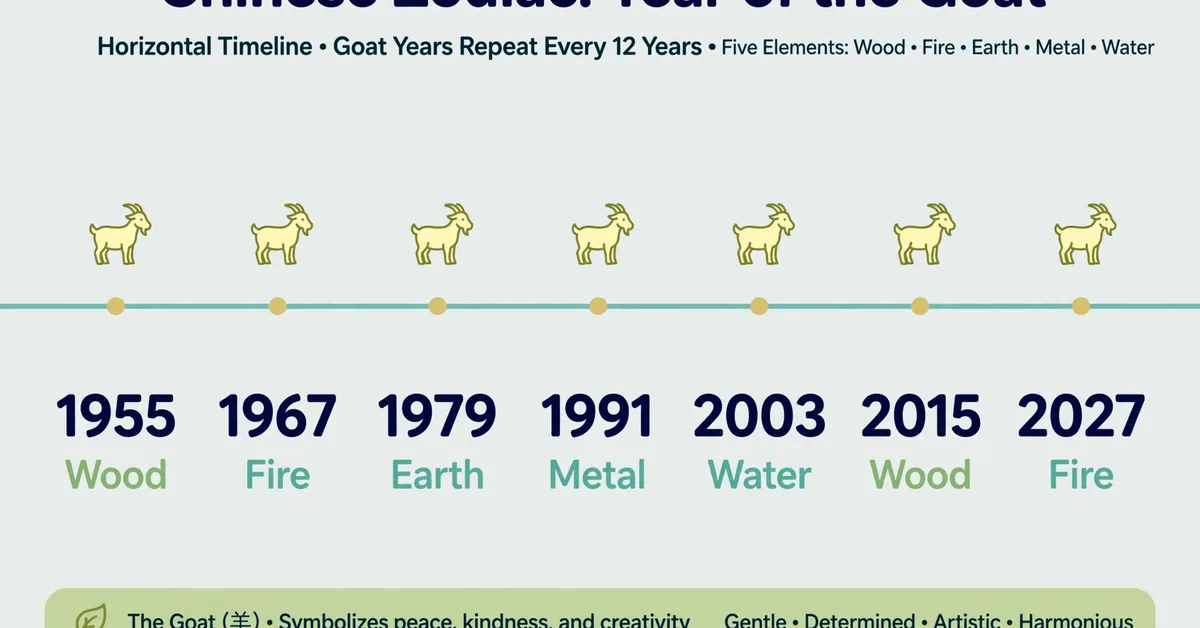
Goat Years: 1955, 1967, 1979, 1991, 2003, 2015 and 2027
| Goat year | Element | Date range |
|---|---|---|
| 1955 | Wood Goat | February 24, 1955 – February 11, 1956 |
| 1967 | Fire Goat | February 9, 1967 – January 29, 1968 |
| 1979 | Earth Goat | January 28, 1979 – February 15, 1980 |
| 1991 | Metal Goat | February 15, 1991 – February 3, 1992 |
| 2003 | Water Goat | February 1, 2003 – January 21, 2004 |
| 2015 | Wood Goat | February 19, 2015 – February 7, 2016 |
| 2027 | Fire Goat | February 6, 2027 – January 25, 2028 |
The dates above are based on the Chinese lunar calendar, where the New Year usually falls between January 21 and February 20. Someone born in January or February may belong to the previous zodiac animal depending on the exact date. For a full list of birth-year correspondences, see timeanddate.com’s Chinese zodiac years page.
How to check your Chinese zodiac sign
Because the Chinese New Year falls on a different date each year, people born in January or February should verify which animal governs their birth year. For example, someone born in January 1991 was born before the Chinese New Year on February 15, 1991, and therefore belongs to the Horse rather than the Goat.
Someone born in January or February should therefore check the exact date of the Chinese New Year for their birth year. A zodiac-year calendar or calculator can confirm the correct animal. This is especially important for Goat-year boundaries, where a few weeks’ difference changes the sign.
Note that some practitioners use the solar terms (jieqi) rather than the lunar New Year to determine the year’s ruling animal, particularly in BaZi (Four Pillars) astrology. Under that system, the year may be considered to begin around February 4. Most popular zodiac references use the lunar New Year, but readers encountering different dates should be aware of this alternative convention.
To find your own sign and element, see what is my Chinese zodiac sign and element.
Lucky Symbols and Traditional Remedies in Chinese Astrology
Traditional Chinese beliefs associate each zodiac sign with lucky and unlucky colors, numbers, flowers, directions and months. These associations vary across sources, and different websites may list different lucky things for the same animal. They are best understood as cultural traditions rather than tested predictions.
This section describes selected common associations and traditional remedies. It does not suggest that a color, number or object can change a person’s fortune. Readers should approach these traditions with respect for their cultural meaning while recognizing that they are not factual explanations of luck or misfortune.
Red clothing and the zodiac birth year
Red is considered a powerful color for warding off evil and attracting good fortune in Chinese culture. During the zodiac year of birth,known as the benmingnian,people may wear red underwear, socks or accessories. The practice is especially common during Chinese New Year.
The custom is a cultural tradition rather than a verified method for changing fortune. Many people observe it because it connects them to family and heritage, not because there is evidence that clothing color alters life outcomes.
Jade and protective charms
Jade is valued in Chinese culture and is sometimes worn as a protective amulet. Other people carry zodiac-specific charms or pendants believed to bring good luck. These objects have cultural and aesthetic significance, although there is no scientific basis for believing they alter fortune.
Feng shui and the arrangement of living spaces
Some people rearrange their home or workplace according to feng shui principles, believing that the placement of furniture, mirrors and decorative objects affects energy flow. The practice has cultural meaning for many families, even though its effects on luck have not been scientifically demonstrated.
Tai Sui and traditional precautions
Tai Sui is a traditional concept associated with the year’s ruling energy. In some beliefs, people whose zodiac sign conflicts with Tai Sui in a particular year may take precautions or perform rituals. These practices are part of traditional Chinese folk religion and should be understood as cultural customs rather than verified predictions.
How to approach traditional remedies sensibly
It is possible to respect cultural traditions without accepting them as literal predictions. Many people wear red, carry jade or observe feng shui because these practices connect them to family, heritage and community. The emotional comfort and sense of continuity can be meaningful in their own right.
At the same time, it is important not to let a superstition limit major life decisions. Avoiding marriage, changing birth plans or discriminating against someone because of a zodiac sign can have real harmful consequences. A balanced approach appreciates the cultural symbolism while recognizing that a person’s future depends on choices, circumstances and opportunities,not on the animal associated with a birth year.
Why the Goat, Rooster and Snake Have Different Reputations
Some articles try to name the single worst Chinese zodiac sign. The honest answer is that Chinese astrology does not establish one universally unluckiest animal. Different sources highlight different signs for different reasons, and those reputations reflect folklore, symbolism and interpretation rather than measured outcomes.
The Goat has the most prominent negative folk reputation because of the “nine out of ten” saying and its associated stereotypes. The Rooster and Snake appear in some horoscope writing as signs associated with difficulty or obstacles. Understanding where each reputation comes from helps readers evaluate these claims instead of accepting them as predictions.
The Rooster: difficult-fate claims in some horoscope writing
Rooster years include 1957, 1969, 1981, 1993, 2005, 2017 and 2029. Roosters are often described as hardworking, observant, confident and precise, with a strong sense of time and detail. In some horoscope writing, however, the Rooster is associated with a difficult or demanding fate.
These are examples found in particular interpretations rather than widespread traditional claims. The Rooster’s industrious nature is generally viewed positively. As with the Goat, difficulty claims in specific readings should not be mistaken for evidence that Rooster-born people are destined for misfortune. For more on this birth year, see our guide to the Chinese zodiac sign for 1993.
The Snake: obstacles in some horoscope interpretations
Snake years include 1953, 1965, 1977, 1989, 2001, 2013 and 2025. Snakes are often described as wise, intuitive, elegant and thoughtful, with a preference for privacy and careful planning. Some horoscope interpretations describe the Snake’s life as full of obstacles or complications.
This reputation appears in particular readings rather than as a universal traditional claim. The Snake also carries positive associations with wisdom and intuition. Like the other reputations discussed here, it is a cultural interpretation, not a finding about the actual lives of Snake-born people. For more on this birth year, see our guide to the Chinese zodiac sign for 1989.
Why these reputations should not be treated as predictions
The saying about Goats is a folk belief, not a verified prediction of individual outcomes. The same applies to difficulty claims about Roosters and Snakes in particular horoscope readings. These are cultural interpretations shaped by symbolism, history and storytelling.
Treating them as predictions would require evidence that people born under these signs experience systematically worse outcomes. No such evidence exists. The reputations are interesting as cultural phenomena and deserve respect as traditions, but they cannot determine anyone’s future.
FAQ: Unluckiest Chinese Zodiac Sign
1. Which Chinese zodiac sign is the unluckiest?
The Goat, also called the Sheep or Ram, is the sign most famously associated with bad luck in a traditional Chinese folk saying. However, Chinese astrology does not establish one universally unluckiest animal, and different sources highlight different signs. The reputation is a cultural belief, not a factual assessment.
2. Why is the Goat considered unlucky?
The reputation comes from a folk saying, “nine out of ten Goats are inadequate,” along with stereotypes describing Goats as followers rather than leaders. China Highlights characterizes the belief as outdated while noting its real social consequences. The Goat also has positive cultural associations with kindness and auspiciousness.
3. Which years are Goat years?
Recent and upcoming Goat years are 1955, 1967, 1979, 1991, 2003, 2015 and 2027. Because the Chinese New Year falls between January 21 and February 20, people born in January or February should check the exact date to confirm their sign.
4. Can a zodiac sign’s luck change?
In traditional belief, each year’s ruling animal may interact differently with a person’s sign, and the birth year (benmingnian) is sometimes considered challenging. These are cultural interpretations, not verified predictions. A person’s circumstances depend on real factors rather than the zodiac.
5. Which Chinese zodiac sign is the luckiest?
The Dragon is the most popular answer, associated with power, prosperity and auspiciousness. Some sources also highlight the Pig, Rat or other signs. There is no agreed-upon ranking, and popularity reflects cultural symbolism rather than measured outcomes.
6. Are Roosters and Snakes unlucky?
Some interpretations associate the Rooster with a difficult fate and the Snake with a life of obstacles. These appear in particular horoscope readings, not as universal traditional claims. Both signs also have positive associations, and the reputations should be understood as cultural interpretations.
7. What can I do if I am worried about bad luck?
Traditional practices include wearing red, carrying jade, adjusting feng shui and observing customs related to Tai Sui. These are cultural traditions that may provide comfort and connection to heritage. They are not evidence-based methods for changing fortune.
Conclusion
The unluckiest Chinese zodiac sign is most commonly identified as the Goat in discussions of Chinese folk superstition, particularly because of the saying “nine out of ten Goats are inadequate.” Yet that reputation is not proof that Goat-born people experience more misfortune. Chinese zodiac symbolism is varied, and the Goat is also associated with positive qualities such as gentleness, creativity and kindness.
The Dragon’s favorable reputation and the occasional negative descriptions of the Rooster and Snake demonstrate how different interpretations can coexist. Cultural associations can be meaningful and historically interesting, but they should not be confused with an established ranking of people’s future success, happiness or well-being.
If you were born in a Goat year, the traditional saying does not define your abilities or determine your destiny. Your future is shaped by your choices, actions and circumstances,not by your zodiac sign alone.

Jack Harrison is a contributor at Square Root Signs, sharing creative ideas, useful information, and engaging content to help readers discover something valuable with every visit.