Exit Sign Batteries: The Complete Guide to Types, Testing, and Replacement
Quick answer: Most exit signs use 4.8V nickel-cadmium (Ni-Cd) stick-pack exit sign batteries. By law, the backup battery must keep the sign lit for at least 90 minutes after a power failure. Typical lifespan is 3–5 years, and you must always replace a battery with the same chemistry and voltage.
Note: This guide covers the red EXIT box mounted inside buildings, not the green highway exit signs you see on freeways. If you’re looking for road signs, that’s a different topic entirely.
How Exit Sign Backup Batteries Work
An illuminated exit sign does two jobs at once. Under normal conditions, it runs on your building’s regular AC power, the same 120V (or 277V in commercial buildings) that powers the lights. But the moment that power fails, the sign must stay lit so people can find their way out. That’s where exit sign batteries come in.
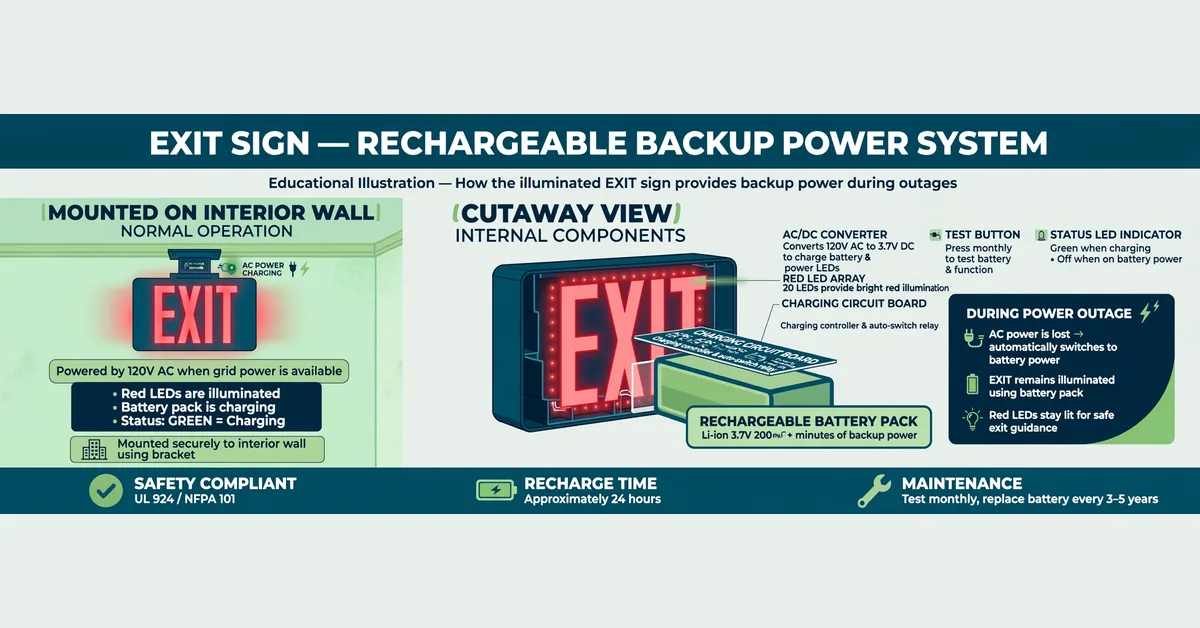
Inside every battery-backup exit sign there are three core components working together:
- The battery pack, stores energy while power is on, releases it during an outage.
- The charging circuit, constantly trickle-charges the battery so it’s always full. A small LED indicator (usually red or green) on the sign tells you the charger is working.
- The transfer switch, an automatic relay that detects power loss and instantly switches the sign from AC power to battery power. The switch happens in milliseconds, so the sign never goes dark.
When utility power returns, the transfer switch flips back to AC and the charging circuit begins recharging the battery. A fully drained battery typically needs up to 24 hours to recharge completely, which is why codes require the battery to be sized generously, it has to survive the outage and be ready for the next one.
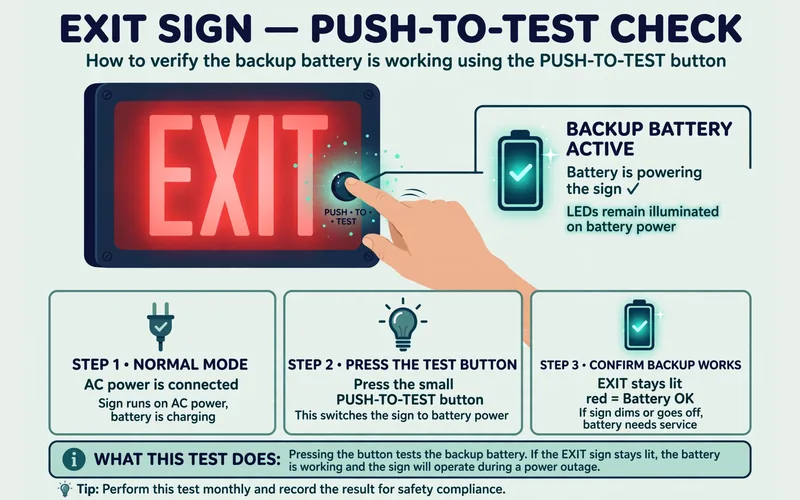
Most modern exit signs also include a push-to-test button. Pressing it simulates a power failure, forcing the sign onto battery power so you can verify the battery actually works. We’ll cover the full testing schedule later in this guide.
The 4 Types of Exit Sign Batteries Compared
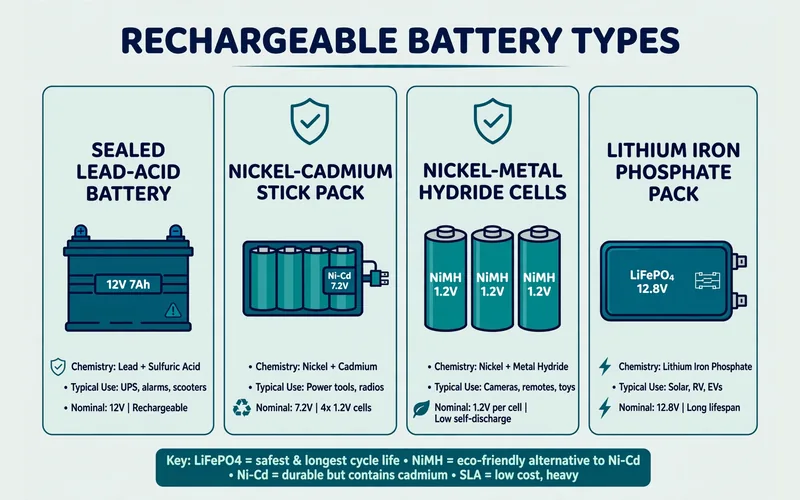
Not all exit sign batteries are the same. Manufacturers use four main rechargeable chemistries, each with different strengths. Here’s how they stack up:
| Feature | Sealed Lead-Acid (Lead Calcium) | Nickel-Cadmium (Ni-Cd) | Nickel-Metal Hydride (NiMH) | Lithium Iron Phosphate (LiFePO4) |
|---|---|---|---|---|
| Typical voltage | 6V or 12V | 3.6V–4.8V (stick packs) | 3.6V–4.8V | 3.2V–9.6V |
| Lifespan | 3–5 years | 3–5 years | 4–6 years | 7–10 years |
| Relative cost | Lowest | Low–moderate | Moderate | Highest |
| Temperature tolerance | Poor in heat; degrades fast above 77°F (25°C) | Good; handles heat better than lead-acid | Moderate | Excellent; widest operating range |
| Size/weight | Bulky and heavy | Compact stick packs | Compact | Very compact and light |
| Memory effect | No | Yes (mild, reduced by modern chargers) | Minimal | No |
| Environmental note | Lead, recyclable, regulated | Cadmium, toxic, strictly regulated | Cleaner than Ni-Cd | Cleanest; longest life = less waste |
| Common use | Older/large combo units | Most common in standard exit signs | Newer LED exit signs | Premium/self-testing units |
Sealed Lead-Acid (Lead Calcium)
The oldest and cheapest option. These are the heavy rectangular batteries you’ll find in older exit sign / emergency light combo units, the big fixtures with two floodlight heads. They’re reliable but bulky, and heat is their enemy: every 15°F above room temperature roughly halves their life. In a hot warehouse or kitchen corridor, a lead-acid battery might die in under two years.
Nickel-Cadmium (Ni-Cd)
The workhorse of exit sign batteries and by far the most common type you’ll encounter. Ni-Cd cells are packaged as slim “stick packs”, typically 4.8V, that slide neatly into modern LED exit signs. They tolerate heat well, deliver consistent power, and cost very little. The downsides: cadmium is toxic (strict recycling rules apply), and Ni-Cd cells can develop a mild “memory effect” if repeatedly partially discharged, though modern smart chargers largely prevent this.
Nickel-Metal Hydride (NiMH)
NiMH is essentially the cleaner successor to Ni-Cd. Same compact stick-pack format, similar voltages, but no toxic cadmium and slightly longer life (4–6 years). You’ll find NiMH packs in newer LED exit signs from manufacturers emphasizing environmental compliance. They cost a bit more than Ni-Cd but are increasingly popular as cadmium regulations tighten.
Lithium Iron Phosphate (LiFePO4)
The premium option. LiFePO4 exit sign batteries last 7–10 years, roughly double the competition, handle extreme temperatures, and are the lightest of the bunch. They’re standard in self-testing and self-diagnostic exit signs. The catch is price: they cost several times more than a Ni-Cd stick pack. For facilities that want to minimize maintenance visits, though, the math often works out.
The 90-Minute Rule Explained
Here’s the single most important regulation governing exit sign batteries: when the power goes out, the sign must stay illuminated for at least 90 minutes.
This requirement comes from three overlapping codes and standards:
- NFPA 101 (Life Safety Code), Section 7.9 and 7.10, requires emergency illumination along exit paths, with battery backup lasting a minimum of 90 minutes. Section 7.9.2.6 specifically mandates that exit sign batteries be rechargeable and automatically recharged.
- UL 924 (Standard for Emergency Lighting and Power Equipment), the testing standard. A battery pack must prove it can power its sign for the full 90 minutes and then recharge to full capacity within 24 hours to earn UL 924 listing. If your exit sign isn’t UL 924 listed, it likely doesn’t meet code.
- IBC (International Building Code), Section 1013, adopts the 90-minute emergency power requirement for exit signs into building code, making it enforceable by local inspectors and fire marshals.
Why 90 minutes? It’s the time safety engineers estimate a large building might need for a full, orderly evacuation, including scenarios where elevators are out, stairwells are crowded, or occupants need assistance. The number isn’t arbitrary; it’s a life-safety margin.
What this means for you: any replacement battery must be rated to deliver the full 90 minutes in your specific sign. A battery that’s merely “close enough” in voltage but undersized in capacity can fade at minute 60, and that’s a code violation and a genuine safety hazard.
How the Charger and Test Button Work
The Charging Circuit
The charger inside an exit sign is a small circuit board that does something clever: it powers the sign’s LEDs from AC while simultaneously feeding a gentle trickle charge to the battery. The little indicator LED on the sign’s face is wired to this circuit:
- Steady green (or red, depending on manufacturer), AC power is present and the battery is charging or fully charged. This is the normal state.
- LED off, no AC power. The sign is running on battery (or the bulb/LED has failed, investigate).
- Flashing or amber, on self-diagnostic models, this signals a fault: weak battery, charger problem, or failed self-test.
Some older signs use a two-wire charger that can overcharge Ni-Cd packs over time. Modern signs use smart chargers that switch to a maintenance float charge once the battery is full, dramatically extending battery life.
The Push-to-Test Button
That small button on the bottom or side of the sign isn’t decorative. Pressing and holding it for 30 seconds cuts AC to the sign’s lamps, forcing them onto battery power, a simulated outage. If the sign stays brightly lit for the full 30 seconds, the battery is holding a charge. If it dims or dies, the battery needs replacement.
Self-testing models go further: they automatically run a 30-second test every 30 days and a full 90-minute discharge test once a year, flashing a warning LED if anything fails. These cost more upfront but eliminate the most common cause of dead exit sign batteries, nobody remembering to test them.
When to Replace Exit Sign Batteries
Exit sign batteries don’t last forever. Plan on replacement every 3–5 years for lead-acid, Ni-Cd, and NiMH types (LiFePO4: 7–10 years). But don’t just go by the calendar, watch for these warning signs:
- Dimming during a test, the sign fades noticeably during a 30-second push-to-test. This is the #1 sign of a dying battery.
- Beeping or chirping, many signs emit an audible chirp when the battery voltage drops too low or the charger detects a fault. (More on this in the FAQ.)
- Failed monthly test, the sign goes dark or very dim the moment you press the test button.
- Swollen or leaking battery, if you open the sign and the pack is bulging, cracked, or leaking, replace it immediately and handle it as hazardous waste. Don’t ignore this.
- Indicator LED out, no glowing LED usually means no charging is happening, which means the battery has been slowly dying unnoticed.
- Age, if you don’t know when the battery was last replaced, assume it’s overdue. Write the installation date on the new battery with a marker.
Pro tip for facility managers: keep a simple log, sign location, battery type, install date. A spreadsheet with 3 columns prevents the all-too-common scenario of discovering five dead exit signs during a fire marshal inspection.
Critical Safety Warning: Always Match Chemistry AND Voltage
This is the mistake that causes the most exit sign battery failures, and it’s completely avoidable:
Your replacement battery must match BOTH the chemistry and the voltage of the original.
- Wrong voltage, a 6V pack in a sign designed for 4.8V can fry the charging circuit; a 3.6V pack in a 4.8V sign won’t hold the LEDs at full brightness for 90 minutes.
- Wrong chemistry, this is the dangerous one. Each chemistry needs a specific charging profile. A lead-acid charger feeding a Ni-Cd pack (or vice versa) will either chronically undercharge it (sign dies early in an outage) or overcharge it (overheating, swelling, even fire risk). The charger and battery are engineered as a pair.
How to get it right: open the sign, read the label on the existing battery pack, and buy the identical spec, same voltage, same chemistry, same or greater capacity (mAh/Ah). When in doubt, check the sign manufacturer’s replacement part number, usually printed on a label inside the housing. If the label is gone, the sign’s model number (also on the housing) will let the manufacturer or supplier identify the correct pack.
Can I use regular alkaline batteries? No, never. Alkaline batteries are not rechargeable, so the sign’s charger would attempt to charge them, which can cause leaking or rupture. Exit sign batteries must always be the rechargeable type specified by the manufacturer.
Testing Schedule: Monthly and Annual Requirements
Code doesn’t just require working batteries, it requires proof they work. NFPA 101 mandates two levels of testing:
Monthly: 30-Second Push-to-Test
- Press and hold the test button for 30 seconds.
- The sign must stay fully illuminated the entire time.
- Do this every month, and keep a written record (a simple logbook or spreadsheet: date, location, pass/fail).
- Takes about a minute per sign. For a building with 20 signs, that’s 20 minutes a month, non-negotiable.
Annually: Full 90-Minute Discharge Test
- Once per year, simulate a real outage: cut power to the signs (via the breaker, or hold the test button on models that support extended test) and verify each sign stays lit for the full 90 minutes.
- This is the test that catches weak batteries the 30-second check misses, a battery can pass 30 seconds and still fade at minute 50.
- Schedule it wisely: the battery needs up to 24 hours to recharge afterward, so don’t run the annual test the day before a fire marshal inspection.
- Keep written records for at least 3 years, inspectors will ask for them.
Who can do the testing? The monthly test can be done by any trained building staff member. The annual 90-minute test is often handled by a fire protection or electrical contractor, especially in large facilities, and many jurisdictions effectively expect it.
Disposal and Recycling: Handle With Care
Dead exit sign batteries are hazardous waste, they don’t go in the trash. Here’s why and what to do:
- Nickel-cadmium (Ni-Cd): Cadmium is a toxic heavy metal. In the US, Ni-Cd batteries are regulated under the Universal Waste Rule (EPA), they must go to a certified battery recycler, never a landfill. Many states add their own stricter rules.
- Sealed lead-acid: Lead is also toxic, but recycling infrastructure is excellent, over 99% of lead-acid batteries in the US are recycled. Any battery retailer or auto parts store will usually take them.
- NiMH and LiFePO4: Less toxic, but still shouldn’t go in regular trash. Recycle through battery collection programs.
- What about the whole sign? If you’re replacing the entire fixture, the battery must be removed and recycled separately from the metal/plastic housing in most jurisdictions.
Where to recycle: Call2Recycle drop-off locations, municipal hazardous waste collection events, battery retailers, and many electrical wholesalers all accept these packs. Tape the terminals with electrical tape before transport to prevent short circuits, a shorted battery in a collection bin is a fire hazard.
Penalties are real: improper disposal of cadmium or lead batteries can bring fines under federal and state environmental law. The 10 minutes it takes to drop them at a recycler is always worth it.
Battery-Free Alternatives
Not every exit sign needs a battery. Two technologies eliminate the battery entirely:
Photoluminescent Exit Signs
These signs use glow-in-the-dark pigment (strontium aluminate) that charges from ambient light and glows for hours in darkness, no wiring, no battery, no electricity at all.
- Pros: Zero maintenance, zero energy cost, 25+ year lifespan, no testing requirements, no hazardous waste.
- Cons: They need adequate ambient light to charge (typically 54+ lux on the sign face); in a completely dark corridor with no light source, they won’t charge. Brightness is lower than LED signs, and some jurisdictions restrict where they can be used.
- Best for: low-maintenance facilities, remote locations, and as supplementary signage.
Tritium Self-Luminous Signs
These contain tiny sealed glass tubes of tritium gas (a mild radioactive isotope of hydrogen) coated with phosphor. The tritium continuously excites the phosphor, producing a steady glow for 10–20 years with no power whatsoever.
- Pros: Completely self-powered for a decade or more; works in total darkness; no wiring or maintenance.
- Cons: Expensive upfront; regulated by the Nuclear Regulatory Commission (NRC), you need a general license to possess them, and disposal is strictly controlled (they must go back to the manufacturer or a licensed facility; losing one triggers reporting requirements). Dimmer than LED.
- Best for: hazardous locations, tunnels, offshore facilities, anywhere running wire is impractical.
Which Should You Choose?
For most buildings, battery-backup LED signs remain the standard, brightest, cheapest, universally code-accepted. Photoluminescent signs are an excellent supplement (or primary choice where allowed) for cutting maintenance to zero. Tritium makes sense only in specialized environments where wiring is impossible and regulatory overhead is manageable.
| Battery-Backup LED | Photoluminescent | Tritium | |
|---|---|---|---|
| Power needed | AC wiring | Ambient light | None |
| Maintenance | Battery every 3–5 yrs + testing | None | None (10–20 yr life) |
| Brightness | Highest | Moderate | Low–moderate |
| Upfront cost | Low–moderate | Low | High |
| Regulatory burden | Testing logs | Placement rules | NRC license + disposal rules |
Frequently Asked Questions
What batteries do exit signs use?
Most exit signs use 4.8V nickel-cadmium (Ni-Cd) stick packs. Older or larger combo units often use 6V or 12V sealed lead-acid batteries. Newer signs may use nickel-metal hydride (NiMH) or lithium iron phosphate (LiFePO4). Always check the label inside your specific sign, the replacement must match the original’s chemistry and voltage exactly.
How long do exit sign batteries last?
Typically 3–5 years for sealed lead-acid, Ni-Cd, and NiMH types. Lithium iron phosphate (LiFePO4) packs last 7–10 years. Heat shortens life significantly, a battery in a hot environment may die in half the rated time. By law, whatever the age, the battery must still deliver the full 90 minutes of backup power.
Can I use regular (alkaline) batteries in an exit sign?
No, never. Exit signs have built-in chargers designed for rechargeable chemistries. Putting non-rechargeable alkaline batteries in a charging circuit can cause leaking, rupture, or fire. Always use the rechargeable battery type specified by the sign manufacturer.
Why is my exit sign beeping or chirping?
A beeping exit sign is almost always a battery or charger fault. The most common causes: the battery has dropped below its voltage threshold (it’s dying), the battery is disconnected, or the charging circuit has failed. Start with the 30-second push-to-test, if the sign dims, replace the battery. If a new battery doesn’t stop the beeping, the charger board itself may need replacement.
Do I need an electrician to replace an exit sign battery?
In most cases, no. Swapping the battery pack is designed to be simple: open the housing (usually a snap-off cover or a few screws), unplug the old pack’s connector, plug in the new one, and close it up. No wiring work is involved. However, if the issue is the charger, the AC wiring, or the sign needs hardwired installation, call a licensed electrician. And always follow your local codes, some jurisdictions require licensed personnel for any life-safety equipment work.
Photoluminescent vs. battery backup, which is better?
It depends on the location. Battery-backup LED signs are brighter, universally accepted by code, and the default choice for most buildings, but they need battery replacements every 3–5 years plus monthly testing. Photoluminescent signs need zero maintenance and no power, but require adequate ambient light to charge and aren’t permitted everywhere. Many facilities use both: LED signs for primary exits, photoluminescent for supplementary marking.
How do I know what voltage battery my exit sign needs?
Open the sign’s housing and read the label on the existing battery pack, it will state the voltage (e.g., 4.8V) and chemistry (e.g., Ni-Cd). There’s usually also a manufacturer label inside the housing with the sign’s model number and approved replacement part number. Never guess: wrong voltage means code violation at best, equipment damage at worst.
What happens if my exit sign fails a fire marshal inspection?
Expect a written violation notice with a correction deadline (often 30 days or less). You may face re-inspection fees, and in serious cases, fines or occupancy restrictions until the deficiency is fixed. The good news: most failures are just dead batteries, a $10–$30 part and 5 minutes per sign. Keeping up with monthly testing and a replacement log makes inspection day uneventful.
The Bottom Line
Exit sign batteries are small, cheap parts with an outsized job: keeping people safe when the lights go out. The formula is simple, know your battery type, match chemistry and voltage on replacement, test monthly, run the full 90-minute test annually, and recycle the old packs properly. Do that, and your exit signs will do their job for years without surprises, and your fire marshal visits will be boring in the best possible way.

Jack Harrison is a contributor at Square Root Signs, sharing creative ideas, useful information, and engaging content to help readers discover something valuable with every visit.