Do Not Enter Sign Meaning: What It Looks Like, What to Do
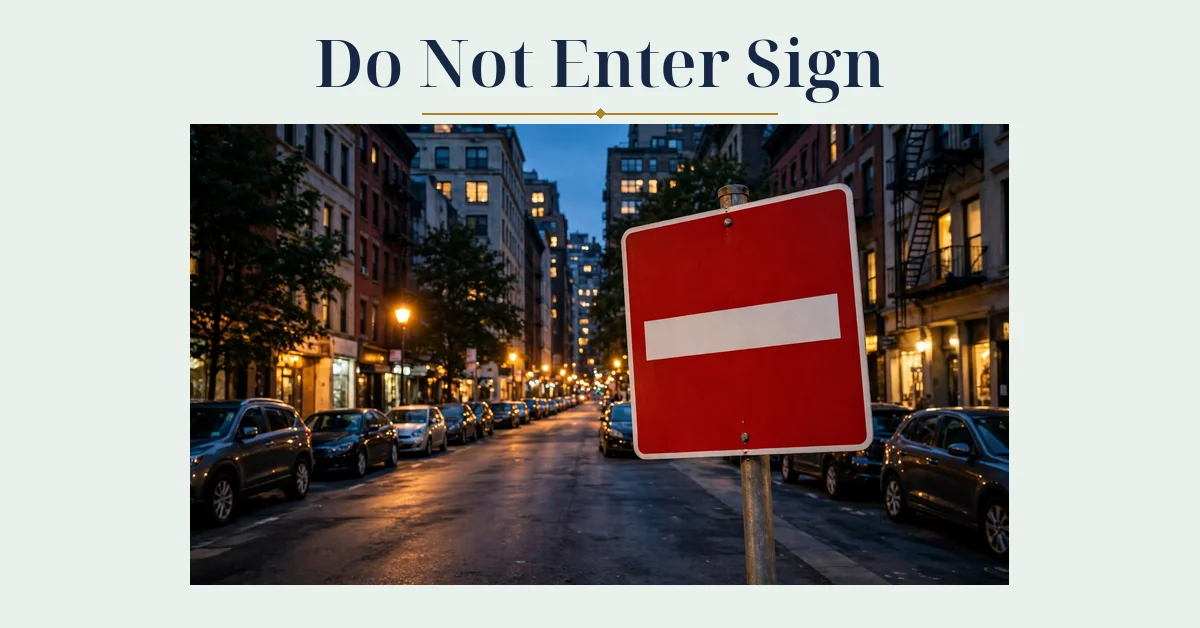
The do not enter sign is the square white sign with a solid red disc in the middle and the white words DO NOT ENTER on it. It means the road ahead is closed to traffic coming from your direction, so you must not drive past it. In the United States the sign carries the official code R5-1 in the Manual on Uniform Traffic Control Devices, the national standard better known as the MUTCD, and it is one of the most important regulatory signs on the road.
Unlike a warning sign, which only advises caution, the do not enter sign gives you a direct order. Ignoring it puts you on a road where other vehicles are coming straight toward you, often at full speed and with no room to move aside. This guide explains what the sign means, what it looks like, where road crews place it, how it differs from the wrong way sign, what to do when you see it, and what to do if you have already driven past it.
What Does the Do Not Enter Sign Mean?
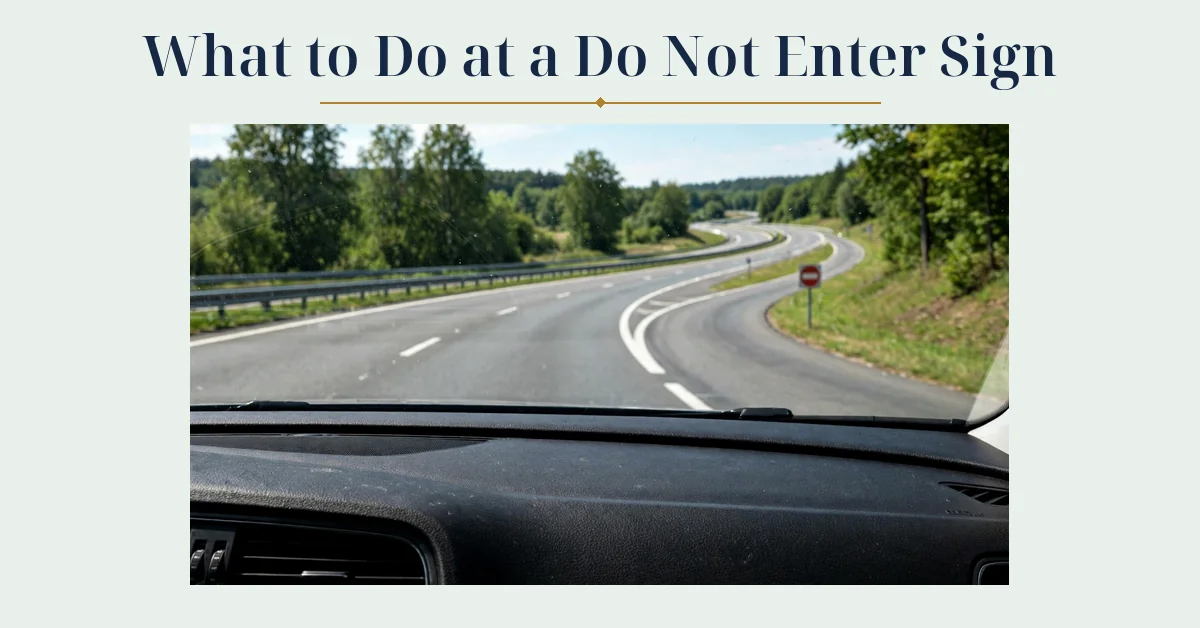
The do not enter sign means do not drive into the road, ramp, lane or driveway beyond the sign. The road on the other side is carrying traffic in the opposite direction, or it is a one way road that runs away from you, so entering it would put you face to face with oncoming vehicles. The sign is aimed squarely at you. It faces the traffic that could enter the wrong way, and it is placed so you see it before you make the turn or the entry, not after.
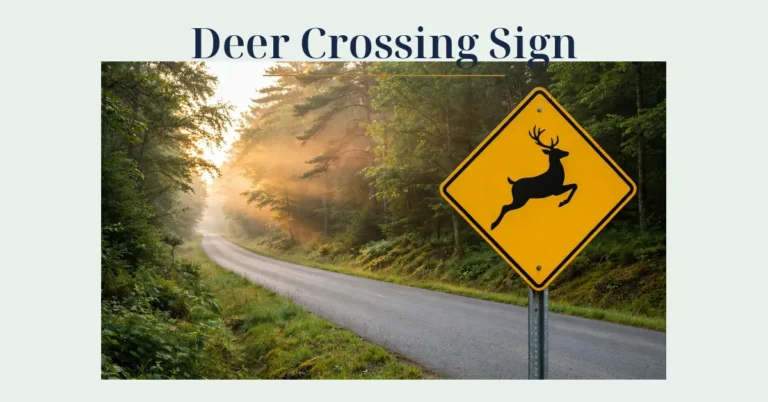
The MUTCD covers this sign in Section 2B.46, and it classifies it as a regulatory sign. That classification matters. Regulatory signs state the law for that stretch of road. A warning sign, such as the yellow diamond deer crossing sign, tells you about a hazard ahead and asks you to take care. A regulatory sign tells you what you must do or must not do, and a police officer can ticket you for disobeying it. The do not enter sign is a prohibition, not a suggestion, and there is no situation in normal driving where you are allowed to drive past it.
It helps to think of the sign as a gate that you cannot see. The road beyond it may look empty, wide and inviting, especially at night or in a quiet parking lot. The emptiness is exactly the trap. A one way street looks empty from the wrong end because the traffic is moving away from you, and an exit ramp looks empty because the cars using it are traveling in the opposite direction and have not reached you yet. The sign is there because the road looks safe to enter when it is not, and because drivers have made that mistake before, often with terrible results.
The sign also applies to every vehicle, not only cars. Motorcycles, trucks, buses and bicycles must all obey it, unless a separate sign or plaque underneath says otherwise. An emergency vehicle with its lights and siren on may be an exception under state law, but an ordinary driver never is. If you are unsure whether a road is one way, treat the do not enter sign as the final answer. Turn around, find another route, and let your navigation system recalculate.
What It Looks Like
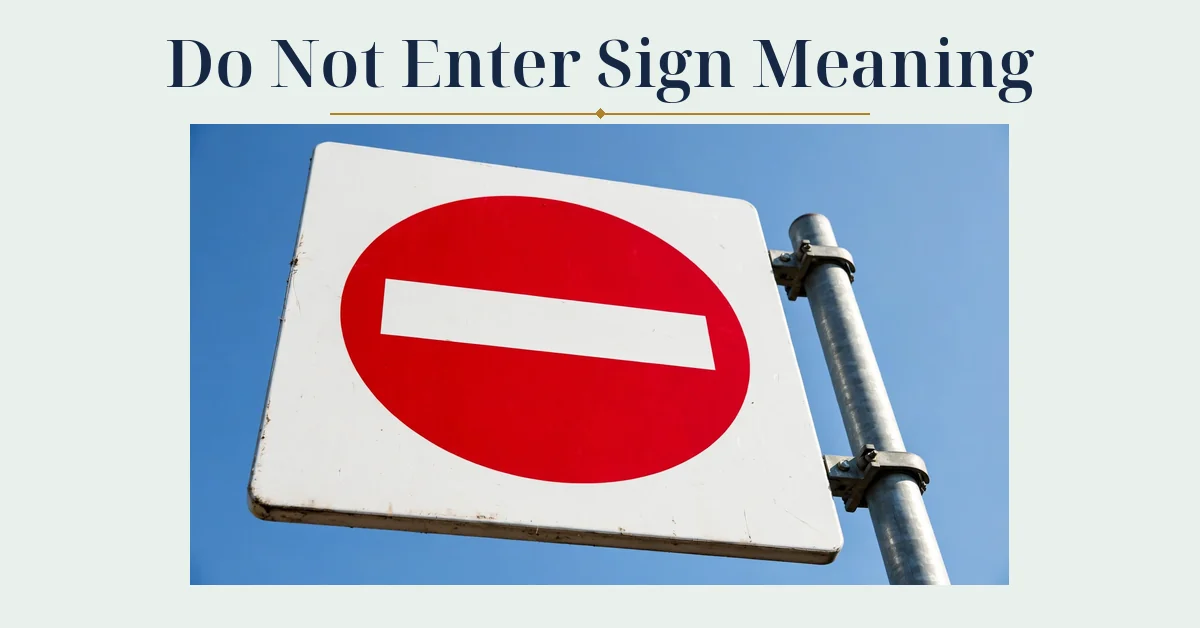
The do not enter sign is designed to be read in a fraction of a second, at speed, in rain, at night and by drivers who do not read English well. Every part of its design works toward that goal, and once you know the parts you will spot it instantly.
Shape. The sign is a square, set straight rather than turned on its corner like a warning diamond. The square shape is part of the regulatory family of signs, the same family that includes speed limit signs and the No U Turn sign. When you see a square or rectangular sign with a white background and a red element, your brain should read it as a rule, not a warning.
Color. The background of the sign is white. In the center sits a large solid red disc, sometimes described as a red circle, which fills most of the square. Red is the color the MUTCD reserves for prohibition and for danger, and here it does both jobs at once. The sign is made with retroreflective sheeting, so your headlights make it glow bright red and white at night, when wrong way entries are most likely to happen.
Words and bar. Inside the red disc are the white words DO NOT above and ENTER below a thick horizontal white bar. The bar runs across the middle of the disc and is the part of the design that drivers recognize first, even before they read the words. In fact the bar alone carries the meaning. It is a universal symbol for no entry, and it is the same bar you will see on no entry signs in other countries that carry no words at all. The white letters are large, bold and in capitals, so the message can be read from a distance while you are still deciding whether to turn.
Size. The MUTCD sizes the sign by road type in Table 2B-1. The typical size is 30 by 30 inches on a single lane conventional road. On a multi lane conventional road the standard size grows to 36 by 36 inches, and on a freeway or expressway it grows to 48 by 48 inches. The bigger the road and the faster the traffic, the bigger the sign, because drivers need more reading distance to react. At a busy freeway exit ramp you may also see two signs, one on each side of the ramp, so the message is visible even if a truck or a parked car blocks one of them.
Some installations add extra emphasis. The sign may be mounted lower than usual, closer to driver eye level, so it is harder to miss. It may sit above a second sign, or beside a one way arrow pointing in the direction traffic is allowed to travel. On some ramps the do not enter sign is paired with pavement markings, such as a white arrow pointing the wrong way with a red slash through it, or with red reflective markers on the pavement. The sign itself never changes, though. Wherever you see a white square with a red disc and a white bar, the message is the same.
Where You See It
Road engineers place the do not enter sign at every point where a driver could easily, and mistakenly, turn into traffic flowing the other way. The four most common locations are worth learning, because each one is a place where the mistake is easy to make.
Where a two way road becomes a one way road. This is the classic location. A street that carried traffic in both directions narrows or changes at an intersection and continues as a one way street. The do not enter sign stands at the end where traffic would come in against the flow, facing the drivers approaching from the two way section. City centers are full of these transitions, and they catch out visitors, delivery drivers and anyone following a navigation app that has not yet recalculated.
At exit ramps meeting a crossroad. A freeway or expressway exit ramp is a one way road that carries traffic away from the highway and onto a crossroad. From the crossroad, the ramp looks like an entrance, especially at night when the curve and the lighting hide the direction of travel. The do not enter sign faces the crossroad traffic at the foot of the ramp, and it is often paired with a wrong way sign further up the ramp for drivers who miss it. This is the most dangerous location of all, because the traffic on the ramp is moving at highway speed.
Where a channelized turning roadway meets a two way road. Some intersections have a separate turning lane or slip lane, separated from the main road by a raised island or painted markings, that carries turning traffic in one direction only. A driver who turns into the wrong end of that channel can find themselves facing the turning traffic head on, with a curb or island on one side and no escape on the other. The do not enter sign marks the closed end of the channel.
At divided highway crossings. Where a road crosses a divided highway, the two roadways are separated by a median, and it is possible to turn onto the wrong roadway by mistake, especially at a wide or poorly lit crossover. The do not enter sign stands at the crossing to stop drivers turning onto the roadway that carries traffic toward them. A related use is at the median opening itself, where a driver might be tempted to cut across into the opposing lanes.
You will also see the sign in quieter places where the same logic applies. Parking lots and multi-story parking garages use it at the exit lane, so entering drivers do not meet cars leaving through the same narrow lane. Airports, hospitals and shopping centers use it on service roads and drop off loops that run in one direction only. Drive through lanes, bus stations and ferry terminals use it too. The setting changes, but the meaning never does. If the sign faces you, the road beyond it is not yours to enter.
Do Not Enter vs Wrong Way
New drivers often confuse the do not enter sign with the wrong way sign, because the two signs work as a team and often stand near each other. They are not the same sign, and the difference is worth learning, because each one tells you something different about where you are.
The do not enter sign, R5-1, is the first sign you meet. It stands at the entrance and warns you before you enter, telling you not to go in. The wrong way sign, R5-1a, is the second sign. It stands further in, past the entrance, and it tells a driver who has already entered that they are traveling against the traffic. If you see a wrong way sign facing you, you have already made the mistake, and you need to get out of the road as soon as it is safe to do so.
| Feature | Do Not Enter (R5-1) | Wrong Way (R5-1a) |
|---|---|---|
| Message | DO NOT ENTER | WRONG WAY |
| Purpose | Stops you before you enter | Warns you that you already entered |
| Shape | Square, white background | Rectangle, wider than it is tall |
| Colors | White background, red disc, white words and bar | Red background, white words |
| Typical size | 30 by 30 inches on a single lane road, 36 by 36 inches on a multi lane road, 48 by 48 inches on a freeway | 36 by 24 inches on a conventional road, 42 by 30 inches on a freeway or expressway |
| Where it stands | At the entrance, facing traffic that could enter | Further in, facing traffic that already entered |
| What to do | Do not enter. Turn away and find another route. | Pull over safely, turn around when it is safe, and leave the road. |
The two signs also differ in how they are built to be read. The do not enter sign uses a symbol, the red disc and white bar, plus words, so it can be understood even by a driver who cannot read the words quickly. The wrong way sign is a red rectangle with white words only, and it is meant to shock a driver who is already in trouble into realizing what has happened. Engineers often mount the wrong way sign lower than normal, near the pavement, so it falls directly in the headlight beam of a car traveling the wrong way at night.
On a driving test, examiners expect you to know both signs and to explain the difference in one sentence. The do not enter sign keeps you out, and the wrong way sign tells you that you are already in. Remembering that single distinction will answer almost every test question about the pair, and it will also keep you calm if you ever see the second sign in real life, because you will know at once that you need to stop and turn around rather than carry on hoping the road will sort itself out.
What to Do When You See It
Seeing a do not enter sign should trigger a short, calm routine. It takes only a few seconds, and it keeps you out of the most dangerous situation a driver can face on a normal road.
Stop turning in. If you are in the middle of turning toward the road, stop the turn as soon as you can do so safely. Check your mirrors, stop, and stay where you are until you can move away in a lawful direction. Do not try to complete the turn to save time. The sign is telling you that the turn itself is the danger.
Do not drive around the sign. The sign applies to the whole entrance, not only to the lane directly behind it. Driving around it on the sidewalk, through a gap in a barrier or across a painted island is still entering the road, and it is still against the law. It is also more dangerous, because you will enter at an angle and with less time to see the oncoming traffic.
Find another route. Turn away from the entrance and follow the road you are already on until you can turn legally. Use a side street, go around the block, or let your navigation system recalculate. If you are on a freeway and you realize the exit you wanted is not the right one, carry on to the next exit rather than trying to use an exit ramp backwards. A few minutes of delay is always cheaper than a head on collision.
Watch for the one way arrow. A do not enter sign is often paired with a one way sign, a white arrow on a black background or a black arrow on a white background, showing the direction traffic is allowed to travel. The arrow tells you which way the road runs, and it can help you work out where you should go instead. If you see a one way arrow pointing to your left, the lawful turn is to your left, not straight ahead past the do not enter sign.
Help other drivers if you can. If you see another driver about to enter the wrong way, a short horn blast and a flash of your headlights may stop them in time. Do not chase them or block them with your car. A warning is helpful, but putting your own vehicle in the path of a confused driver creates a second hazard. If the other driver does enter, note the location and, when you are safely parked, report it to the local police non emergency line so road crews can check whether the signs are visible enough.
Stay alert at night and in bad weather. Wrong way entries happen most often at night, in rain and in fog, when signs are harder to read and road markings are harder to follow. Slow down near ramps and one way transitions after dark, keep your headlights clean, and read every sign before you turn. The yield sign and other regulatory signs work the same way, by giving you a rule at the exact place you need it, so building a habit of reading signs before every turn protects you in all of these situations.
What to Do If You Already Entered
Realizing you are driving the wrong way is frightening, and the fear itself is part of the danger, because a panicked driver makes sudden moves. The steps below are the ones taught in driver handbooks across the United States, and they are worth rehearsing in your head before you ever need them.
Stay calm and slow down. Take your foot off the accelerator and let the car slow gently. Do not brake hard unless a collision is about to happen, because a sudden stop in a live lane can cause the car behind you, which is traveling the right way, to hit you from the front. Switch on your hazard lights at once so oncoming drivers can see that something is wrong.
Pull over safely. Move to the right hand side of the road you are on, which is the side closest to the edge from your point of view, and stop as far off the traveled lane as you can. On a ramp or a narrow one way street there may be a shoulder, a driveway or a side street you can use. Put the car in park, keep your hazard lights on, and keep your seat belt fastened while you work out what to do next.
Turn around only when it is safe. If you can see clearly in both directions and there is a safe place to turn, such as a driveway, a side road or a wide shoulder, turn the car around carefully and leave the way you came in. Wait for a clear gap, turn in one smooth movement, and do not rush. If you cannot see far enough ahead, or the road is busy, stay parked and call for help instead of guessing.
Never reverse onto a highway. Reversing is the most dangerous option of all, and on a freeway or expressway ramp it is never the right one. A reversing car is slow, hard to see and impossible to steer properly, and oncoming drivers will not expect it. If you are already on a freeway roadway going the wrong way, pull onto the shoulder, stop, switch on your hazards and call 911. Stay in the car with your seat belt on unless it is safer to get out and move behind a barrier, away from the traffic.
Call for help if you are stuck. If you cannot turn around safely, call 911 and explain exactly where you are, which direction you are facing and what you can see. The police can stop traffic, close the ramp or guide you out. Do not feel embarrassed about calling. Emergency dispatchers would far rather send a patrol car to a confused driver than to a head on crash.
Penalties and Consequences
Driving past a do not enter sign is a moving violation in every state, because the sign is a regulatory order under the MUTCD. The exact penalty depends on where you are, since traffic fines and point systems are set by state law, not by federal law. In general, a driver caught entering the wrong way can expect a fine and points on their driving license, and the fine grows if the entry causes a crash or puts other people at risk.
Because fines are set by each state, there is no single national amount, but real examples show the range. In California, disobeying a regulatory sign falls under Vehicle Code section 21461(a), and the total cost of a ticket is typically 234 to 238 dollars after court assessments, with one point added to the driving record. In New York, disobeying a traffic control device brings a fine of up to 150 dollars for a first offense, plus a mandatory 93 dollar state surcharge, and three points on the license. In general, a first offense for ignoring a regulatory sign costs roughly 50 to 300 dollars depending on the state, with two to four points, and court surcharges often double or triple the base fine.
The consequences grow quickly from there. If the wrong way entry causes a collision, the driver who entered is usually found at fault, and their insurance will have to cover the damage. If anyone is injured, the driver can face far more serious charges, including reckless driving, and if alcohol was involved, a drunk driving charge on top of the entry itself. A wrong way entry is also one of the fastest ways to lose a license, because courts treat it as evidence of dangerous driving rather than a small mistake.
The practical consequence matters as much as the legal one. A ticket and points raise your insurance premium, and a crash on your record stays with you for years. None of that compares with the human cost, which is why the law treats this sign so seriously. The sign is not there to catch drivers out or to raise revenue. It is there because the road beyond it is designed for traffic coming the other way, and the law backs it up so that drivers take it seriously.
Why Wrong Way Driving Is So Dangerous
Wrong way crashes are rare, and that rarity is part of why they are so deadly. Drivers do not expect a car to come toward them in their own lane, so they have almost no time to react when it happens. The closing speed is the sum of both cars speeds, so two cars each traveling at 50 miles per hour meet at 100 miles per hour, and the impact is far worse than an ordinary crash.
The numbers show how serious the problem is. The AAA Foundation for Traffic Safety reported in March 2026 that 4,164 fatal wrong way crashes happened on divided highways in the United States from 2014 to 2023, killing 5,730 people. The annual number of these crashes nearly doubled over that period, from 278 in 2014 to 520 in 2023. The National Transportation Safety Board found in its 2012 special investigation report on wrong way driving that about 22 percent of wrong way collisions were fatal, compared with only 0.3 percent of all highway crashes. The same report found that 78 percent of fatal wrong way collisions happened between 6 p.m. and 6 a.m., and the AAA Foundation found that nearly 7 in 10 wrong way drivers were over the legal alcohol limit.
Those figures explain why engineers spend so much effort on this one sign. The do not enter sign, the wrong way sign, the one way arrows, the pavement markings and the reflective markers are all layers of the same defense, and the do not enter sign is the first and most important layer. Every driver who stops at it is one fewer driver in those statistics. For the official standard behind the signs, the Federal Highway Administration publishes the Manual on Uniform Traffic Control Devices, and the AAA Foundation publishes its wrong way crash research for anyone who wants to read the full figures.
Do Not Enter Sign Around the World
The American do not enter sign is part of a worldwide family, and travelers will meet its cousins in almost every country. In the United Kingdom and across Europe, the no entry sign is a red circle with a thick white horizontal bar across the middle, and it usually carries no words at all. The meaning is identical, and the red circle and white bar are the parts that carry it, which is why the American sign keeps the same red disc and white bar inside its white square and adds the words DO NOT ENTER around the bar.
The international version was standardized in the early 1930s, and the United States adopted the red disc and white bar design in the 1970s while keeping its own square shape and wording. Canada uses a version very close to the American one, with the same square shape and red disc, while in Australia the standard sign is the same red circle and white bar with no words, and in New South Wales it is a tall rectangle that adds the words NO ENTRY under the circle. If you drive abroad, learn the local version before you set off, and remember that the rule is the same everywhere. A red circle with a white bar means do not enter, whatever language the country speaks.
Do Not Enter Sign on the Permit Test
The do not enter sign appears on almost every American learner permit test and driving test, because examiners know it is a sign every driver must recognize without thinking. It usually appears in three forms. First, as a picture question, where you are shown the sign and asked what it means. Second, as a written question, such as what should you do when you see a do not enter sign, or what does a do not enter sign indicate. Third, as a paired question with the wrong way sign, asking you to explain the difference between the two.
The answers examiners want are short and exact. The sign means do not enter, the road is closed to traffic from your direction, and you must not drive past it. If you are asked what to do, the answer is to turn away and find another route. If you are asked about the wrong way sign, the answer is that you have already entered and must pull over and turn around when it is safe. Learn the MUTCD code R5-1 as well, because some state handbooks and practice tests ask for it, and learn the shape and colors, square, white background, red disc, white words and bar, so you can answer a question that describes the sign without showing it.
The best way to prepare is to practice with your state driver handbook, which lists every sign you will be tested on, and to take a few online practice tests until the sign questions feel automatic. On the practical driving test, the rule is even simpler. If your examiner sees you drive past a do not enter sign, or turn toward one and fail to stop, you will fail the test on the spot. Treat every do not enter sign you meet while learning as a test of its own, and the real test will hold no surprises.
Conclusion
The do not enter sign is a short message with a serious purpose. The white square, the red disc and the white bar, standardized as R5-1 in the MUTCD, mark the places where a road is closed to traffic from your direction, and driving past it puts you face to face with oncoming vehicles. Your response should be just as simple: stop, turn away, and find another route. If you have already entered, slow down, switch on your hazards, pull over safely and turn around only when it is safe, and never reverse onto a highway. Learn the sign, respect it, and it will quietly do its job, which is to keep a simple wrong turn from becoming a tragedy.
Frequently Asked Questions
What does a do not enter sign mean?
A do not enter sign means the road ahead is closed to traffic from your direction, so you must not drive past it. The road beyond the sign carries traffic in the opposite direction, and entering it would put you face to face with oncoming vehicles.
What is the MUTCD code for the do not enter sign?
The MUTCD code for the do not enter sign is R5-1. It is a regulatory sign covered by Section 2B.46 of the Manual on Uniform Traffic Control Devices, the national standard published by the Federal Highway Administration.
What color and shape is the do not enter sign?
The do not enter sign is a square white sign with a solid red disc in the middle. Inside the disc are the white words DO NOT above and ENTER below a thick horizontal white bar.
What is the difference between a do not enter sign and a wrong way sign?
The do not enter sign, R5-1, stands at the entrance and tells you not to go in, while the wrong way sign, R5-1a, stands further in and tells a driver who already entered that they are traveling against the traffic. The do not enter sign is a white square with a red disc, and the wrong way sign is a red rectangle with white words.
What should you do when you see a do not enter sign?
When you see a do not enter sign, stop turning in, do not drive around the sign, and find another route. Turn away, go around the block or let your navigation system recalculate, and never try to use an exit ramp backwards.
What should you do if you already drove past a do not enter sign?
If you already drove past a do not enter sign, stay calm, slow down, switch on your hazard lights and pull over safely to the right. Turn around only when it is safe to do so, never reverse onto a highway, and call 911 if you cannot turn around safely.
Can you get a ticket for ignoring a do not enter sign?
Yes, you can get a ticket for ignoring a do not enter sign. It is a moving violation in every state, and it usually brings a fine and points on your license. The penalty is higher if the entry causes a crash or puts other people at risk.
Is a do not enter sign the same in the UK?
The meaning is the same in the UK, but the design is different. The UK no entry sign is a red circle with a thick white horizontal bar and usually no words, while the American sign is a white square with a red disc, a white bar and the words DO NOT ENTER.
Where are do not enter signs usually placed?
Do not enter signs are usually placed where a two way road becomes a one way road, at exit ramps meeting a crossroad, where a channelized turning roadway meets a two way road, and at divided highway crossings. They also appear in parking lots, garages and drive through lanes that run in one direction only.
Does the do not enter sign appear on the driving permit test?
Yes, the do not enter sign appears on almost every American learner permit test and driving test. It is tested as a picture question, as a written question about what it means, and often paired with the wrong way sign, so learn the meaning, the R5-1 code and the difference between the two signs.

Jack Harrison is a contributor at Square Root Signs, sharing creative ideas, useful information, and engaging content to help readers discover something valuable with every visit.