Deer Crossing Sign: Meaning, What It Looks Like and What to Do
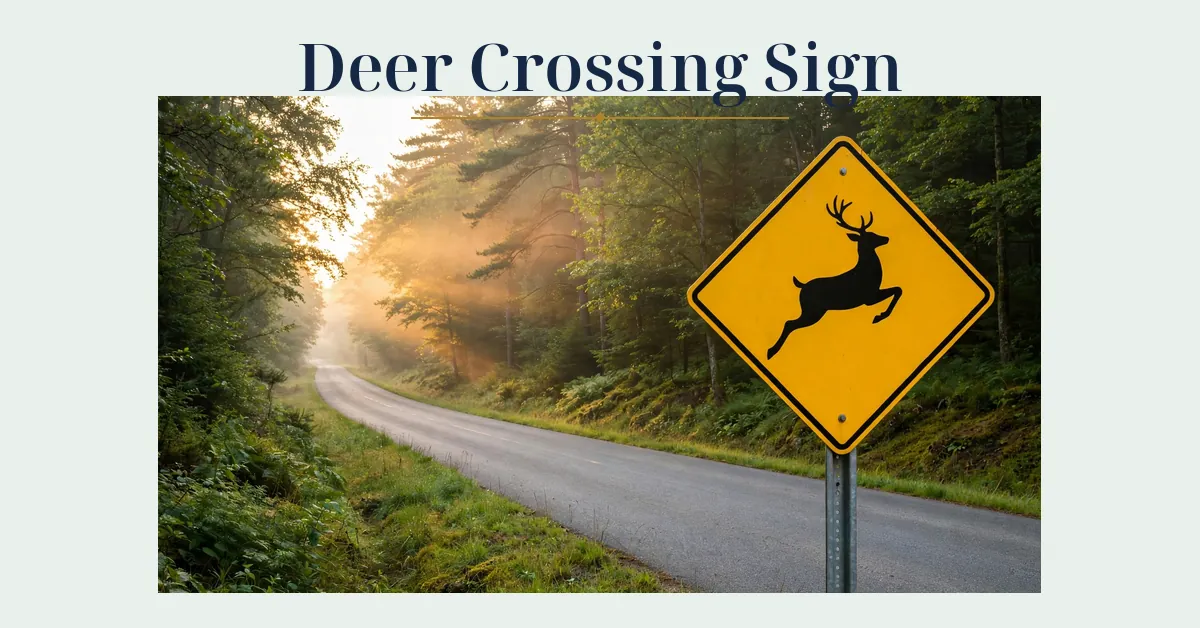
The deer crossing sign is the yellow diamond shaped warning sign with a black leaping deer on it. It means deer are known to cross the road ahead, often without warning, so you should slow down, scan both sides of the road and be ready to brake. In the United States the sign carries the official code W11-3 in the Manual on Uniform Traffic Control Devices, the national standard better known as the MUTCD.
Unlike a stop sign or a speed limit sign, the deer crossing sign does not order you to do anything. It is a warning, and warnings only help if you change how you drive. This guide explains what the sign means, what it looks like, where road crews place it, when deer are most active, and the exact steps that keep you, your passengers and the deer safe.
What Does the Deer Crossing Sign Mean?
The deer crossing sign means you are entering a stretch of road where deer regularly move across the pavement. The MUTCD groups it with the Non-Vehicular Warning signs, and its official wording says these signs may be used to alert road users in advance of locations where unexpected entries into the roadway might occur, or where deer might share the roadway with traffic. In plain language, the sign is telling you that a deer stepping into your lane here is not a freak event. It is a known pattern.
Two points about the meaning are worth understanding. First, the sign usually warns about a zone, not one exact crossing spot. Deer follow old trails between feeding areas, water and cover, and those trails can cross a road anywhere along a mile or more of pavement. The sign may stand at the start of that stretch rather than at the single place a deer will appear. Second, the sign is advisory, not regulatory. Breaking no law is involved in passing it, but ignoring it removes your best early warning. Treat it the way you would treat a curve warning or an icy bridge sign, as information that should change your speed and your attention.
What the Deer Crossing Sign Looks Like
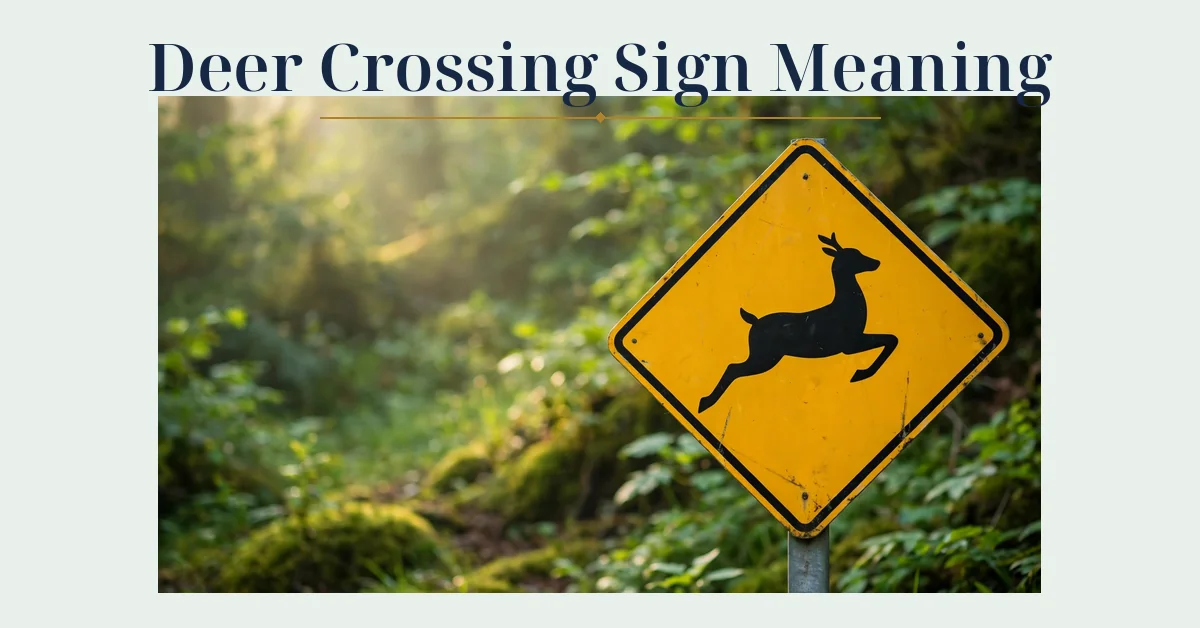
The standard deer crossing sign is easy to recognise once you know its four design elements.
Shape. It is a diamond, a square turned 45 degrees, which is the shape reserved for warning signs on American roads. When you see a diamond, your brain should read it as caution ahead, whatever picture sits inside it.
Colour. The background is yellow with a black symbol and a black border. Yellow is the general warning colour in the MUTCD system. Some newer signs use a fluorescent yellow green background, a brighter finish chosen because it stays visible in low light, which is exactly when deer move most.
Symbol. The picture is the black silhouette of a deer in mid leap, legs tucked, head up, with a small set of antlers. There are no words on the main sign, because a picture can be read at speed, in rain, and by drivers who do not read English. The leaping pose is deliberate. A standing deer would look calm, while a leaping deer tells your instincts the animal is moving fast and could be in front of you in a second.
Size. The MUTCD sizes the large animal signs by road type. The standard sign is 30 by 30 inches on a single lane conventional road, 36 by 36 inches on multi lane roads and expressways, with a 24 by 24 inch minimum and a 48 by 48 inch oversized version for high speed roads where drivers need more reading distance.
Sometimes a smaller rectangular plaque hangs below the diamond. It may carry words such as NEXT 2 MILES, which tells you the length of the risk zone, or an arrow showing the direction of the crossing area. A few high risk locations add flashing yellow beacons or seasonal signs that road crews put out only during the autumn peak. If you are learning American signs for a driving test, compare this warning diamond with regulatory signs such as the No U Turn sign, which uses a completely different shape and colour scheme because it gives an order rather than a warning.
Where Deer Crossing Signs Are Placed
Road authorities do not scatter these signs at random, and they do not put one up simply because a resident asks. Placement follows engineering judgement backed by local evidence. The usual triggers are a recorded history of deer vehicle crashes on that stretch, carcass removal records kept by maintenance crews, known deer trails and habitat on both sides of the road, and reports from police or wildlife officers. Some cities write the trigger into their own guidelines. Overland Park in Kansas, for example, has used a threshold of three deer crashes in a quarter mile section within 12 months, or ten deer crashes in a one mile section over 12 months, before a sign goes up.
The habitat clues matter as much as the crash numbers. Signs cluster where a road cuts between woods and open fields, because deer feed in the open and shelter in the trees, crossing at dawn and dusk. They also appear near streams and river crossings, along fence lines that funnel animals to one gap, and on rural highways that slice through farmland, orchards or forest. The MUTCD notes that the conflict may be confined to one spot or may occur randomly over a whole segment, which is why one sign can cover a long signed zone with a distance plaque.
There is a limit to how well signs work, and honest engineers admit it. Studies of driver behaviour show that a permanent sign on a road you drive every day fades into the background, a problem called sign habituation. That is why many agencies resist requests to sign every road where a deer has ever been seen. A sign everywhere would soon mean a sign that nobody notices anywhere. The signs you do see are meant to mark the places where the evidence is strongest, so they deserve your attention even on a familiar commute.
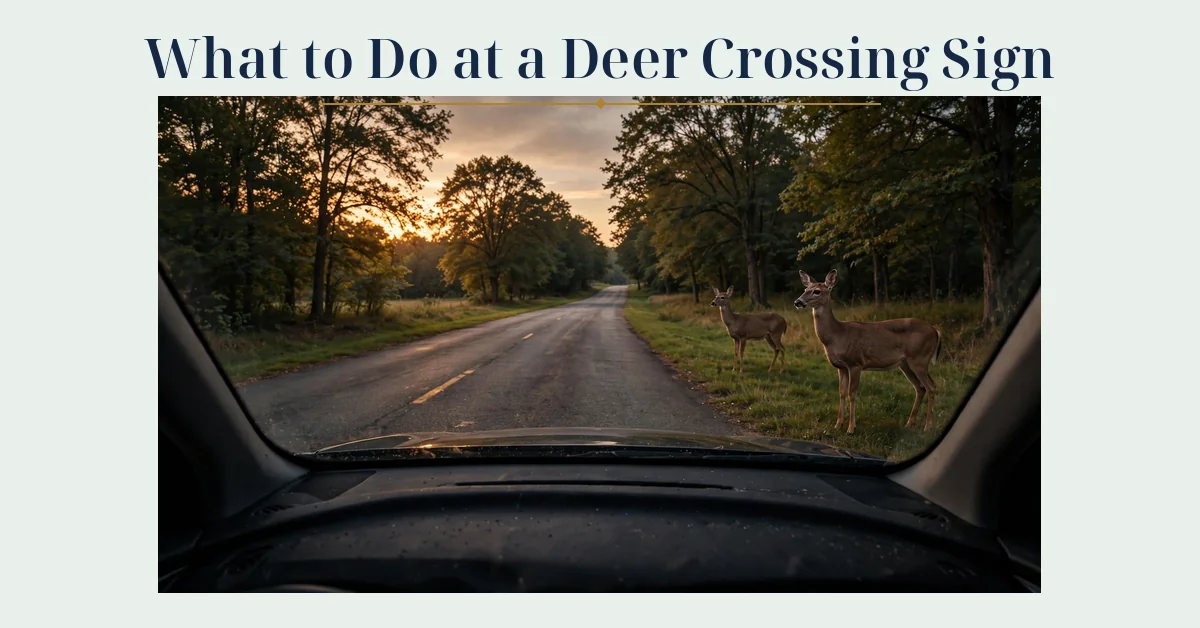
What to Do When You See a Deer Crossing Sign
Passing the sign should trigger a small, calm routine. None of it is dramatic, and all of it buys you time, which is the one thing that prevents a collision.
Slow down. Ease off the accelerator and drop a few miles per hour below your cruising speed, especially at dawn, at dusk and after dark. Lower speed shortens your stopping distance and softens any impact you cannot avoid. Most deer crashes happen because the driver simply ran out of road in which to stop.
Scan the edges, not just the lane. Move your eyes in a pattern: far ahead, left shoulder, right shoulder, and the ground just beyond the pavement. Deer appear from tree lines, tall grass and ditches. At night, watch for eye shine, the twin reflection of your headlights in an animal’s eyes, which often shows before the body does.
Use high beams when you can. On a dark road with no oncoming traffic, high beams light up the shoulders and the fields beside them. Dip them for approaching drivers, then bring them back up.
Expect more than one deer. Deer travel in groups. A doe crossing alone is often followed by fawns or by the rest of the herd, and the second or third animal is the one drivers hit because they relaxed after the first. If one deer crosses, slow right down and wait until you are sure the road and both verges are clear.
If a deer steps out, brake firmly and stay in your lane. This is the single most important rule. Do not swerve. Swerving sends cars into oncoming traffic, trees, poles and ditches, and safety data shows those outcomes injure and kill far more people than hitting the deer itself. Brake in a straight line, grip the wheel with both hands, and sound the horn in a long blast if there is time, which sometimes moves a frozen deer. If the deer stays frozen in your lights, switching briefly to low beams can break the trance, because deer can be mesmerised by a steady bright beam.
If a collision is unavoidable, keep braking, stay straight, and try to slow as much as possible before impact. After any crash, pull well off the road, switch on your hazard lights, check everyone in the car, and call the police or local non emergency line to report it. Do not approach an injured deer. A frightened animal with hooves and antlers can hurt you badly, and a dead deer in the roadway should be reported so crews can remove it before it causes a second crash.
A few popular gadgets deserve a warning of their own. Deer whistles and ultrasonic hood devices are widely sold, but wildlife agencies such as Fairfax County’s in Virginia state plainly that studies have shown these devices do not work. Your speed, your lights and your attention are the only proven defences.
When Are Deer Most Active?
Deer are crepuscular animals, which means their busiest hours are the twilight periods around dawn and dusk. They feed in the open during the low light of early morning and evening, then rest in cover through the middle of the day and much of the night. For drivers, the danger window is roughly the hour after sunset and the hour before sunrise, when deer are moving but visibility is at its worst. Research cited by driving safety sources puts the single highest crash peak at about one hour after sunset.
The season matters even more than the hour. The highest risk period in the United States runs from October through December, the deer mating season known as the rut. Bucks chase does with little attention to traffic, deer move far more than usual, and they move at all hours. State Farm’s claims data shows how sharp the peak is: about 650,000 animal collision claims, roughly 41 percent of the whole year, fall in October, November and December alone, with November usually the worst single month. The shorter days of autumn make things worse, because the evening rush hour slides into the dusk activity window, putting the most cars on the road at exactly the deer’s busiest hour.
Spring brings a smaller secondary rise. In May and June, does drive off last year’s fawns and give birth, so inexperienced young deer wander widely and cross unfamiliar roads. Yearling deer dispersing in spring and autumn are behind a share of crashes that surprises many drivers, because these animals have not yet learned the local traffic patterns.
Weather and moonlight play smaller roles. Deer move ahead of approaching storms to feed, and on bright moonlit nights they may stay active longer. None of this changes the core rule: in a signed deer zone, treat dawn, dusk and the autumn months as red alert conditions.
Deer Crossing Sign vs Other Animal Crossing Signs
The deer sign belongs to a whole family of animal warning signs in the W11 series, all sharing the same yellow diamond design. What changes is the silhouette, and the silhouette tells you the size of the problem you might meet.
| Sign | MUTCD Code | Animal Shown | Where You See It |
|---|---|---|---|
| Deer Crossing | W11-3 | Leaping deer | Most states, near woods, fields and streams |
| Cattle Crossing | W11-4 | Cow | Open range and ranch country, mainly the West |
| Horse Crossing | W11-7 | Horse and rider or horse | Areas with trails, stables and equestrian crossings |
| Elk Crossing | W11-19 | Elk | Mountain and northern states with elk herds |
| Moose Crossing | W11-21 | Moose | Alaska, northern New England and the upper Great Lakes |
| Bighorn Sheep Crossing | W11-18 | Ram | Rocky Mountain and desert canyon roads |
The driving response is the same for all of them, but the stakes change with the animal. An adult deer typically weighs 100 to 200 pounds, and a collision usually damages the car more than the people inside, provided nobody swerves. A moose can weigh 1,000 pounds or more, stands tall enough that its body comes through the windshield rather than bouncing off the hood, and moose collisions are far more often fatal. Cattle are heavy and slow, and a herd can block both lanes completely. So the bigger the silhouette on the sign, the more seriously you should take the instruction to slow down.
One wording question comes up often: deer crossing versus deer crossing ahead. They mean the same thing. The standard sign carries no words at all, just the leaping deer. Where words appear on plaques or on older and novelty signs, crossing ahead simply stresses that the risk zone starts a little further on. Some countries use the words game crossing or wild animals for the same idea, with a similar leaping animal inside a warning triangle instead of a diamond.
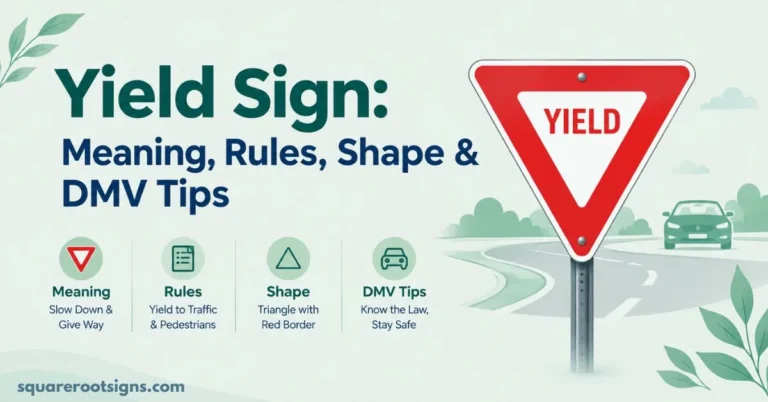
Do not confuse these animal signs with the pedestrian crossing sign, which shows a walking person and usually appears near crosswalks in towns and school zones. That sign is also a yellow or yellow green diamond in the W11 family, W11-2, but it warns about people on foot and often comes with different duties under state law, such as stopping for a person in the crosswalk. Animal signs carry no such legal duty to stop, only the practical duty to take care. For a reminder of how a totally different sign family looks, our guide to the yield sign shows the inverted triangle used for right of way rules.
Facts and Safety Statistics
Deer are the most commonly struck large animal on American roads, and the numbers explain why the signs exist. According to State Farm’s 2025 analysis of claims from July 2024 to June 2025, drivers filed about 1.7 million animal collision claims in the United States in that year, and deer accounted for more than 1.1 million of them. The national odds of an animal collision claim were about 1 in 139. The riskiest state was West Virginia, at about 1 in 40, while Pennsylvania recorded the highest estimated number of claims, around 147,000.
The human cost is real but often misunderstood. The Insurance Institute for Highway Safety reports that 210 people died in 2024 in crashes that began with a collision with an animal. In 63 percent of those deaths the animal strike itself was the most harmful event, but 12 percent involved a rollover and 8 percent a later strike on a fixed object, which is the statistical fingerprint of swerving. In other words, a large share of the worst outcomes happened after the driver left the road or lost control, not at the moment of hitting the animal. That is the strongest evidence behind the brake, do not swerve rule.
Some design and history facts round out the picture. The leaping deer symbol is standardised nationally, so the same silhouette greets you in Maine and in Oregon, a deliberate choice that lets drivers learn one picture for one danger. The sign is one of the most stolen road signs in rural areas, a backhanded compliment to its design, and souvenir copies are sold legally by sign shops for garages and cabins. Engineers increasingly pair the classic static sign with technology, including flashing beacons in the rut season, animal detection systems that trigger warning lights when something large breaks an infrared beam near the road, and wildlife underpasses and fencing on major highways, which studies show can cut animal collisions dramatically where they are installed.
For the official standard behind the sign itself, the Federal Highway Administration publishes the Manual on Uniform Traffic Control Devices, and county wildlife pages such as Fairfax County’s deer vehicle collision guidance collect the same driving advice your state patrol gives: slow down, use high beams, watch for eye shine, and never swerve.
Conclusion
The deer crossing sign is a simple message with serious evidence behind it. The yellow diamond and its leaping deer, standardised as W11-3, mark the stretches where deer cross often enough that crashes have already happened. Your response should be just as standard: slow down, scan both edges of the road, use your high beams, expect the second deer, and if one steps out, brake firmly in your lane instead of swerving. Risk peaks at dawn and dusk and through the October to December mating season, so signed zones deserve extra care then. Respect the sign, and it will quietly do its job, which is to make sure the deer you meet is the one you saw in time.
Frequently Asked Questions
What does a deer crossing sign mean?
A deer crossing sign means deer are known to cross the road ahead, so you should slow down, scan both sides of the road and be ready to brake. It is a warning sign, not an order, and it usually covers a stretch of road rather than one exact spot.
What is the MUTCD code for the deer crossing sign?
The MUTCD code for the deer crossing sign is W11-3. It belongs to the Non-Vehicular Warning signs in the Manual on Uniform Traffic Control Devices, the national standard published by the Federal Highway Administration.
What colour and shape is the deer crossing sign?
The deer crossing sign is a yellow diamond with a black border and a black silhouette of a leaping deer. The diamond shape marks it as a warning sign, and some newer versions use a brighter fluorescent yellow green background.
What should you do when you see a deer crossing sign?
When you see a deer crossing sign, slow down, scan the road edges and shoulders, use high beams at night when there is no oncoming traffic, and watch for eye shine. Stay alert for the whole signed stretch, because deer can cross anywhere inside the zone.
Should you swerve to avoid a deer?
No, you should not swerve to avoid a deer. Brake firmly, hold your lane and grip the wheel. Swerving can send you into oncoming traffic, a tree or a ditch, and safety data shows those outcomes cause more serious injuries than hitting the deer.
What time of day are deer most active near roads?
Deer are most active at dawn and dusk, the twilight hours when they move between cover and feeding areas. The riskiest window for drivers is about one hour after sunset, when deer are on the move and visibility is poor.
What month has the most deer collisions?
November usually has the most deer collisions, in the middle of the October to December mating season called the rut. State Farm data shows those three autumn months account for about 650,000 animal collision claims, roughly 41 percent of the whole year.
Why is there a deer crossing sign on a road with no deer visible?
A deer crossing sign is placed where crashes, carcass records or known deer trails show a repeated pattern, not because deer are always present. Deer move mostly at dawn, dusk and night, so a road can look empty at midday and still be a genuine crossing zone.
What is the difference between a deer crossing sign and a cattle crossing sign?
The difference is the animal pictured and the code. The deer crossing sign, W11-3, shows a leaping deer and appears near woods and fields in most states. The cattle crossing sign, W11-4, shows a cow and appears in open range and ranch country where livestock may be on the road.
What should you do after hitting a deer?
After hitting a deer, pull off the road, turn on your hazard lights, check that everyone in the car is safe and call the police to report the crash. Do not approach an injured deer, because a frightened animal can kick and cause serious injury.

Jack Harrison is a contributor at Square Root Signs, sharing creative ideas, useful information, and engaging content to help readers discover something valuable with every visit.