Stop Sign Ahead Sign Meaning: W3-1 Explained
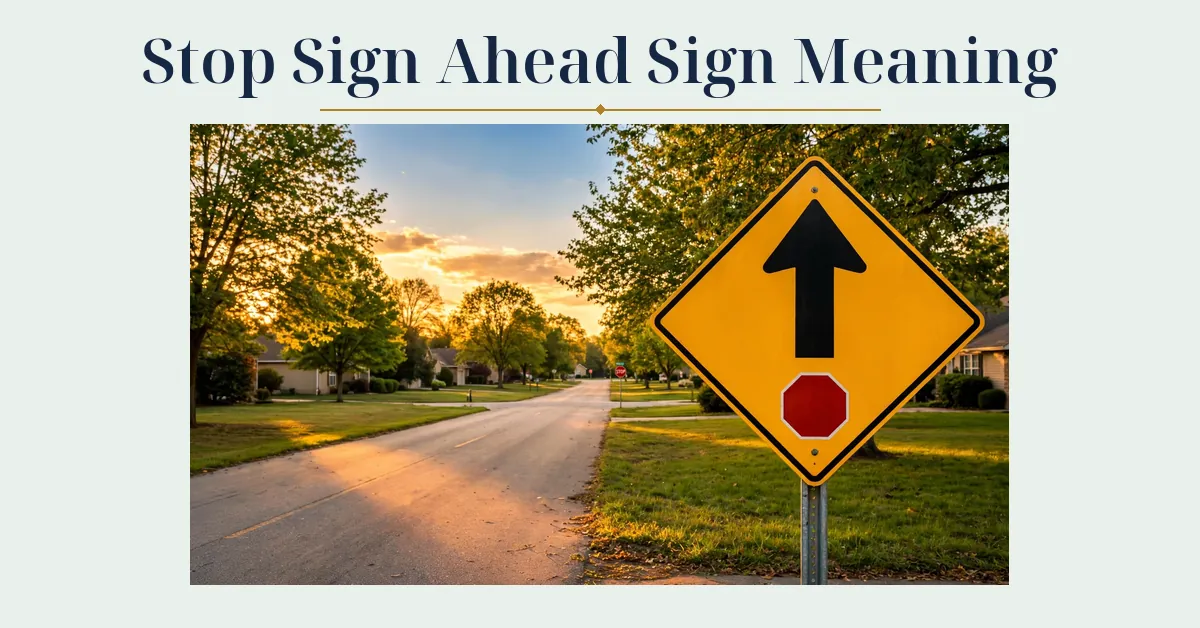
The stop sign ahead sign meaning is simple: a stop sign is coming up, so slow down and get ready to stop. It is the yellow diamond warning sign, code W3-1 in the US Manual on Uniform Traffic Control Devices, and it shows a black arrow above a small red octagon. It does not tell you to stop where you are standing. It tells you that a real stop sign waits further up the road, often around a bend or over a hill where you cannot see it yet.
This guide explains the stop sign ahead sign meaning in full: what the sign looks like, how it differs from the red octagonal Stop sign, where and how far ahead of the intersection it is placed, what to do when you see it, the mistakes drivers make with it, and how other countries warn drivers about a stop ahead.
What Does the Stop Sign Ahead Sign Mean?
A Stop Ahead sign means that a stop sign is ahead of you on this road and that you will have to come to a complete stop when you reach it. The sign is a warning, not an order. It exists to buy you time. On a clear, straight road you can see a stop sign from a long way off and slow down without thinking about it. On a road where a hill, a curve, trees, or a building hides the intersection, you can be on top of the stop sign before you have had a chance to brake. The Stop Ahead sign closes that gap. It is placed far enough back that a driver travelling at the posted speed can ease off, slow down smoothly, and arrive at the stop sign ready to stop.
The rule behind the sign is written in Section 2C.35 of the Manual on Uniform Traffic Control Devices, the MUTCD, which is the national standard for traffic signs in the United States. The full text is in the FHWA Manual on Uniform Traffic Control Devices, Chapter 2C. The MUTCD says the Stop Ahead sign, W3-1, shall be installed on an approach to a stop sign that is not visible for a sufficient distance to permit the road user to respond. In plain terms, if drivers cannot see the stop sign early enough to stop safely, the warning sign must go in. The same section also allows the sign to be used for emphasis even when the stop sign can be seen in good time, for example at an intersection where drivers have run the stop before.
That is the whole job of the sign. It is an early warning about a stop you cannot see yet. It does not change the speed limit, it does not mark a hazard in the road surface, and it does not tell you to stop on the spot. It tells you to prepare, and the preparation is the point: a driver who has slowed down early can stop calmly at the line, look both ways, and go on safely, while a driver who meets the stop sign without warning has to brake hard or risks running straight through it.
Learner drivers meet this sign in every state driving test, and it is one of the most commonly misunderstood signs on the road. The confusion comes from the red octagon on its face. Drivers see the octagon, think stop, and either brake hard on the spot or stop dead where the warning sign stands. Both reactions are wrong, and both are dangerous, because the traffic behind you is not expecting a stop at that point. The sign is telling you about a stop that is still ahead of you, not about a stop right here.
What Does the Sign Look Like?
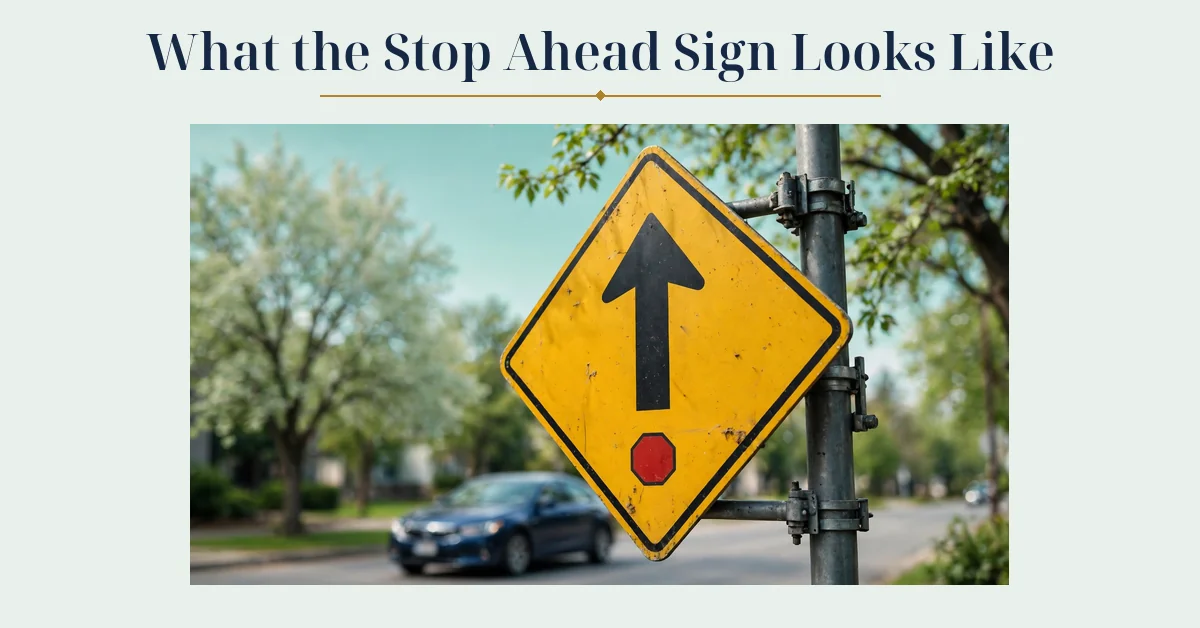
The Stop Ahead sign is easy to recognise once you know its three parts: a yellow diamond, a black arrow, and a small red octagon. The diamond shape is the standard shape for warning signs in the United States, and the yellow background is the standard warning color. A black border runs around the edge of the diamond. Inside it, a black arrow points straight up, and below the arrow sits a small red octagon carrying the word STOP in white letters. The arrow says ahead, and the octagon says stop, so the two symbols together read as stop ahead, with no words needed.
The design is deliberate. Shapes and colors carry the meaning before a driver has time to read anything, which matters at speed. A diamond means warning, yellow means pay attention, and the octagon is reserved for stop signs, so a driver who has seen even one stop sign recognises the red octagon at a glance. That is also why the sign works for drivers who cannot read English well. The symbol does the talking.
The official code for the sign is W3-1. The W marks it as a warning sign, the 3 puts it in the advance traffic control series, and the 1 makes it the first sign in that series. Its neighbours in the same series are the Yield Ahead sign, W3-2, which shows a red and white yield triangle, the Signal Ahead sign, W3-3, which shows a traffic light, and the Be Prepared to Stop sign, W3-4, which carries the words BE PREPARED TO STOP. If you can read the W3 series, you can read the whole family of signs that warn about traffic control ahead.
There is also an older text version of the sign, coded W3-1a, which spells out the words STOP AHEAD in black letters on the same yellow diamond. It means exactly the same thing as the symbol version. The worded sign was common in the 1950s and 1960s, and the symbol version became the standard in the 1970s, when the MUTCD moved toward symbols that drivers could read at a glance. Some states have since dropped the worded version from their sign manuals, and Ohio, for example, removed W3-1a with the note to use the symbol, but old worded signs can still be found standing on some roads. If you see one, treat it exactly like a W3-1.
At night the sign is just as visible as it is in daylight, because warning signs are made with retroreflective sheeting that bounces your headlights back at you. On some signs you may also see a flashing yellow beacon on top, or yellow lights set into the border of the sign. These are added at intersections where drivers have missed the stop before, or where the warning needs extra emphasis. The lights make the sign harder to miss, but they do not change what it means.
Stop Ahead vs Stop Sign
The Stop Ahead sign and the Stop sign look related, and they are, but they do opposite jobs, and mixing them up is the most common mistake drivers make with either one. The Stop Ahead sign warns you. The Stop sign orders you. One is yellow and diamond shaped, the other is red and octagonal. One sits well back from the intersection, the other sits at the intersection itself. Knowing which is which takes a second, and it changes what your foot should be doing.
| Feature | Stop Ahead Sign (W3-1) | Stop Sign (R1-1) |
|---|---|---|
| Shape | Yellow diamond, square turned on its point | Red octagon, eight sides |
| Color | Yellow background, black border and arrow, small red octagon | Red background, white border and STOP lettering |
| Sign type | Warning sign, it advises you | Regulatory sign, it orders you |
| MUTCD code | W3-1, Section 2C.35 | R1-1, Section 2B.04 |
| What it means | A stop sign is coming up ahead | Come to a complete stop here |
| Where it stands | Well before the intersection, at the advance warning distance | At the intersection, on the near side, no more than 50 feet from the edge of the road you are crossing |
| What you must do | Slow down and prepare to stop | Stop fully, look, give way, then go when it is clear |
| Legal effect | No stop order of its own | A full stop is required by law |
The legal difference is the one that matters most. The red Stop sign, R1-1, is a regulatory sign, which means it gives notice of a traffic law. The MUTCD says it is used where a full stop is always required on an approach to an intersection. When you reach it, you must stop completely, behind the stop line or crosswalk if there is one, and you must not go on until the way is clear. Running it is a traffic violation, and the consequences are covered in our guide to the fine for hitting a stop sign.
The yellow Stop Ahead sign, W3-1, is a warning sign, which means it gives notice of a situation that might not be readily apparent. It carries no law of its own and no stop order. You cannot be ticketed for failing to stop at a W3-1, because there is nothing to stop at. You can, however, be in trouble for what happens next, because the stop sign it warns about is a real one, and running that sign is a real violation. The warning sign is the road doing you a favour. The regulatory sign is the road giving you an order.
A good way to remember the pair is this: yellow means prepare, red means stop. The same rule works across the whole American sign system. Yellow diamonds warn, red octagons and red circles order, and the shape and color tell you the type of sign before you have read a single symbol. Once that clicks, the two signs can never be confused again.
When and Where You Will See It
You will see a Stop Ahead sign on the approach to an intersection where the stop sign is hidden or unexpected. The most common hiding places are the crest of a hill, where the road drops away and the intersection sits below the skyline, and a sharp curve, where trees, a fence, or a building block the view around the bend. You will also see it where the intersection itself is easy to miss, for example where a side road joins at an angle, where a stop sign sits behind a parked truck or a bus stop, or where a new stop has been added to a road that drivers have used for years without one. In each case the problem is the same: a driver travelling at the posted speed would not see the stop sign in time to stop comfortably, so the warning sign is placed further back to give that driver the missing seconds.
The distance between the warning sign and the stop sign is not guessed. It is set by the road authority from MUTCD Table 2C-3, which gives the advance placement distance for a potential stop at each speed. The table is built from perception and reaction time plus braking distance, so faster roads get longer warnings. The figures are about 155 feet on a 25 mph road, 200 feet at 30 mph, 250 feet at 35 mph, 305 feet at 40 mph, 360 feet at 45 mph, 425 feet at 50 mph, and 495 feet at 55 mph, rising to about 730 feet at 70 mph. A driver doing 55 mph covers roughly 80 feet every second, so 495 feet is about six seconds of warning, which is enough to lift off, brake smoothly, and arrive at the stop line under control.
The sign itself is sized to match the road. Under MUTCD Table 2C-1, a W3-1 is 30 by 30 inches on a conventional road and 48 by 48 inches on an expressway or freeway, with 30 by 30 inches as the minimum. Bigger signs are used where speeds are higher, so the warning can be read from further away. The sign stands on the right hand side of the approach it applies to, facing the traffic it warns, and it is usually mounted on its own post. Where a stop sign is paired with a warning beacon, the beacon may sit on the warning sign as well, and a distance plaque can be mounted below the sign to say how far ahead the stop is.
You will also see the sign used for emphasis at intersections with a bad history. If drivers have repeatedly run a particular stop, or if a crash study has shown that the stop is being missed, the road authority can add a Stop Ahead sign even where the stop sign is visible in good time. The MUTCD allows this, and it is a common treatment at rural intersections, at the end of a long straight stretch where drivers switch off, and at intersections near schools or busy pedestrian crossings. In those places the sign is not fixing a sight problem. It is fixing an attention problem.
There are places where you will not see it, and the absence is just as informative. On a clear, straight, low speed street where the stop sign is plainly visible from a long way off, no warning sign is needed, and adding one would only add clutter. Warning signs are meant to be used where they are needed, and a sign that warns about nothing teaches drivers to ignore signs. That is why the MUTCD ties the sign to an engineering study or engineering judgment, and why you see it on blind approaches and not on every street corner.
What to Do When You See It
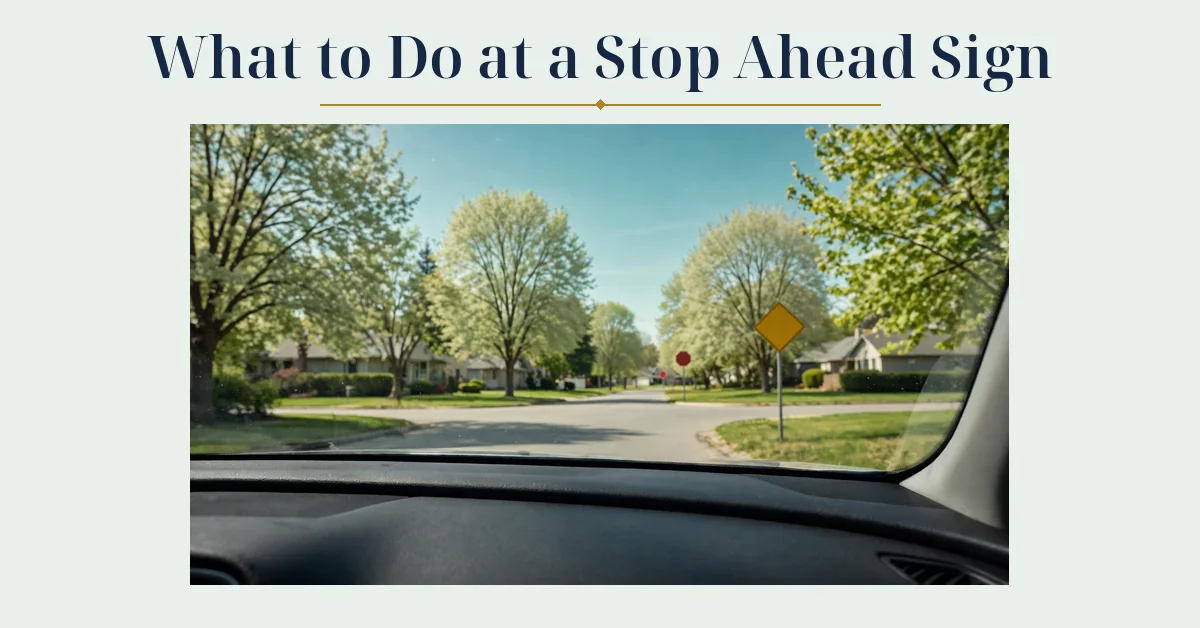
Seeing a Stop Ahead sign is a cue to start a short, calm routine. The whole point of the sign is that you have time, so use it. The steps below take a few seconds, and they turn a hidden stop into an ordinary one.
First, lift your foot off the accelerator. The sign has told you a stop is coming, so there is no reason to keep feeding the car speed you will only have to brake away. Let the car begin to slow on its own while you look ahead for the intersection and the stop sign itself.
Second, check your mirrors. A driver behind you has seen the same sign, but you should still know what is behind you before you slow down. A quick glance tells you whether the car behind is close, and whether you need to brake a little earlier and more gently to give them room.
Third, brake smoothly and early. Bring your speed down gradually over the distance the sign has given you, rather than waiting until the stop sign appears and braking hard. Smooth braking keeps the car stable, keeps your passengers comfortable, and gives the driver behind you a clear, early signal that you are slowing.
Fourth, look for the stop sign and the intersection. Scan ahead for the red octagon, the stop line or crosswalk on the road, and any cross traffic or pedestrians. At night, watch for the reflective face of the stop sign catching your headlights. If you cannot see the stop sign yet, keep slowing, because the intersection is closer than it looks.
Fifth, come to a complete stop at the stop sign. Stop behind the stop line, or behind the crosswalk if there is one, and if there is no line or crosswalk, stop at the point where you can see clearly in both directions without blocking the road you are about to enter. A rolling stop is not a stop. Bring the car to a full halt, wheels still, before you look and go.
Sixth, look, give way, and go when it is clear. Give way to pedestrians and to traffic on the road you are joining or crossing, and watch for a second stop sign or an all way plaque that changes who goes first. Then pull away smoothly and carry on. The routine is the same at every stop sign, and the warning sign only changes one thing: you started it early, which is exactly what it was put there for.
Common Mistakes and What It Does NOT Mean
The Stop Ahead sign is simple, but drivers get it wrong in the same few ways, and most of those mistakes come from reading the red octagon and stopping the thought there. The list below covers the ones that cause the most trouble, and each one is easy to avoid once you have seen it named.
The first mistake is stopping at the warning sign itself. A driver sees the red octagon, brakes, and comes to a halt beside the yellow diamond, sometimes a hundred yards or more before the intersection. The cars behind are not expecting a stop there, and the driver has now stopped in a place where no stop is required, which can cause a rear end collision. The stop belongs at the stop sign, not at the warning sign.
The second mistake is the opposite: treating the sign as decoration and carrying on at full speed. The sign is there because the stop ahead cannot be seen in time, so ignoring it means meeting the stop sign late, braking hard, and either stopping past the line or running the stop altogether. A driver who ignores a warning sign has thrown away the very seconds the sign was giving them.
The third mistake is braking hard the moment the sign appears. The sign gives you distance, and hard braking wastes it. It also startles the driver behind you and can unsettle the car on a wet or loose surface. The right response is a smooth, early slowdown, not a sudden one.
The fourth mistake is assuming the stop is right around the corner. The sign is placed hundreds of feet before the intersection on a fast road, so after passing it you may drive for several seconds before the stop sign appears. Drivers who expect the stop immediately sometimes relax too early, speed up again, and then meet the stop sign unprepared. Hold your reduced speed until you can see the stop sign and the intersection.
The fifth mistake is thinking the sign means the stop is optional, or that it only applies to some drivers. The warning sign itself carries no order, but the stop sign it warns about is a full regulatory stop for everyone on that approach. There is no version of this sign that means slow down and roll through. The stop ahead is a real stop.
The sixth mistake is confusing the Stop Ahead sign with its neighbours. The Yield Ahead sign, W3-2, shows a yield triangle and means a yield sign is ahead, which may or may not need a stop. The Signal Ahead sign, W3-3, shows a traffic light and means a signal is ahead. The Be Prepared to Stop sign, W3-4, is used where traffic may be stopped ahead, often at a queue. Each one warns about a different thing ahead, and each one asks for a different response, so it is worth learning the family, not just the one sign. Our guide to the yield sign explains the closest of these relatives, and the dip sign meaning guide shows how the same yellow diamond system warns about a road condition instead of a traffic control.
Finally, the sign does not mean there is a stop sign right behind it, it does not mean the road ends, it does not mean a hazard such as a dip or a curve is ahead, and it does not mean you are already at the intersection. It means one thing only: a stop sign is ahead, so slow down and be ready to stop when you reach it.
Stop Ahead Signs in Other Countries
The idea of warning drivers about a stop they cannot see yet is used all over the world, but the sign itself changes with each country’s system. The American yellow diamond is only one version, and drivers who travel or take a driving test abroad will meet different shapes, colors, and words for the same message.
In the United Kingdom, the warning is a white triangle with a red border, diagram 501 in the Traffic Signs Regulations, showing the junction ahead with the thicker line marking the priority road. It is used where the clear visibility distance to the STOP or GIVE WAY sign is less than the standard, and it is paired with a supplementary plate, diagram 502, that says STOP and gives the distance in yards, for example STOP ahead in 100 yds. The Highway Code lists the sign as Distance to STOP line ahead, and the same triangle with a different plate warns of a give way line instead. The triangle means warning, the red border means attention, and the plate supplies the detail, which is the British way of building the same message the American sign builds with a diamond, an arrow, and an octagon.
In Canada the system is close to the American one, because Canada also uses the yellow diamond for warnings. In Ontario the sign is coded Wb-1, a yellow diamond with the stop symbol, and the Ontario Traffic Manual lists standard sizes of 75 by 75, 90 by 90, and 120 by 120 centimetres. The Ontario Official Driver’s Handbook describes it in the same terms as the American sign, a warning that a regulatory stop sign is coming, often where the view is limited, and the rule for drivers is the same: slow down, prepare, and stop at the stop sign itself. Canadian drivers meeting a W3-1 in the United States will find it familiar, and American drivers in Canada will find the Wb-1 just as easy to read.
Across much of Europe the warning follows the Vienna Convention system, where warning signs are triangles with a red border on a white background, like the British sign. The exact design varies by country, and many countries use a triangular sign with a stop symbol or the word STOP on a distance plate, but the logic is identical: a triangle warns, the plate explains, and the driver slows down before the stop. An American driver in Europe should look for the red bordered triangle and read the plate beneath it, because that plate carries the detail the American sign carries in its symbol.
The lesson for any driver is to read the system, not just the sign. In the United States, a yellow diamond means a warning is coming, and the symbol inside it says what the warning is. In the UK and Europe, a red bordered triangle means the same thing. The shapes and colors are different, but the message is the same in every country: a stop is ahead, so slow down now and be ready to stop when you reach it.
Conclusion
The stop sign ahead sign meaning is a stop sign is coming up, so slow down and prepare to stop. The sign is the MUTCD W3-1, a yellow diamond with a black arrow above a small red octagon, placed where the stop sign ahead cannot be seen early enough for a driver to react. It is a warning, not an order: you slow down at the yellow diamond and you stop at the red octagon, the R1-1, which sits at the intersection itself. The distance between the two signs grows with speed, from about 155 feet on a 25 mph road to about 495 feet at 55 mph, and the sign is sized at 30 by 30 inches on ordinary roads and 48 by 48 inches on expressways. The mistakes to avoid are stopping at the warning sign, ignoring it, braking hard, or confusing it with the stop sign itself. Other countries warn about the same hidden stop with different shapes, a red bordered triangle in the UK and a yellow diamond in Canada, but the message is the same everywhere. See the yellow diamond, ease off, slow down smoothly, and stop fully when you reach the red octagon.
Frequently Asked Questions
What does a stop sign ahead sign mean?
A stop sign ahead sign means a regulatory stop sign is coming up on the road ahead, and you should slow down and prepare to stop. It is the US MUTCD warning sign W3-1, a yellow diamond with a black arrow above a small red octagon. It does not order you to stop where you see it. It warns you early so you can brake smoothly and come to a full stop at the actual stop sign ahead.
Do I have to stop at a Stop Ahead sign?
No. You do not have to stop at the Stop Ahead sign itself. It is a warning sign, not a regulatory sign, so it carries no stop order of its own. The full stop is required at the red octagonal STOP sign (R1-1) further up the road. Stopping at the warning sign itself is a common mistake, and it can surprise the drivers behind you.
What is the MUTCD code for the Stop Ahead sign?
The MUTCD code for the Stop Ahead sign is W3-1. It is listed in Section 2C.35 of the Manual on Uniform Traffic Control Devices under Advance Traffic Control signs, alongside the Yield Ahead sign (W3-2), the Signal Ahead sign (W3-3), and the Be Prepared to Stop sign (W3-4). The W in the code marks it as a warning sign.
What is the difference between a Stop Ahead sign and a Stop sign?
The Stop Ahead sign (W3-1) is a yellow diamond warning sign that tells you a stop is coming, while the Stop sign (R1-1) is a red octagon regulatory sign that orders you to stop. The warning sign is placed well before the intersection so you can slow down in time. The regulatory sign sits at the intersection itself, and you must come to a complete stop there and give way before you go on.
What does the W3-1a sign mean?
The W3-1a sign is the older text version of the Stop Ahead sign. Instead of the arrow and red octagon symbol, it spells out the words STOP AHEAD on a yellow diamond. It means exactly the same thing as the symbol version, W3-1. The symbol version has been the standard since the 1970s, and some states have dropped the worded version, but old W3-1a signs can still be seen standing on some roads.
How far ahead of the stop sign is the Stop Ahead sign placed?
The distance depends on the speed of the road, because faster traffic needs more room to slow down. Under MUTCD Table 2C-3, the advance placement distance for a potential stop is about 155 feet on a 25 mph road, 200 feet at 30 mph, 360 feet at 45 mph, and 495 feet at 55 mph. The exact spot is set by the road authority using the posted speed and the sight distance at that intersection.
What size is a W3-1 Stop Ahead sign?
Under MUTCD Table 2C-1, a W3-1 Stop Ahead sign is 30 by 30 inches on a conventional road and 48 by 48 inches on an expressway or freeway. The minimum size is 30 by 30 inches. Larger signs are used where speeds are higher, so drivers can read the warning from further away.
Why is there a Stop Ahead sign if the stop sign is already there?
A Stop Ahead sign is installed where the stop sign itself cannot be seen from far enough away for a driver to react in time. A hill, a sharp curve, trees, a building, or a bend in the road can hide the stop sign until a driver is almost on top of it. The warning sign gives that driver the extra seconds needed to slow down safely. It can also be added for emphasis at an intersection with a history of drivers missing the stop.
What does the Stop Ahead sign look like in the UK?
In the UK there is no yellow diamond. The advance warning is a white triangle with a red border, diagram 501, showing the junction ahead, used with a supplementary plate, diagram 502, that says STOP and gives the distance in yards, for example STOP ahead in 100 yds. The Highway Code lists it as Distance to STOP line ahead. The idea is the same as the US W3-1, only the shape, color, and wording follow the British system.
Can a Stop Ahead sign have flashing lights?
Yes. A Stop Ahead sign can be fitted with a warning beacon or with yellow light emitting diodes in the sign border to make it stand out, especially at night or at an intersection where drivers have missed the stop before. The lights draw the eye to the warning, but they do not change the meaning. You still slow down and prepare to stop at the stop sign ahead.

Jack Harrison is a contributor at Square Root Signs, sharing creative ideas, useful information, and engaging content to help readers discover something valuable with every visit.