Fine for Hitting a Stop Sign: Penalties, Costs & What to Do
What Is the Fine for Hitting a Stop Sign?
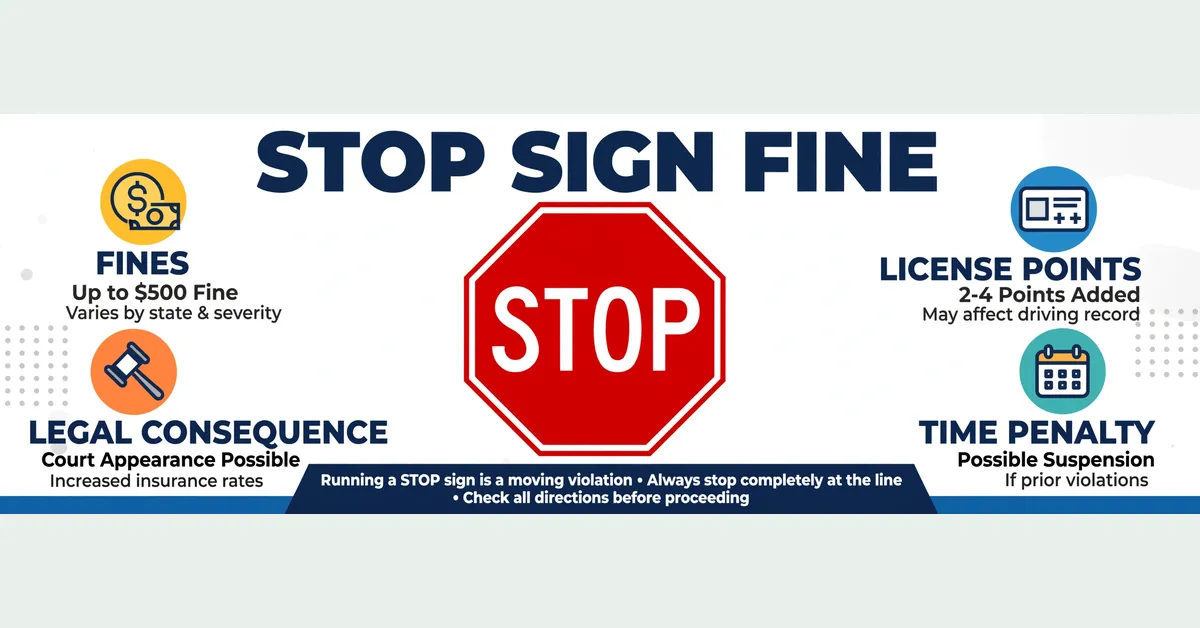
The fine for hitting a stop sign in the United States has no single nationwide dollar amount. Depending on the circumstances and state law, a driver may face a traffic citation, a separate penalty for failing to report the collision, and a bill for repairing or replacing the damaged sign. Replacement costs can start at tens of dollars for the sign itself and reach hundreds or more once labor and installation are included.
For example, Arizona classifies violating its highway-fixture reporting law as a Class 1 misdemeanor, while Texas has specific penalties for failing to notify the responsible person after damaging certain roadside fixtures. These are penalties for violating reporting requirements,not automatic fines for every accidental collision. The exact charge, repair bill, and insurance outcome depend on the facts.

What Should You Do If You Hit a Stop Sign or Road Sign?
If your vehicle strikes a stop sign, pull over somewhere safe, check for injuries, and determine whether the damaged sign creates a danger for other drivers. Call 911 if someone is injured or the sign has fallen in a way that creates an immediate hazard. Otherwise, contact the appropriate local police department, road authority, or municipality and ask how to report the collision.
Photograph the damaged traffic sign, its post, your vehicle, the surrounding intersection, and any visible debris. Record the location, time, weather, and details of what happened. Keep the incident number and any correspondence from the responsible agency. Do not attempt to reinstall an official stop sign yourself; improper placement can create a serious road-safety risk.
Immediate steps after knocking down a stop sign
- Protect people: Move to a safe location and check for injuries.
- Report the damage: Contact the appropriate authorities or road-maintenance agency.
- Document the collision: Take photographs and preserve witness information.
- Notify your insurer: Follow your policy’s reporting requirements.
- Keep the paperwork: Save the incident number, repair estimates, and any reimbursement demand.
- Follow up: Respond to official requests and meet any applicable reporting deadlines.
Reporting a damaged traffic-control device promptly helps the responsible agency restore a critical traffic-control device before another driver approaches the intersection without adequate warning.
How Much Is the Fine for Hitting a Stop Sign by State?
State laws distinguish accidental property damage, failure to report a collision, intentional destruction of a traffic-control device, and failure to obey a stop sign. The table below gives five verified state-law examples, using official legislative or DMV sources.
| State | Verified legal rule | Potential consequence | Official source |
|---|---|---|---|
| Arizona | Under A.R.S. § 28-665, drivers who damage fixtures or other property legally on or beside a highway must take reasonable steps to notify the owner or person responsible. | Violating the statute is a Class 1 misdemeanor. | Arizona Legislature, § 28-665 |
| Texas | Under Texas Transportation Code § 550.025, drivers must take reasonable steps to notify the owner or person in charge after a collision damaging a qualifying roadside structure, fixture, or landscaping. | Failure to comply is a Class C misdemeanor if damage is under $200, or a Class B misdemeanor if damage is $200 or more. | Texas Statutes, Chapter 550 |
| Florida | Florida Statutes § 316.063 addresses collisions damaging unattended vehicles or other property and requires the driver to stop, provide identifying information, and notify police as specified. | Failure to comply is a second-degree misdemeanor. | Florida Legislature, Chapter 316 |
| Illinois | Under 625 ILCS 5/11-311, unlawfully altering, injuring, knocking down, or removing an official traffic-control device is prohibited. | A conviction under this provision is a Class A misdemeanor with a statutory minimum fine of $250, in addition to other penalties. This concerns unauthorized interference, not every accidental collision. | Illinois Vehicle Code, § 11-311 |
| Nevada | Nevada DMV lists disobeying a traffic signal or stop sign as a four-point offense. That is a separate traffic violation, not a fine for physically striking a sign. Nevada’s crash-reporting statute also contains a reporting threshold for qualifying crashes. | A driver may face points for a separate stop-sign violation. The applicable collision or reporting consequences require analysis of the facts and relevant law. | Nevada DMV, Demerit Points; Nevada Revised Statutes, Chapter 484E |
Last checked: October 17, 2026. These examples illustrate specific statutory rules; they are not a complete schedule of fines for hitting a stop sign. A misdemeanor classification does not itself state the exact fine a court will impose. Court costs, additional charges, and other consequences may apply under separate provisions.
For a reliable estimate, identify the state and city where the accident occurred, the exact citation or statute, and whether the allegation involves accidental damage, careless driving, failure to report, or intentional damage.
What Happens If You Don’t Report It?
Leaving after hitting a stop sign without meeting the applicable legal requirements can create a more serious problem than the collision itself. Depending on the jurisdiction, failing to stop, identify yourself, notify the property owner, or report the crash may lead to a separate offense. A hit-and-run allegation is not automatic merely because a sign was damaged; the relevant statute and facts determine whether the driver violated the law.
Arizona’s A.R.S. § 28-665, for example, specifically requires reasonable efforts to notify the owner or person responsible for qualifying highway fixtures and classifies a violation as a Class 1 misdemeanor. Texas Transportation Code § 550.025 establishes separate requirements and offense classifications for certain roadside-property collisions.
If you already left the scene, contact the appropriate authority promptly to determine how to report the incident. If the incident involves an injury, an allegation of criminal conduct, or a substantial dispute over responsibility, consider obtaining advice from a qualified local attorney.
Is Car Damage From Hitting a Sign Covered by Insurance?
Collision coverage may pay for damage to your own vehicle after you hit a stationary object, including a stop sign or signpost. Payment depends on the policy, exclusions, deductible, and circumstances of the loss. Comprehensive coverage generally addresses different risks, such as theft or certain weather-related damage, rather than an ordinary collision with a sign.
For example, suppose the covered repair estimate is $1,800 and your collision deductible is $500. If the claim is covered and no other adjustment applies, the insurer might pay $1,300. That is an illustration, not a promise of coverage or payment.
Before filing a claim, compare the estimated repair cost with your deductible and ask your insurer whether the incident must be reported even if you do not request payment. An at-fault claim may affect future premiums, depending on state law, the insurer, and the circumstances.
Will Insurance Cover the Damaged Stop Sign?
Property-damage liability coverage may pay for damage to a public stop sign if you are legally responsible and the loss falls within your policy’s coverage. The relevant government agency may also seek reimbursement for the cost of repairing or replacing the sign.
The distinction between insurance coverages matters:
- Collision coverage: May cover damage to your own vehicle.
- Property-damage liability: May cover damage to the sign or other property for which you are legally responsible.
- Deductible: Usually applies to collision coverage, according to your policy.
- Policy limits and exclusions: May affect how much the insurer pays.
Ask the insurer to explain how the vehicle damage and public-property damage will be handled. If the municipality sends a replacement invoice, preserve it and share it with your insurer where appropriate. Do not assume every repair charge, fine, or legal expense is covered.
How Much Does a Stop Sign Cost to Replace?
The cost of replacing a stop sign includes more than the sign face. The complete job may require a new post, mounting hardware, labor, equipment, traffic control, and installation. Damage to a sign at a complex intersection may require more work than replacing a simple roadside sign.
Progressive’s published road-sign guidance gives an illustrative sign-only range of 25–150 and notes that labor can raise the total to $500 or more. These figures are examples, not a current nationwide price list or a guaranteed invoice amount. The actual cost depends on the materials, location, labor rate, installation conditions, and extent of damage.
What affects stop sign damage cost?
- Sign face: The size, material, and type of sign can affect the replacement price.
- Post and mounting: A bent or broken support may need to be replaced along with the sign.
- Labor: Removing the damaged equipment and installing a compliant replacement adds cost.
- Traffic management: Crews may need cones, temporary traffic control, or specialized equipment.
- Urgency: Emergency work may require additional mobilization or after-hours labor.
- Additional damage: Pavement, barriers, or other roadside equipment may increase the total bill.
If you receive a bill for damaging a traffic sign, request an itemized breakdown of materials, labor, installation, and related charges. Compare the invoice with the documented damage and direct any questions to the responsible agency or its claims department.
How Is a Stop Sign Made and Replaced?
A stop sign is part of a traffic-control system, not simply a red metal panel. Its visibility, dimensions, reflective properties, placement, and installation matter for road safety. Public agencies use applicable traffic-control standards when specifying and maintaining official signs.
The Federal Highway Administration publishes the Manual on Uniform Traffic Control Devices (MUTCD), which establishes standards and guidance for traffic-control devices on roads open to public travel. The applicable requirements depend on the sign and roadway context. A replacement must meet the specifications required by the authority responsible for that road.
What Is the Difference Between Hitting a Stop Sign and Running One?
Hitting a stop sign means a vehicle physically strikes the sign or its post. Running a stop sign means failing to make the required stop at an intersection. A collision may involve both, but one does not automatically prove the other.
This distinction matters because the legal issues differ. A driver who strikes a sign may need to address property damage, reporting requirements, and a possible driving citation. A driver who fails to stop may receive a traffic citation even if no collision occurs.
Nevada provides a useful example: the DMV assigns four demerit points to the separate offense of disobeying a traffic signal or stop sign. That point value should not be represented as the penalty for physically damaging a sign.
When reading a citation, check the exact offense, statute, issuing agency, and court instructions. Those details are more reliable than assuming the charge from the wording of a search query.

Alternatives for Resolving a Stop Sign Ticket
If you receive a traffic citation after a collision, read the ticket carefully and note the deadline for responding. Depending on the jurisdiction and offense, available options may include paying the citation, contesting it in court, requesting a hearing, or qualifying for traffic school or another authorized program.
Keep photographs, witness details, the incident report, insurance correspondence, and repair estimates. If the citation alleges reckless driving, a hit-and-run, or another criminal offense, consider speaking with a lawyer licensed in that jurisdiction before deciding how to proceed.
Resolving a traffic ticket does not necessarily settle a separate claim for damage to public property. Likewise, paying a replacement invoice does not automatically resolve a citation or eliminate a reporting requirement. Treat each issue separately and follow the relevant deadlines.
Frequently Asked Questions
How much is the fine for hitting a stop sign in the USA?
There is no single nationwide fine. The amount depends on the state, the alleged offense, and the circumstances. A driver may also have to reimburse the responsible agency for repairing or replacing the sign.
Can you get a ticket for accidentally hitting a stop sign?
Yes, a driver may receive a citation if the circumstances establish a traffic violation. Whether a citation is appropriate depends on the evidence and applicable law. Accidental damage does not automatically mean the driver committed an intentional-damage offense.
Do you have to pay for a stop sign you hit?
You may be held responsible for eligible repair or replacement costs. The responsible agency may provide an invoice, and applicable insurance coverage may help pay the claim. Ask for an itemized breakdown if you dispute the amount.
Is hitting a stop sign considered a hit-and-run?
Not automatically. A hit-and-run or leaving-the-scene allegation depends on the applicable law and whether the driver complied with the required duties after the collision. Reporting the incident promptly is important.
Does insurance cover hitting a stop sign?
Collision coverage may cover damage to your vehicle, while property-damage liability coverage may cover damage to the sign if you are legally responsible and the loss is covered. Deductibles, exclusions, and policy limits apply.
Can you lose your license for hitting a stop sign?
A collision alone does not automatically mean license suspension. Additional consequences may arise from certain driving offenses, serious circumstances, or other violations under state law. Check the specific charge and applicable licensing rules.
How much does a stop sign cost to replace?
The sign face may cost tens or hundreds of dollars, while the full project can cost substantially more when labor, posts, equipment, and traffic control are included. Progressive provides an illustrative sign-only range of 25–150 and notes that labor can increase the total to $500 or more.
What should you do if you hit a stop sign and nobody saw it?
You should still follow the applicable reporting requirements. Document the damage, contact the responsible authority, and preserve your records. The absence of witnesses does not automatically eliminate reporting duties or potential liability.
Conclusion: What Is the Fine for Hitting a Stop Sign?
The fine for hitting a stop sign depends on the specific law and circumstances. Some states impose explicit penalties for failing to notify the owner after damaging a roadside fixture; other legal consequences may arise from a separate traffic violation, intentional damage, or leaving the scene unlawfully. The cost of replacing the sign is a separate financial issue.
If you have hit a stop sign, prioritize safety, report the incident as required, document the damage, and contact your insurer. If you need an accurate estimate of the legal consequences, start with the state and city where the collision happened and the exact offense listed on any citation.

Jack Harrison is a contributor at Square Root Signs, sharing creative ideas, useful information, and engaging content to help readers discover something valuable with every visit.