Slower Traffic Keep Right Sign Meaning: Know the Rule
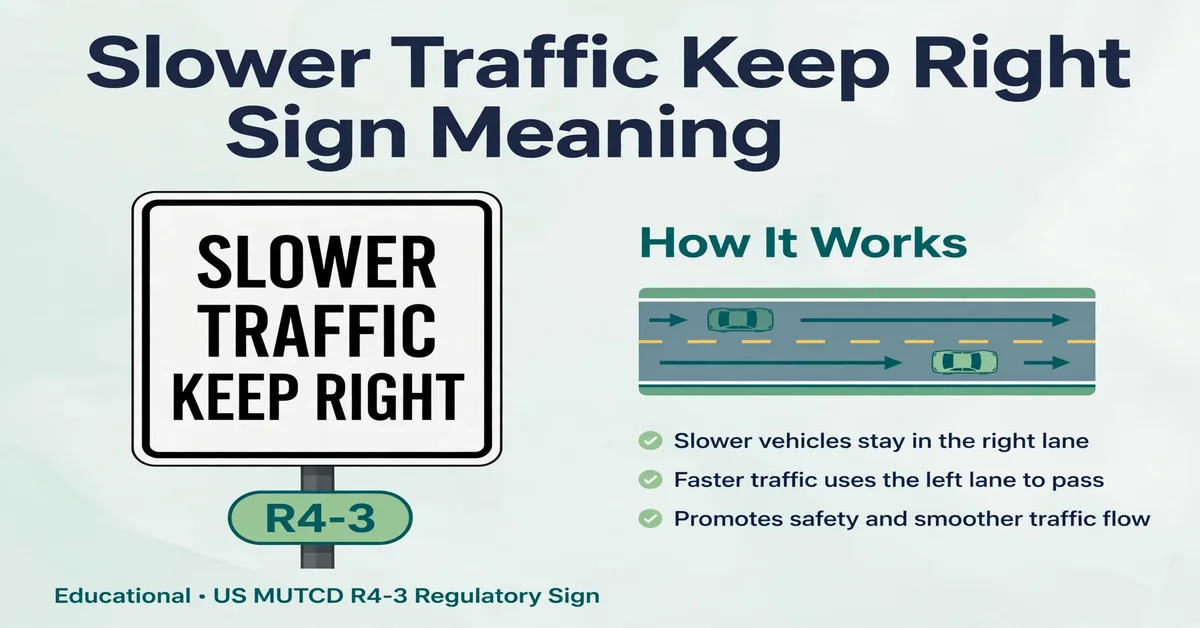
The slower traffic keep right sign meaning is straightforward: drivers traveling more slowly than the normal flow of traffic should use the right-hand lane or lanes on a multilane roadway when appropriate, allowing other vehicles to pass on the left where permitted. The Federal Highway Administration (FHWA) identifies this regulatory sign as R4-3 in the Manual on Uniform Traffic Control Devices (MUTCD).
The sign is a white rectangle with black lettering that reads “SLOWER TRAFFIC KEEP RIGHT.” It helps communicate appropriate lane use and can improve traffic flow on multilane roads. However, the sign’s federal standardization and its legal application in a particular driving situation are separate matters. Drivers must also follow applicable state traffic laws, other signs, pavement markings, and safe-driving requirements.
Whether you’re preparing for a DMV road sign test or reviewing highway driving rules, this guide explains how to recognize the R4-3 sign, what action to take, and how it differs from Keep Right, Keep Right Except to Pass, Trucks Use Right Lane, and minimum-speed signs.
Official reference: FHWA MUTCD, 11th Edition, Chapter 2B.
What to do at a Slower Traffic Keep Right Sign
When you encounter a Slower Traffic Keep Right sign, understand it as guidance for appropriate lane selection. If you’re traveling more slowly than surrounding traffic and a suitable right-hand lane is available, move right when it is safe and consistent with applicable traffic rules.
Before changing lanes:
- Check your mirrors and the traffic around your vehicle.
- Signal your intention before moving.
- Check your blind spot.
- Wait for a safe gap rather than forcing your way into another lane.
- Maintain a safe speed and following distance.
- Follow any additional lane restrictions, signs, or pavement markings.
Never make a sudden lane change just because you have seen the sign. Safe driving requires anticipating traffic and choosing a suitable opportunity to move.
A practical highway example
Imagine you’re traveling on a three-lane interstate. You’re in the left lane, but you’re not passing another vehicle, and traffic is moving more quickly in the lanes around you. If the right lane is available and changing lanes is safe, moving right can allow other drivers to pass without unnecessary disruption.
Now imagine a truck climbing a steep grade. It may travel more slowly than passenger vehicles. Appropriate lane use can help reduce conflicts between vehicles moving at different speeds.
The important principle is to maintain safe, predictable driving behavior. The sign does not instruct you to race faster traffic, exceed the posted speed limit, or make an unsafe maneuver.
Why this sign exists
The FHWA’s MUTCD explains that the R4-3 sign may be used on multilane through roadways to improve traffic capacity or reduce unnecessary lane changes caused by slower vehicles impeding the normal flow of traffic.
When drivers use lanes appropriately, other road users can better anticipate their movements. This can reduce avoidable changes in speed and direction, making traffic flow more predictable.
The sign is part of a broader system of traffic-control devices. It does not replace lane markings, speed limits, passing restrictions, or the driver’s responsibility to respond to actual road conditions.
Read the federal standard in MUTCD Section 2B.38, Slower Traffic Keep Right and Trucks Use Right Lane signs.
Why the left lane matters
On many US highways, drivers use the left lane to pass slower vehicles where permitted. However, the precise rules governing left-lane use vary by state and roadway.
Some roads have left-side exits, managed lanes, reversible lanes, or other arrangements that affect which lane a driver should use. A driver may also need to remain in a particular lane temporarily because of traffic, hazards, construction, or an upcoming maneuver.
Read the entire road environment rather than assuming that the left lane is always reserved exclusively for passing in every situation. Follow posted restrictions and the law applicable to the road you’re using.
Commonly confused with
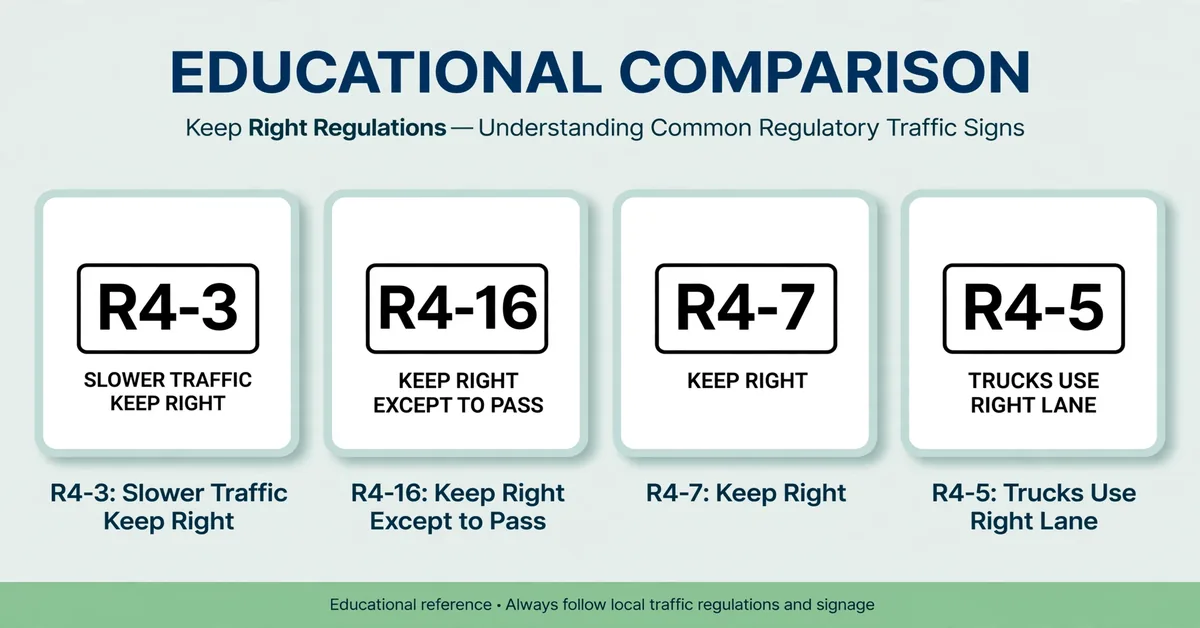
Several US regulatory traffic signs have similar wording or relate to lane selection, but their messages are different. The R4-3 sign concerns slower traffic and lane use. Other signs address passing-lane expectations, the side of an obstruction to pass, or a specific instruction for trucks.
The federal MUTCD identifies these signs separately. Knowing the difference is useful for both safe driving and DMV road sign practice tests.
| Sign | MUTCD designation or category | Main meaning |
|---|---|---|
| Slower Traffic Keep Right | R4-3 | Guides slower traffic toward the right-hand lane or lanes on multilane roadways |
| Keep Right Except to Pass | R4-16 | Directs drivers to keep right except when passing, subject to the applicable roadway rules |
| Keep Right | R4-7 series | Directs traffic to pass to the right of an obstruction or median |
| Trucks Use Right Lane | R4-5 | Directs truck traffic toward the right lane in the applicable roadway arrangement |
| Minimum Speed Limit | Regulatory minimum-speed sign | Specifies a minimum speed where that requirement applies |
Primary reference: FHWA MUTCD, 11th Edition with Revision 1 incorporated. See Sections 2B.38 and 2B.39 for the relevant R4-3 and Keep Right sign provisions. R4-16 is addressed separately in the MUTCD’s passing-lane provisions.
Keep Right
The KEEP RIGHT sign, in the R4-7 series, generally directs drivers to pass to the right of an obstruction, median, or traffic island. It addresses the path vehicles must follow around a physical feature.
For example, a traffic island at an intersection may require vehicles to travel on its right side. A KEEP RIGHT sign communicates that instruction.
The R4-3 sign has a different purpose: it concerns appropriate lane use by slower traffic on a multilane roadway. Do not confuse a direction around an obstruction with a lane-use instruction.
See MUTCD Section 2B.39, Keep Right and related signs.
Keep Right Except to Pass
The KEEP RIGHT EXCEPT TO PASS sign is designated R4-16. Unlike R4-3, which specifically addresses slower traffic, R4-16 communicates a broader keep-right-except-when-passing instruction.
The wording matters:
- R4-3: Slower traffic should use the right-hand lane or lanes when appropriate.
- R4-16: Drivers are instructed to keep right except when passing, subject to applicable rules and roadway conditions.
Do not assume these signs have identical legal effects in every state. The MUTCD standardizes sign designs and their intended use; state laws and the particular roadway determine the applicable legal obligations.
For example, Georgia’s driver’s manual discusses its Keep Right, Except to Pass rules and identifies circumstances in which remaining in a passing lane may be permitted or necessary. That state-specific guidance should not automatically be applied to every other state.
Read the Georgia Department of Driver Services Driver’s Manual for Georgia-specific guidance.
Minimum Speed Limit
A minimum-speed sign addresses the minimum speed that applies on a particular roadway or under the conditions specified by the sign and applicable law. It is different from the R4-3 sign, which communicates lane-use guidance.
A minimum-speed requirement does not mean a driver should ignore congestion, poor weather, hazards, or other conditions affecting safe travel. Drivers should understand any applicable exceptions and follow official state guidance.
For example, a vehicle traveling below a posted minimum may need to use an alternate route if it cannot safely maintain the required speed. The precise legal requirements depend on the applicable jurisdiction and circumstances.
For official sign standards and regulatory-sign classifications, consult the FHWA MUTCD and your state’s current driver’s manual.
Trucks Use Right Lane
The TRUCKS USE RIGHT LANE sign is designated R4-5. It specifically directs truck traffic toward the right lane in the roadway situation where the sign applies.
The R4-3 and R4-5 signs can both be used in relation to slower traffic and multilane roadways, but their messages differ. R4-3 addresses slower traffic generally; R4-5 explicitly identifies trucks.
The FHWA discusses these signs in its regulatory-sign provisions. See the MUTCD, Chapter 2B.
How to recognize this sign
The standard Slower Traffic Keep Right sign is a white, vertically rectangular regulatory sign with black uppercase lettering: SLOWER TRAFFIC KEEP RIGHT. Its MUTCD designation is R4-3.
For accurate visual identification, use the official sign illustration from the FHWA MUTCD or the sign displayed in the Georgia DDS driver’s manual.
When studying this sign for a DMV test, remember the message rather than relying on the sign’s color alone: it guides slower traffic toward the right-hand lane or lanes on a multilane road.
Common mistake
One common mistake is assuming the sign means you must accelerate to match the fastest vehicles around you. It does not. Your lane choice and your permitted speed are separate considerations.
The sign concerns appropriate lane use. The posted speed limit and applicable speed laws determine the maximum permitted speed, while road, weather, visibility, and traffic conditions may require you to travel more slowly.
Another mistake is treating R4-3 as interchangeable with KEEP RIGHT or KEEP RIGHT EXCEPT TO PASS. Those signs communicate different instructions. Identify the exact wording, observe the roadway, and follow the applicable traffic rules.
What if you are already at the speed limit?
Traveling at the posted speed limit does not, by itself, answer every lane-use question. The R4-3 sign concerns lane selection for slower traffic, while speed laws govern how fast you may legally travel.
If you’re in the left lane and a safe move right is appropriate, you should not accelerate above the speed limit merely to prevent another vehicle from passing. A faster driver does not authorize you to exceed the permitted speed.
If traffic, an obstruction, an upcoming left exit, or another condition makes moving right unsafe or inappropriate, maintain control and wait until you can act safely. For the exact legal requirement, consult the current traffic laws and official driver’s manual for your state.
DMV practice question
Question: You’re driving on a multilane highway and see a white rectangular sign reading “SLOWER TRAFFIC KEEP RIGHT.” What is the best interpretation? A. All drivers must immediately move into the far-right lane. B. Drivers traveling more slowly should use the right-hand lane or lanes when appropriate, allowing passing on the left where permitted. C. Drivers should increase their speed until they match the fastest vehicle. D. Drivers must pass every slower vehicle on the right.
Correct answer: B.
Explanation: The R4-3 sign communicates lane-use guidance for slower traffic on a multilane roadway. It does not require an immediate unsafe lane change, authorize speeding, or establish that every right-side pass is legal. Drivers should move right when appropriate and safe, while following the applicable traffic laws, signs, and pavement markings.
For further study, compare the sign with the official R4-3 illustration in the FHWA MUTCD.
Frequently asked questions
What does the Slower Traffic Keep Right sign mean?
It guides slower traffic toward the right-hand lane or lanes on a multilane roadway, allowing other vehicles to pass on the left where permitted. The FHWA designates it as R4-3 in the MUTCD.
What should you do when you see this sign?
Observe traffic around you and use a suitable right-hand lane when appropriate and safe. Signal before changing lanes, check your blind spot, and obey other signs and pavement markings.
Do you have to move right if you are already at the speed limit?
The speed limit alone does not resolve every lane-use question. The sign concerns lane selection, while applicable speed laws determine the permitted speed. Whether a particular lane change is legally required depends on the state, roadway, and circumstances. Never exceed the speed limit simply to accommodate a faster driver.
Is passing on the right illegal?
Passing rules vary by state and roadway situation. Some circumstances permit passing on the right, while others prohibit or restrict it. Follow applicable law, posted signs, and pavement markings. The R4-3 sign does not make every right-side pass legal or illegal.
What is the difference between Keep Right and Slower Traffic Keep Right?
KEEP RIGHT generally directs drivers to pass to the right of an obstruction or median. SLOWER TRAFFIC KEEP RIGHT concerns lane use by slower traffic on a multilane roadway. The MUTCD classifies these as different signs.
What is the difference between R4-3 and R4-16?
R4-3 is SLOWER TRAFFIC KEEP RIGHT. R4-16 is KEEP RIGHT EXCEPT TO PASS. The former focuses on lane use by slower traffic, while the latter communicates a keep-right-except-when-passing instruction. Applicable legal requirements depend on the jurisdiction and roadway.
What does the R4-3 designation mean?
R4-3 is the MUTCD designation for the Slower Traffic Keep Right sign. The federal manual describes its intended use on multilane through roadways.
Is Slower Traffic Keep Right a regulatory sign?
Yes. The MUTCD classifies R4-3 among regulatory signs. The precise legal requirements associated with a sign installation depend on the applicable jurisdiction and circumstances.
What does the Trucks Use Right Lane sign mean?
The R4-5 sign specifically directs truck traffic to use the right lane where the sign applies. It differs from R4-3, which addresses slower traffic generally.
For a quick memory aid, remember that the slower traffic keep right sign meaning concerns appropriate lane selection, not driving faster than the speed limit.
Slower Traffic Keep Right Sign Meaning: Related Resources
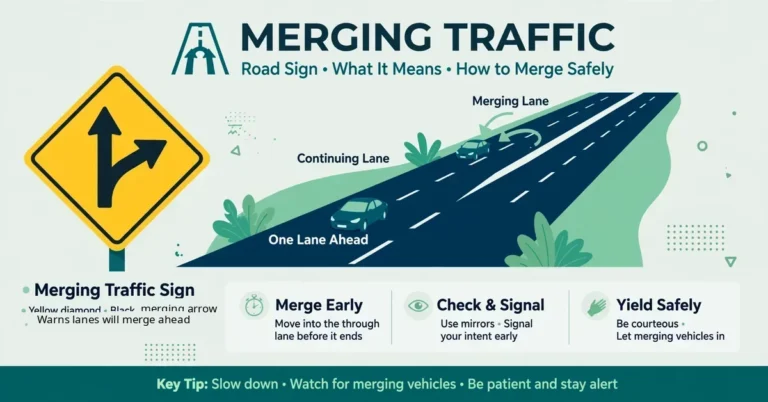
For more on the slower traffic keep right sign meaning and related road sign rules, see the dead end sign meaning guide, the merging traffic sign guide, or the MUTCD from the Federal Highway Administration for official sign standards.

Jack Harrison is a contributor at Square Root Signs, sharing creative ideas, useful information, and engaging content to help readers discover something valuable with every visit.