
Mercury Sign Meaning: What Your Mercury Sign Says About You
Mercury Sign Meaning: A Quick Definition
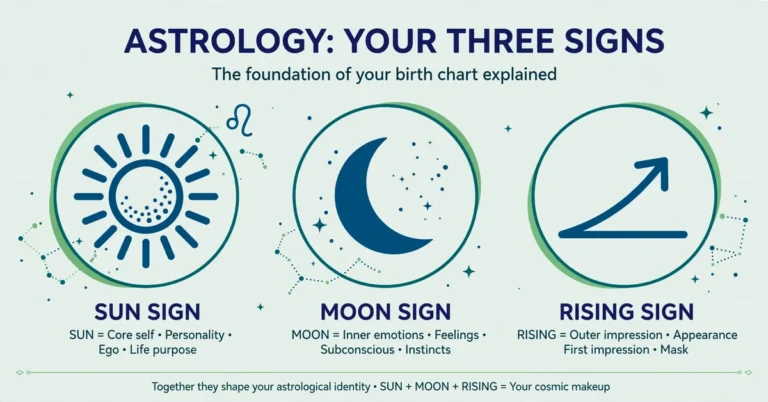
Your Mercury sign is the zodiac sign Mercury occupied when you were born. In Western astrology, it represents your symbolic communication style, thinking patterns, learning preferences, and approach to exchanging information. Your Mercury sign is different from your Sun sign, which is associated with core identity, and your Moon sign, which is associated with emotions and inner needs. To discover your placement, check Mercury in a natal chart calculator or a reliable Mercury sign table for your birth date.
What Does Mercury Represent in Astrology?
Mercury is the planet astrologers associate with communication, reasoning, curiosity, writing, learning, and everyday decisions. Your Mercury placement is traditionally interpreted as a description of how you express ideas, gather information, ask questions, and make sense of conversations.
Imagine two coworkers preparing for the same meeting. One wants a concise agenda and a clear decision; the other prefers brainstorming and exploring possibilities before choosing a direction. Astrology might interpret these differences through Mercury placements. In real life, however, communication also depends on experience, personality, culture, education, and circumstances.
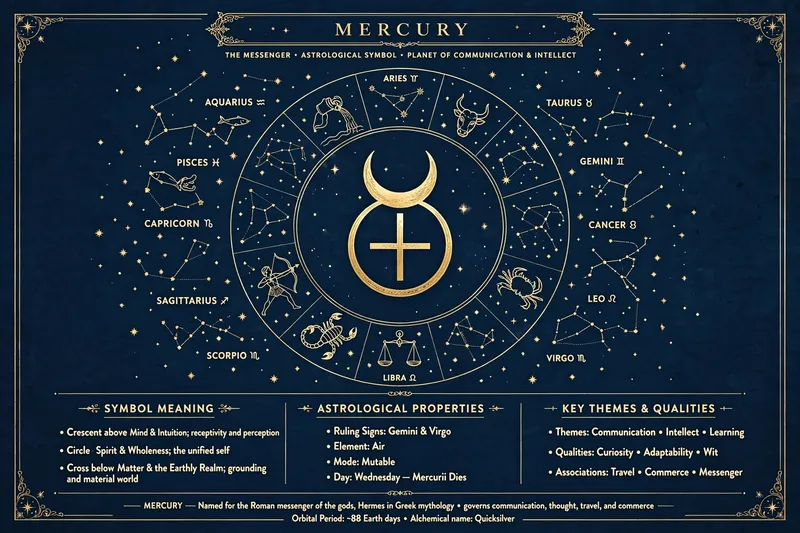
Mercury is traditionally associated with Gemini and Virgo. Gemini emphasizes curiosity, versatility, and the exchange of ideas, while Virgo emphasizes analysis, precision, and practical details. These associations provide the foundation for interpreting Mercury through the twelve zodiac signs.
Astrology is a symbolic interpretive tradition, not a scientifically established method for measuring intelligence or predicting personality. The descriptions in this guide are best used as prompts for reflection rather than fixed labels.
How to Find Your Mercury Sign
You can find your Mercury sign by generating a natal chart or checking a Mercury sign table that matches your birth date and year.
- Gather your full birth date, including the year.
- Find a reputable natal chart calculator, such as Astro.com or Cafe Astrology.
- Enter your birth information as requested.
- Find Mercury in the planetary placements section.
- Read the zodiac sign listed beside Mercury.
Do you need your birth time? Not always. Mercury can remain in one sign for several weeks, so many birth dates have an unambiguous placement. However, if Mercury changed signs on your birthday, your birth time and location may be necessary to determine the correct sign.
If a chart calculator gives conflicting results, verify the time zone, birth location, and whether the tool uses the tropical or sidereal zodiac.
Mercury Sign by Birth Date: How to Look Up Your Placement
There is no single accurate month-and-day table that identifies everyone’s Mercury sign across all birth years. Mercury moves through the zodiac at varying rates, and its retrograde cycles can cause it to re-enter a previous sign.
| What you know | How to find the placement |
| Full birth date and year | Use a Mercury sign table for that specific year or a natal chart calculator. |
| Birth date but no birth time | Check whether Mercury changed signs on that date. |
| Birth date near a sign transition | Use the exact birth time and location when available. |
| Birth date during Mercury retrograde | Check the actual planetary position; do not assume Mercury continued moving into the next sign. |
| An existing natal chart | Locate Mercury’s symbol or planetary listing and read its sign. |
For historical birth dates, Cafe Astrology’s Mercury sign tables provide sign-entry dates and times for many years. Pay attention to the time zone listed on the table and convert it appropriately if necessary.
For the most precise result, a natal chart calculator is generally more convenient than guessing from a Sun-sign date range. Mercury can be in a different sign from the Sun, even though the two placements remain relatively close together in the zodiac.

Mercury in Astrology: Why It Matters in a Birth Chart
Mercury is associated with the exchange and organization of information. Astrologers interpret its sign, house, and aspects together to develop a broader picture of how communication themes appear in a natal chart.
Mercury’s astronomical position
Mercury is the closest planet to the Sun and completes one orbit in approximately 88 Earth days. As viewed from Earth, it never appears very far from the Sun. This is why Mercury’s zodiac sign is usually the same as, or one of the neighboring signs to, a person’s Sun sign.
Mercury’s traditional rulership
In Western astrology, Mercury rules Gemini and Virgo. Gemini is traditionally connected with communication, variety, and curiosity. Virgo is associated with analysis, organization, and attention to detail. Different astrological traditions may interpret planetary rulership differently.
Mercury and everyday communication
Mercury symbolism can be applied to practical questions: Do you prefer to think aloud or write your thoughts first? Do you focus on the big picture or individual details? Do you enjoy debating ideas, or do you need time to process them?
These questions can make an astrological reading more useful because they invite you to examine actual behavior rather than simply accept a personality description.
Mercury in Each Zodiac Sign: Meaning, Strengths, and Challenges
The sign of Mercury describes a particular communication style within Western astrological interpretation. Each sign also belongs to an element and modality, which add context to its traditional symbolism.
| Mercury sign | Element | Modality | Traditional communication theme |
| Aries | Fire | Cardinal | Direct, decisive, spontaneous |
| Taurus | Earth | Fixed | Steady, practical, deliberate |
| Gemini | Air | Mutable | Curious, adaptable, conversational |
| Cancer | Water | Cardinal | Emotionally aware, reflective |
| Leo | Fire | Fixed | Expressive, confident, creative |
| Virgo | Earth | Mutable | Analytical, precise, organized |
| Libra | Air | Cardinal | Diplomatic, balanced, collaborative |
| Scorpio | Water | Fixed | Investigative, focused, private |
| Sagittarius | Fire | Mutable | Big-picture, enthusiastic, philosophical |
| Capricorn | Earth | Cardinal | Structured, strategic, purposeful |
| Aquarius | Air | Fixed | Independent, conceptual, unconventional |
| Pisces | Water | Mutable | Imaginative, intuitive, symbolic |
Mercury in Aries
Mercury in Aries is associated with quick decisions, direct speech, and an energetic approach to ideas. This placement is often interpreted as preferring a clear answer over a long discussion. In conversation, its symbolic style is candid and action-oriented: “Let’s try it and see what happens.”
The strength of this approach is momentum. It can help people express a position without unnecessary hesitation. The potential blind spot is responding before all the facts are available or mistaking disagreement for opposition. A useful practice is to pause, ask one clarifying question, and check whether the other person has finished explaining their point.
Mercury in Taurus
Mercury in Taurus symbolizes steady thinking, practical language, and a preference for information that can be applied in the real world. Rather than changing opinions with every new idea, this placement is traditionally associated with taking time to evaluate information and reach a considered conclusion.
Its strength is consistency. In conversation, it may sound like: “Show me how this will work, and then I’ll decide.” The challenge is becoming too attached to a familiar method or resisting evidence that calls for a change. Listening to new perspectives without feeling pressured to accept them immediately can preserve both stability and flexibility.
Mercury in Gemini
Mercury in Gemini is associated with curiosity, verbal agility, quick connections, and enjoyment of conversation. Because Mercury traditionally rules Gemini, astrologers often emphasize information exchange, questioning, and versatility in this placement.
Its strength is exploring several ideas and explaining them in accessible language. It may sound like: “That’s interesting,what if we looked at it another way?” The potential challenge is spreading attention across too many subjects or moving on before a discussion reaches depth. Keeping notes, asking follow-up questions, and returning to unfinished ideas can help turn curiosity into lasting understanding.
Mercury in Cancer
Mercury in Cancer is associated with memory, emotional context, sensitivity, and reflective communication. This placement is traditionally interpreted as paying attention not only to what someone says but also to how the conversation feels and what the words mean within a relationship.
Its strength is recognizing personal context and remembering meaningful details. It may sound like: “I remember how that affected you last time.” The challenge is taking criticism personally or assuming that a feeling proves an interpretation is correct. Separating the emotional impact of a message from its factual content can make sensitive conversations clearer and more constructive.
Mercury in Leo
Mercury in Leo is associated with expressive speech, creative storytelling, confident opinions, and a desire to make ideas memorable. Astrologers often interpret this placement as preferring communication with warmth, personality, and a clear point of view.
Its strength is presenting an idea in a way that captures attention. It may sound like: “Let me show you why this matters.” The challenge is dominating a conversation or becoming defensive when an audience disagrees. Making room for questions and acknowledging other people’s contributions can help expressive communication become a two-way exchange rather than a performance.
Mercury in Virgo
Mercury in Virgo is associated with analysis, precision, organization, and close attention to detail. Because Mercury traditionally rules Virgo, this placement is often interpreted as valuing accurate language, clear processes, useful feedback, and practical solutions.
Its strength is noticing errors and improving systems. It may sound like: “Let’s check the details before we finalize this.” The potential challenge is overthinking, excessive self-editing, or focusing on small imperfections at the expense of the main goal. Setting a reasonable standard for completion can make analytical thinking more productive without sacrificing accuracy.
Mercury in Libra
Mercury in Libra symbolizes diplomacy, fairness, balanced reasoning, and an interest in understanding different perspectives. This placement is traditionally associated with careful wording and an effort to keep discussions constructive, particularly when opinions differ.
Its strength is finding common ground and helping people articulate competing viewpoints. It may sound like: “Let’s consider both options before deciding.” The challenge is delaying a decision because every alternative deserves consideration. A practical approach is to identify the most important criteria, listen to the relevant views, and set a clear deadline for making a choice.
Mercury in Scorpio
Mercury in Scorpio is associated with investigation, concentration, privacy, and a desire to understand what lies beneath a surface explanation. Astrologers may interpret this placement as preferring substantial conversations over small talk and examining a subject until it makes sense.
Its strength is persistence and a willingness to ask difficult questions. It may sound like: “What evidence supports that conclusion?” The challenge is becoming suspicious without sufficient evidence or assuming that an unclear statement must conceal something. Direct questions and a willingness to revise an interpretation help turn investigative thinking into genuine insight.
Mercury in Sagittarius
Mercury in Sagittarius is traditionally associated with broad perspectives, philosophical questions, enthusiasm, and interest in how individual facts fit into a larger picture. This placement is often interpreted as enjoying discussion about beliefs, cultures, possibilities, and future plans.
Its strength is connecting ideas and communicating with optimism. It may sound like: “How does this change the bigger picture?” The challenge is overlooking details or expressing an opinion more confidently than the evidence supports. Checking facts and listening to alternative viewpoints can make big-picture thinking both inspiring and reliable.
Mercury in Capricorn
Mercury in Capricorn is associated with structure, discipline, strategic thinking, and purposeful communication. Astrological interpretations often describe this placement as preferring clear objectives, realistic plans, and conversations that lead toward a decision or measurable outcome.
Its strength is organizing ideas into practical steps. It may sound like: “What’s the plan, and what needs to happen first?” The challenge is dismissing an idea too quickly because it seems impractical or treating every conversation like a task to complete. Allowing room for experimentation and informal discussion can reveal useful possibilities that a strict plan might miss.
Mercury in Aquarius
Mercury in Aquarius is associated with independent thinking, original concepts, systems, and unconventional perspectives. This placement is traditionally interpreted as being interested in new approaches, social questions, technology, or ideas that challenge familiar assumptions.
Its strength is seeing alternative solutions and questioning established methods. It may sound like: “What if we redesigned the whole process?” The challenge is becoming so focused on an abstract idea that its practical implications are overlooked. Explaining concepts in concrete language and considering how others will experience a proposed change can make innovative thinking easier to apply.
Mercury in Pisces
Mercury in Pisces is associated with imagination, symbolism, emotional sensitivity, and creative expression. Astrologers often interpret this placement as favoring stories, metaphors, music, images, or intuitive associations over strictly linear explanations.
Its strength is finding meaning and expressing subtle experiences. It may sound like: “I can’t quite explain it yet, but something about this feels important.” The challenge is confusing an impression with a confirmed fact or leaving important details unstated. Writing down practical steps, checking assumptions, and asking for clarification can help translate imaginative ideas into clear communication.
Mercury in the 12 Houses: Where Communication Themes Appear
In a natal chart, the house containing Mercury is traditionally interpreted as the area of life where communication, information, and mental activity may receive particular attention. House meanings are symbolic, and the exact house placement depends on the chart calculation.
| Mercury house | Traditional interpretation |
| First house | Communication is visible in self-presentation, identity, and everyday interaction. |
| Second house | Thought may focus on resources, values, possessions, and practical security. |
| Third house | Learning, writing, conversation, local environment, and everyday information are emphasized. |
| Fourth house | Family stories, private reflection, roots, and the home environment may be important themes. |
| Fifth house | Creative expression, storytelling, hobbies, and playful communication receive emphasis. |
| Sixth house | Work routines, practical problem-solving, organization, and everyday systems become key themes. |
| Seventh house | Dialogue, negotiation, partnerships, and understanding another person’s viewpoint are highlighted. |
| Eighth house | Research, confidential matters, shared resources, and deeper psychological questions may attract attention. |
| Ninth house | Philosophy, higher education, travel, belief systems, and big-picture learning are emphasized. |
| Tenth house | Career communication, public reputation, professional planning, and visible expertise become themes. |
| Eleventh house | Friendships, communities, collective goals, and exchanging ideas with groups are highlighted. |
| Twelfth house | Private reflection, imagination, solitude, and less visible thought processes receive emphasis. |
To interpret Mercury in a house, combine the house theme with the Mercury sign. For example, Mercury in Gemini in the tenth house combines Gemini’s traditional association with information exchange and adaptability with the tenth house’s career and public-life themes.
For further reading, see Mercury in the Houses.
Mercury Aspects: How Mercury Connects With Other Planets
An aspect is an angular relationship between two planetary placements in a birth chart. Astrologers interpret aspects involving Mercury as additional context for communication, reasoning, and the exchange of information.
| Aspect | Traditional symbolic theme |
| Mercury–Sun | Relationship between conscious identity and communication style |
| Mercury–Moon | Interaction between thought, memory, and emotional responses |
| Mercury–Venus | Diplomacy, aesthetic expression, and relationship-oriented communication |
| Mercury–Mars | Assertiveness, debate, quick responses, and verbal drive |
| Mercury–Jupiter | Big-picture thinking, beliefs, teaching, and broad ideas |
| Mercury–Saturn | Structure, careful reasoning, discipline, and cautious expression |
| Mercury–Uranus | Original thinking, unconventional ideas, and sudden insights |
| Mercury–Neptune | Imagination, symbolism, intuition, and ambiguity |
| Mercury–Pluto | Research, concentration, probing questions, and psychological themes |
In astrology, conjunctions, trines, and sextiles are often described differently from squares and oppositions. These labels represent interpretive conventions rather than scientifically validated effects.
A full chart reading considers the planets involved, the aspect, the signs, and the houses instead of assuming that one aspect determines someone’s communication style.
Mercury Compatibility: How Two Communication Styles Interact
Mercury compatibility in astrology compares two people’s Mercury placements to explore how they exchange ideas, handle disagreement, and understand each other. It is one possible lens for discussing communication, not a reliable test of relationship success.
| Combination | Possible communication dynamic |
| Fire and air signs | Enthusiasm, brainstorming, and rapid idea exchange |
| Earth and water signs | Practical concerns, personal context, and careful reflection |
| Two fixed signs | Consistency and persistence, with potential difficulty changing positions |
| Two mutable signs | Flexibility and variety, with possible difficulty maintaining a decision |
| Two cardinal signs | Initiative and directness, with potential competition over direction |
These are broad elemental and modality patterns, not rules for every pairing. Two people with different Mercury signs can communicate effectively through listening, clear questions, respect, and a willingness to clarify misunderstandings.
For a more complete astrological comparison, astrologers may examine Mercury aspects between both charts, along with Venus, Mars, the Moon, and other relevant placements. No combination guarantees compatibility or incompatibility.
Mercury Retrograde vs. Your Natal Mercury Sign
Your natal Mercury sign identifies Mercury’s zodiac position at your birth. Mercury retrograde describes an apparent backward movement of Mercury against the background stars as seen from Earth. These are different concepts.
In astrology, Mercury retrograde periods are traditionally associated with reviewing plans, revisiting conversations, and reconsidering information. This symbolism does not mean that every communication problem during a retrograde period is caused by a planet, nor does it establish that retrograde motion causes technological failures or misunderstandings.
If you were born during Mercury retrograde, your birth chart may show Mercury marked as retrograde. Astrologers interpret this in different ways, sometimes associating it with reflective or inward processing. It does not mean that you are less intelligent or unable to communicate well.
For current or future retrograde dates, check a year-specific ephemeris rather than relying on a timeless list. See our related guide: Mercury Retrograde Meaning.
A Practical Mercury Sign Reflection Exercise
Instead of using a sign description as a fixed label, use it to examine how you communicate in real situations.
- Identify your Mercury sign. Confirm it using a natal chart calculator.
- Read the traditional description. Note two themes that seem relevant and one that does not fit.
- Recall a real conversation. Think of a recent meeting, disagreement, or important message.
- Identify your actual behavior. Did you interrupt, ask questions, avoid a difficult point, or need time to think?
- Choose one improvement. You might pause before replying, summarize what you heard, or ask someone to clarify their meaning.
- Review the result. Notice whether the change improves communication, regardless of whether you identify with the astrological interpretation.
This exercise turns astrology into a prompt for self-reflection rather than a substitute for evidence about your own habits.
Frequently Asked Questions About Mercury Sign Meaning
What does my Mercury sign mean?
Your Mercury sign is the zodiac sign Mercury occupied when you were born. In astrology, it symbolizes your communication style, thought processes, learning preferences, and approach to exchanging ideas.
How do I find my Mercury sign by birth date?
Use a natal chart calculator or a Mercury sign table for your exact birth year. If Mercury changed signs on your birthday, your birth time and location may be needed to identify the correct placement.
Is my Mercury sign the same as my Sun sign?
Not necessarily. Mercury remains relatively close to the Sun in the sky, so its zodiac sign is usually the same as your Sun sign or one of the neighboring signs. Each placement has a different symbolic interpretation in astrology.
Which signs does Mercury rule?
In traditional Western astrology, Mercury rules Gemini and Virgo. Gemini is associated with curiosity and information exchange, while Virgo is associated with analysis, organization, and attention to detail.
What does Mercury in the third house mean?
Mercury in the third house is traditionally associated with everyday communication, learning, writing, local environments, and information exchange. Astrologers interpret it alongside the Mercury sign and other chart factors.
Does Mercury sign affect relationships?
Astrology uses Mercury placements to explore conversational styles and potential differences in how people communicate. However, Mercury signs are not scientifically validated predictors of relationship outcomes. Listening, empathy, and clear communication remain important regardless of astrology.
Is Mercury retrograde the same as having Mercury retrograde in your birth chart?
No. A current Mercury retrograde is an astronomical period when Mercury appears to move backward from Earth’s perspective. Natal Mercury retrograde means Mercury appeared retrograde at the time of your birth, according to the chart calculation.
Is Mercury sign meaning scientifically proven?
No. Astrology is a cultural and symbolic interpretive system, not an established scientific method for measuring personality, intelligence, or communication ability. Readers can explore its symbolism without treating it as scientific evidence.
Conclusion: Understanding Your Mercury Sign Meaning
Your Mercury sign meaning offers an astrological framework for exploring how you express ideas, process information, and approach conversations. From direct Mercury in Aries to imaginative Mercury in Pisces, each placement has its own traditional symbolism, strengths, and possible challenges.
For the most useful interpretation, look beyond the sign alone. Consider the Mercury house, planetary aspects, your lived experience, and the context of the conversation. Use the symbolism as a starting point for curiosity,not as a fixed judgment about yourself or anyone else.

Jack Harrison is a contributor at Square Root Signs, sharing creative ideas, useful information, and engaging content to help readers discover something valuable with every visit.