Sun, Moon, and Rising Signs: Find Your Big Three
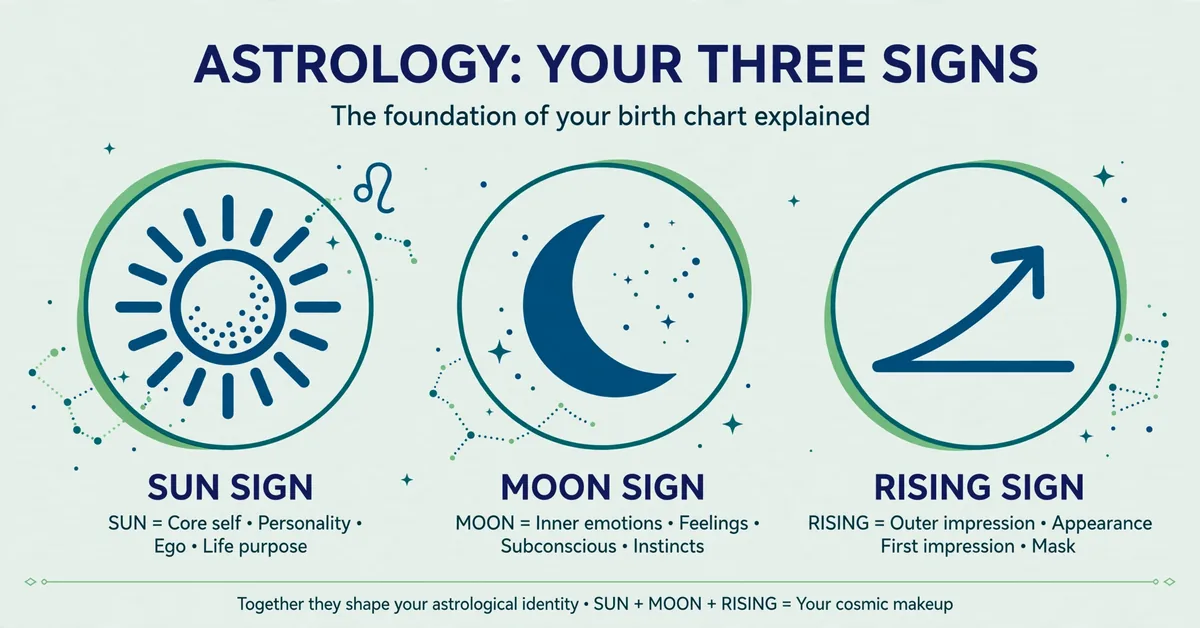
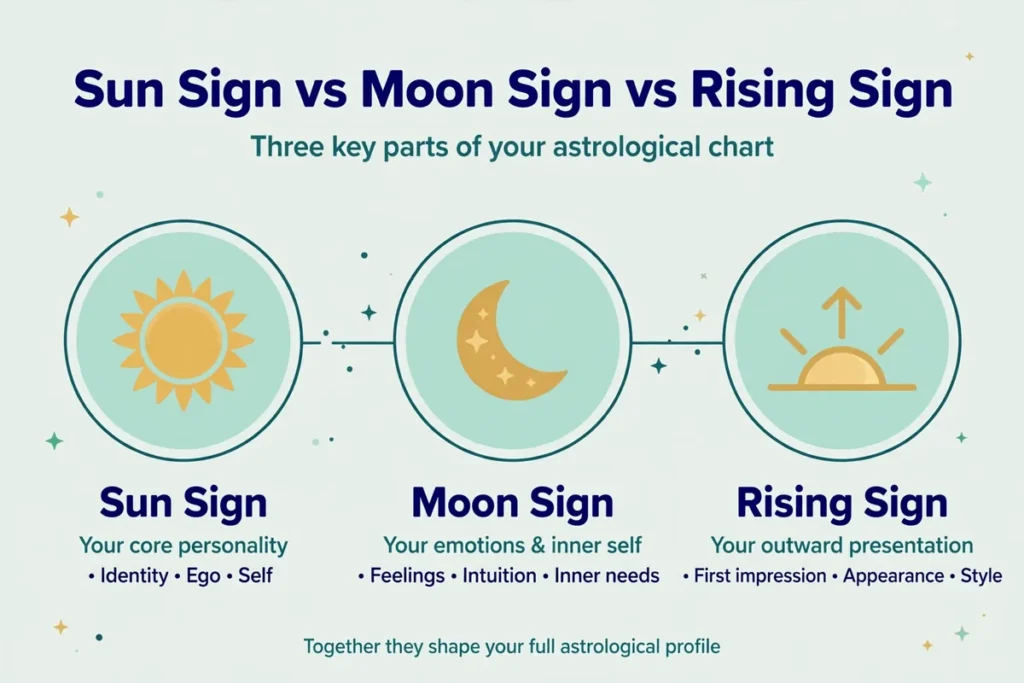
Your sun, moon and rising signs are known as the Big Three in modern Western astrology. The Sun sign is traditionally associated with identity, the Moon sign with emotions and instinctive needs, and the Rising sign with outward expression and the way you approach new situations.
To find your Big Three, you generally need your birth date, birth time, and birthplace. A natal chart calculator uses these details to determine the zodiac positions at your birth. Your birth time is especially important for the Rising sign and may also be necessary to confirm your Moon sign.
This guide explains what each placement means in astrological tradition, how to find your three signs, how they differ, and what to do if your birth time is unknown. It also explains why two people with the same Sun sign can have different birth charts.
Astrology is a cultural and interpretive tradition, not a scientifically established method for measuring personality or predicting behavior. You can use these interpretations for personal reflection while recognizing that no single zodiac placement defines who you are.
Quick Reference: Sun, Moon, and Rising Signs
The easiest way to understand the Big Three is to look at the three placements separately.
| Placement | Traditional astrological meaning | Information needed |
|---|---|---|
| Sun sign | Identity, purpose, and conscious self-expression | Birth date; exact time may matter near a sign transition |
| Moon sign | Emotions, instinctive reactions, and comfort | Birth date and sometimes birth time |
| Rising sign | Outward manner, first impressions, and chart orientation | Accurate birth time and birthplace |
| Big Three | A combined interpretation of the three placements | Full birth details for the most reliable calculation |
These meanings describe how astrologers traditionally interpret a natal chart. They are not scientifically validated personality categories.
Your Sun sign is only one part of your chart. Two people born under the same Sun sign can have different Moon signs, Rising signs, planetary placements, and aspects. These differences provide astrologers with additional material for interpreting a chart.
Table of Contents
- What Are Sun, Moon, and Rising Signs?
- What Does Your Sun Sign Mean?
- What Does Your Moon Sign Mean?
- What Does Your Rising Sign Mean?
- How to Find Your Big Three
- Can You Find Your Signs Without a Birth Time?
- How to Interpret Your Big Three Together
- Frequently Asked Questions
What Are Sun, Moon, and Rising Signs?
In Western astrology, the Sun, Moon, and Ascendant represent three different elements of a natal chart. The Sun is associated with identity, the Moon with emotional patterns, and the Ascendant with outward expression and the orientation of the chart.
The Sun and Moon are celestial bodies whose positions can be calculated for a particular date and time. The Ascendant is an angle determined by the eastern horizon at the birth moment and location.
Astrological interpretations assign symbolic meanings to these positions. For example, an astrologer might describe a person as confident in public but more private when processing emotions. The Sun, Moon, and Rising placements may be used to explore those different aspects within an astrological reading.
What Is the Difference Between a Sun Sign, Moon Sign, and Rising Sign?
The main difference is what each placement represents within astrological interpretation.
- Sun sign: The zodiac sign occupied by the Sun at birth. It is commonly associated with identity, motivation, and conscious self-expression.
- Moon sign: The zodiac sign occupied by the Moon at birth. It is traditionally associated with emotional responses, habits, and comfort.
- Rising sign: The zodiac sign on the eastern horizon at birth. It is associated with first impressions, outward manner, and the organization of the natal chart.
The Rising sign is also called the Ascendant, often abbreviated as ASC. These two terms refer to the same chart factor in Western astrology.
What Does Your Sun Sign Mean?
Your Sun sign is the zodiac sign occupied by the Sun at the moment of your birth. It is the placement most commonly used in newspaper horoscopes, birthday-based zodiac guides, and popular astrology.
In Western tropical astrology, the zodiac is divided into 12 equal signs along the ecliptic, beginning at the vernal equinox. This system differs from the sidereal zodiac used in some other astrological traditions.
Astrologers traditionally associate the Sun with identity, purpose, vitality, confidence, and conscious self-expression. The placement is often interpreted as a symbolic representation of the qualities a person develops or identifies with.
For example, an astrologer might describe an Aries Sun as direct and action-oriented, while a Taurus Sun might be associated with persistence and a preference for stability. These are conventional astrological interpretations, not established facts about everyone born under those signs.
Can You Find Your Sun Sign From Your Birthday?
Usually, yes. Most people can identify their Sun sign using their birth date and a standard zodiac date guide.
However, the Sun does not enter a new sign at the same clock time every year. If you were born close to a sign boundary, your birth year, exact time, time zone, and chosen zodiac system may affect the result.
If your birthday falls near a transition, use a natal chart calculator rather than relying on a date range alone.
What Does Your Moon Sign Mean?
Your Moon sign is the zodiac sign occupied by the Moon at your birth moment. In astrology, it is traditionally associated with emotional needs, instinctive reactions, habits, and the conditions in which a person feels comfortable.
Some people find their Moon-sign descriptions more relatable than their Sun-sign descriptions because the interpretations focus on private feelings rather than public identity. That personal connection does not establish that astrology scientifically explains emotions or personality.
The Moon moves relatively quickly through the zodiac, typically spending around two to two and a half days in a sign, although the duration varies. As a result, two people born on the same calendar date can have different Moon signs if the Moon changed signs between their birth times.
Why Your Birth Time Can Matter for Your Moon Sign
Your birth date may be enough to identify your Moon sign if the Moon remained in the same sign throughout the relevant period. If it crossed into another sign that day, the exact birth time can determine which placement applies.
For example, imagine the Moon enters a new zodiac sign during the afternoon. Someone born that morning may have the previous Moon sign, while someone born that evening may have the next one. The actual transition time depends on the date and the calculation system.
If a calculator gives you an uncertain result, check the Moon’s position for your birth date and time using a reliable ephemeris or natal chart calculator. A dedicated moon sign calculator can make this check easier.
What Does Your Rising Sign Mean?
Your Rising sign, also known as the Ascendant, is the zodiac sign rising on the eastern horizon at the moment and location of your birth.
Unlike the Sun sign, the Ascendant depends strongly on the time of day and geographical location. The rising sign changes as Earth rotates, crossing into a different zodiac sign approximately every two hours on average. The timing varies, however, and it is not a fixed rule for every location or sign.
In Western astrology, the Ascendant is important because it establishes the first house in many common house systems and helps orient the remaining houses. Astrologers also associate it with first impressions, outward manner, and the way a person approaches unfamiliar situations.
For example, an astrologer might interpret a Capricorn Sun with Leo Rising as a combination of a goal-focused identity and a more expressive outward style. This is a symbolic interpretation rather than a guaranteed description of how that person behaves.
Why an Accurate Birth Time Matters
Even a relatively small birth-time error can affect the calculated Ascendant, particularly if the birth occurred close to a sign transition. The accuracy of house placements may also be affected.
A useful calculator should account for the correct birthplace, historical local time, time-zone rules, and daylight-saving changes where applicable. Selecting the correct city is important because two locations with similar names may have different geographical coordinates.
If your recorded birth time is approximate, treat the Rising sign as provisional until you can verify the information.
How to Find Your Big Three
To calculate your Sun, Moon, and Rising signs, gather your birth date, local birth time, and birthplace. Enter these details into a natal chart calculator that supports the zodiac system you want to use.
Step 1: Enter Your Birth Date
Provide your complete date of birth, including the year. The year matters because planetary positions and the timing of zodiac transitions vary.
Step 2: Enter Your Birth Time
Use the time recorded on your birth certificate or another reliable birth record when available. Check whether the record gives local time and whether the time is exact or approximate.
If you do not know your birth time, do not invent one simply to complete the form. A default time can produce a chart, but it cannot confirm a time-sensitive placement such as the Ascendant.
Step 3: Select Your Birthplace
Enter the city and region where you were born. Select the correct location from the calculator’s suggestions.
The birthplace helps the calculator determine the local astronomical horizon and the appropriate time-zone conversion. The location is especially important for the Ascendant and house placements.
Step 4: Generate Your Natal Chart
Submit the details and look for these labels:
- Sun: Your Sun sign.
- Moon: Your Moon sign.
- ASC or Ascendant: Your Rising sign.
Check whether the calculator uses tropical or sidereal astrology. The systems can produce different zodiac sign placements, so make sure you understand which one the results represent. If you follow the sidereal tradition, a Vedic moon sign calculator can help clarify your Moon placement.
Step 5: Confirm Any Uncertain Placements
If your birth time is missing or approximate, check whether the Moon changed signs during your birth date and whether the Ascendant could have crossed a sign boundary during the possible birth-time range.
Do not treat an estimated Rising sign as confirmed. If the calculator does not explain its assumptions, consult a second reputable calculator or a suitable ephemeris.
Can You Find Your Signs Without a Birth Time?
You can often determine your Sun sign without an exact birth time, unless you were born close to a sign transition. Your Moon sign may also be identifiable without the time if the Moon stayed in the same zodiac sign throughout the relevant period.
The Rising sign is more difficult. Because it depends on the local horizon at a particular moment, a reliable Ascendant generally cannot be established without a sufficiently accurate birth time.
| Birth information available | What you can usually determine |
|---|---|
| Birth date only | Usually the Sun sign; the Moon sign may remain uncertain |
| Birth date and approximate time | Potentially all three, depending on the uncertainty and any sign transitions |
| Birth date, accurate time, and birthplace | The most reliable basis for calculating the Big Three |
| Birth date and birthplace, but no time | Often the Sun sign and possibly the Moon sign; Rising sign remains unconfirmed |
If you do not know your birth time, consider checking your birth certificate, hospital records, or other official records where available. A family member may also remember the time.
Some astrologers offer birth-time rectification, an interpretive attempt to estimate a birth time from life events. This method should not be confused with verifying an official record or establishing an objectively confirmed Ascendant.
How to Interpret Your Big Three Together
After finding your placements, you can explore how astrologers traditionally combine their meanings. Instead of treating one sign as a complete personality description, consider the three placements as different symbolic perspectives.
1. Start With Your Sun Sign
Consider the qualities astrologers associate with your Sun sign, such as identity, motivation, and conscious goals. Think about whether the description gives you a useful way to reflect on your priorities.
Do not assume that every characteristic associated with a sign must apply to you. Astrological descriptions are broad interpretations rather than individual psychological assessments.
2. Explore Your Moon Sign
Next, consider the themes traditionally linked to your Moon sign, including emotional comfort, habitual responses, and private needs.
You might reflect on how you respond to change, what helps you feel secure, or how you prefer to process difficult experiences. These questions can be useful for self-reflection regardless of whether you accept astrological explanations.
3. Consider Your Rising Sign
Your Rising sign is interpreted as the outward-facing part of the Big Three. Astrologers may use it to discuss first impressions, social presentation, and the way someone approaches new environments.
Compare this interpretation with how you experience yourself in different settings. Remember that behavior is shaped by many factors, including personal history, culture, circumstances, and individual choices.
4. Read the Three Placements as a Combination
Consider a hypothetical person with a Capricorn Sun, Pisces Moon, and Leo Rising.
An astrologer might interpret the Capricorn Sun as goal-oriented, the Pisces Moon as sensitive or imaginative, and the Leo Rising as expressive. Together, these placements could form a symbolic narrative about ambition, emotional sensitivity, and outward confidence.
This example illustrates how the Big Three are combined; it does not predict that everyone with these placements will have the same traits.
For a deeper chart reading, astrologers may also examine Mercury, Venus, Mars, planetary aspects, and house placements. These factors add interpretive detail, but they do not turn astrology into a scientifically validated personality test.
Frequently Asked Questions About Sun, Moon, and Rising Signs
What are my Sun, Moon, and Rising signs?
Your Sun sign is associated with identity, your Moon sign with emotional needs, and your Rising sign with outward expression in Western astrology. To calculate all three reliably, use your birth date, birth time, and birthplace.
Can I find my Moon and Rising signs without my birth time?
You may be able to determine your Moon sign if the Moon remained in the same zodiac sign throughout your birth date. If it changed signs that day, your birth time may be necessary. Your Rising sign generally requires an accurate birth time and birthplace.
Is the Rising sign the same as the Ascendant?
Yes. In Western astrology, the Rising sign and Ascendant refer to the same placement: the zodiac sign on the eastern horizon at the moment of birth.
Which is more important: the Sun, Moon, or Rising sign?
There is no universally accepted ranking. Many modern Western astrologers interpret the three together because each has a different traditional role in a natal chart. The emphasis may vary according to the astrologer’s tradition and approach. For a closer comparison of the two, see our guide to Sun vs Moon signs.
Why do I relate more to my Moon or Rising sign than my Sun sign?
You may find one description more relatable because the three placements focus on different symbolic themes. Astrologers associate the Sun with identity, the Moon with emotions, and the Rising sign with outward expression. Relating to a description does not prove that astrology scientifically explains your personality.
Can two people have the same Sun, Moon, and Rising signs?
Yes. Two people can share the same three zodiac signs while having different planetary degrees, house placements, aspects, and other chart factors. Even people with similar charts can have different experiences and personalities.
Does your Rising sign change as you get older?
Your natal Rising sign does not change with age because it is calculated from your birth moment and location. Astrologers may interpret its symbolism differently as a person develops, but the original Ascendant remains the same.
What if my birth certificate does not show a birth time?
Check whether an official birth record is available or ask a family member who may remember the time. If the time remains unknown, you can still explore placements that can be determined reliably, but you should not treat an estimated Ascendant as confirmed.
Can my Sun sign change depending on the astrology system?
Yes. Western tropical astrology and sidereal astrology use different zodiac reference systems, so a person’s Sun sign may differ between them. If you compare calculators, check which zodiac system each one uses.
Is astrology scientifically proven?
Astrology is a long-standing cultural and interpretive tradition, but its personality interpretations and predictive claims are not established as scientifically reliable methods. You can explore your Big Three as a form of reflection or cultural interest without treating the placements as definitive facts about yourself.
Final Thoughts: Understanding Your Sun, Moon, and Rising Signs
Your Sun, Moon, and Rising signs offer three traditional starting points for exploring a Western astrology birth chart. The Sun is associated with identity, the Moon with emotional needs, and the Ascendant with outward expression and chart orientation.
To find your Big Three, begin with accurate birth details and use a calculator that accounts for the correct time and location. If you do not know your birth time, confirm what you can and leave uncertain placements unresolved rather than relying on a guess.
Once you know your placements, you can explore how astrologers interpret them together, then learn about other chart factors if you want a more detailed reading. The most useful approach is to remain curious, recognize the limits of astrological claims, and remember that your experiences and choices cannot be reduced to three zodiac signs.

Jack Harrison is a contributor at Square Root Signs, sharing creative ideas, useful information, and engaging content to help readers discover something valuable with every visit.