Uranus Sign Meaning: Find Yours by Birth Year (All 12 Signs)
Last updated: November 5, 2026
Your Uranus sign reveals how astrology interprets your generation’s relationship with freedom, innovation, rebellion, and change. Unlike your Sun sign, which represents your core identity in astrology, Uranus is associated with broader generational themes. Its zodiac placement offers another perspective on your birth chart, especially when interpreted alongside your Moon sign, rising sign, planetary houses, and aspects.
If you want to discover your Uranus sign without getting lost in complicated astrology terminology, this guide provides approximate birth-year ranges, explains all 12 Uranus signs, and shows how to find your exact placement. These interpretations reflect modern Western astrology, a symbolic tradition rather than a scientifically established method of predicting personality or future events.
What Is a Uranus Sign?
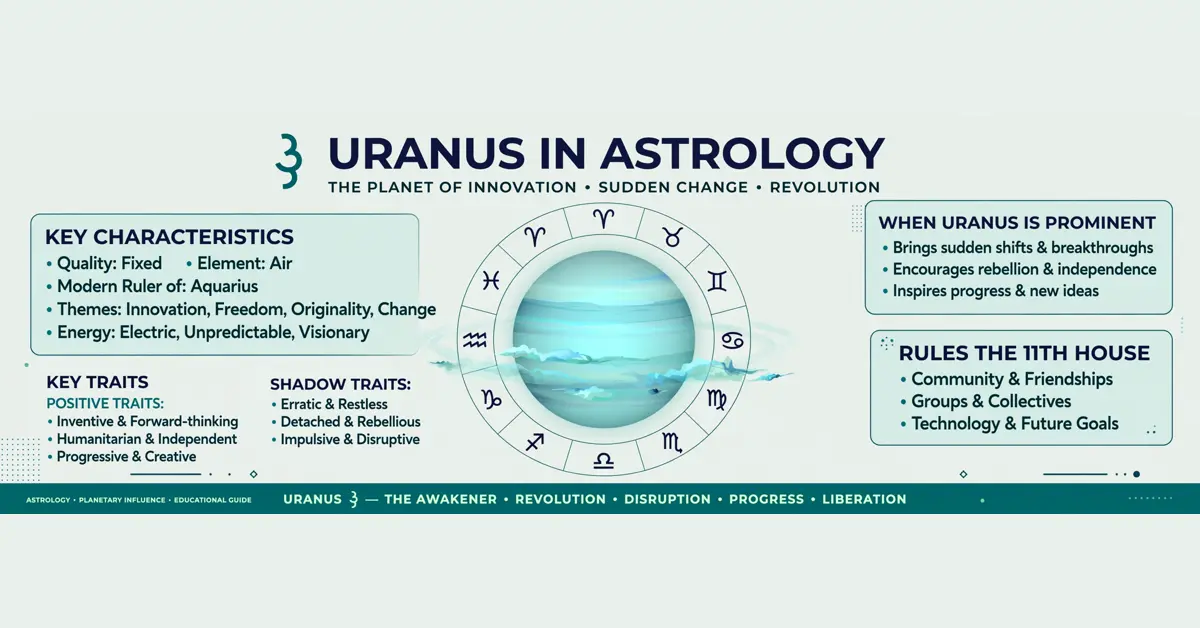
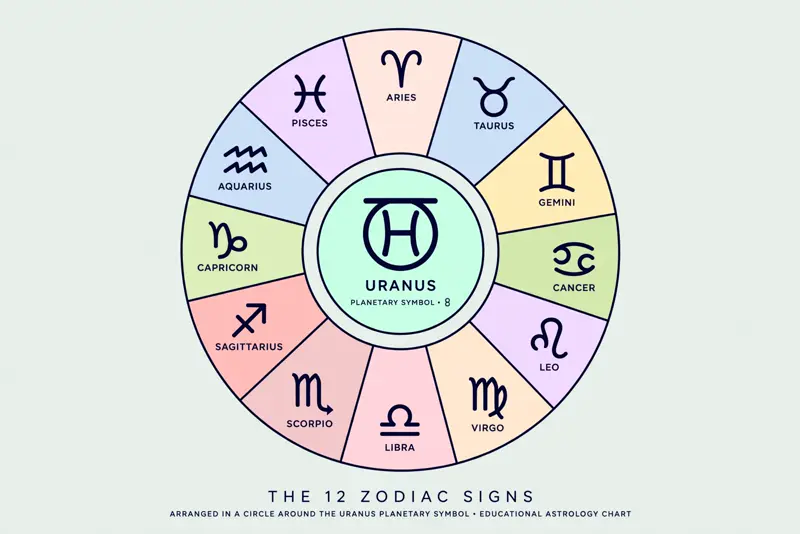
Your Uranus sign is the zodiac sign Uranus occupied when you were born. In modern Western astrology, Uranus symbolizes independence, originality, disruption, technological innovation, and the desire to challenge established traditions.
Because Uranus takes approximately 84 Earth years to orbit the Sun, it spends roughly seven years in each zodiac sign. People born during the same Uranus-sign period therefore share a generational placement. Astrologers interpret that placement through collective themes such as changing social values, new technology, evolving family structures, and unconventional approaches to work.
For example, Uranus in Aquarius is commonly associated with technological innovation, community, and social reform. Uranus in Taurus, by contrast, is interpreted through changes involving material security, resources, money, and established values.
Your Uranus sign is only one component of your natal chart. Your house placement and planetary aspects provide additional context for interpreting its symbolism.
Uranus Sign by Birth Year: Find Your Placement
The table below provides a quick starting point for identifying your Uranus sign from your birth year. These are approximate calendar-year ranges, not exact date boundaries. Uranus sometimes enters a sign, turns retrograde, and returns to the previous sign before making its longer-lasting transition.
| Uranus sign | Approximate birth years |
| Aries | 1927–1935; 2010–2019 |
| Taurus | 1934–1942; 2018–2026 |
| Gemini | 1941–1949; 2025 onward |
| Cancer | 1948–1956 |
| Leo | 1955–1962 |
| Virgo | 1961–1969 |
| Libra | 1968–1975 |
| Scorpio | 1974–1981 |
| Sagittarius | 1981–1988 |
| Capricorn | 1988–1996 |
| Aquarius | 1995–2003 |
| Pisces | 2003–2011 |
Important: These ranges intentionally overlap because sign transitions can occur more than once during a period of retrograde motion. They also cross calendar years, so a birth year alone cannot always identify the correct placement.
For example, Uranus entered Gemini in July 2025, returned to Taurus in November 2025, and re-entered Gemini in April 2026. Someone born during one of these transition periods should check their exact birth date and, if necessary, birth time.
For an accurate result, consult a reliable natal-chart calculator or planetary ephemeris using your birth details.
How Do I Find My Uranus Sign?
The simplest way to find your Uranus sign is to enter your birth date into a natal-chart calculator. Many calculators also request your birth time and birthplace so they can calculate your Ascendant, house placements, and other chart details.
If you already have a birth chart, locate the Uranus symbol, usually shown as ♅, and identify the zodiac sign beside it. If your chart lists planetary degrees, you can use those degrees and the relevant ephemeris to confirm the placement.
A birth-year table is useful for a quick estimate, but exact dates matter around sign transitions. If Uranus changed signs on your birthday, the time of birth and the time zone can determine which sign appears in your natal chart.
You can also explore a dedicated Uranus sign calculator or consult the historical Uranus sign dates table.
Uranus in Astrology: What Does the Planet Represent?
Uranus is associated with rebellion, independence, invention, sudden change, and unconventional thinking in modern Western astrology. It is also connected with technology, social reform, scientific progress, and the urge to question traditions that no longer seem useful.
Astronomically, Uranus was discovered by William Herschel in 1781. NASA reports that it takes approximately 84 Earth years to complete one orbit around the Sun. This long orbital period helps explain why astrologers treat its sign as a generational placement rather than a rapidly changing personal indicator.
Uranus is commonly associated with Aquarius in modern astrology, although Saturn remains Aquarius’s traditional ruler. Astrologers often describe Saturn and Uranus through a symbolic contrast: Saturn represents structure, boundaries, and established systems, while Uranus represents experimentation, disruption, and freedom.
These planetary meanings belong to astrological interpretation. Astronomy establishes Uranus’s physical characteristics and orbital period, but it does not establish that planetary positions determine human behavior.
Uranus in the 12 Zodiac Signs
Each Uranus sign is interpreted through the combination of the planet’s symbolism and the zodiac sign it occupies. The following descriptions explore generational themes, possible expressions in everyday life, and reflective questions for work, relationships, and personal growth.
Your Uranus sign should not be treated as a complete personality profile. Two people with the same placement can have very different lives because their full natal charts and personal circumstances differ.
Uranus in Aries
Approximate periods: 1927–1935 and 2010–2019, with transition-year exceptions.
Uranus in Aries is associated with independence, bold initiatives, pioneering ideas, and challenges to authority. Aries symbolizes action and self-direction, while Uranus represents disruption and innovation. Together, astrologers interpret this placement as a generational theme of questioning existing rules and pursuing new approaches with courage.
In work and leadership, this symbolism can represent entrepreneurial thinking, willingness to experiment, and impatience with unnecessary restrictions. In relationships, independence may be especially important, making room for individuality and honest communication essential.
The growth challenge is balancing courage with consideration. Not every established rule is harmful, and not every new idea needs immediate action. A useful reflection is to ask whether a desire for change comes from a meaningful goal or simply from frustration with limitations.
Uranus in Taurus
Approximate periods: 1934–1942 and 2018–2026, with transition-year exceptions.
Uranus in Taurus connects innovation with money, material security, possessions, food, nature, and personal values. Taurus is associated with stability and tangible resources, while Uranus symbolizes disruption. Astrologers interpret this combination as a generational tension between maintaining security and rethinking the systems that provide it.
In work and finances, its symbolism may involve changing attitudes toward ownership, technology, sustainable resources, or traditional employment. In relationships, it can raise questions about the difference between genuine commitment and remaining in familiar situations simply because they feel safe.
The growth opportunity is learning that stability does not have to mean standing still. A person can preserve important values while changing outdated habits. Reflect on which routines genuinely support long-term security and which ones persist mainly because they are familiar.
Uranus in Gemini
Approximate periods: 1941–1949 and 2025 onward, with transition-year exceptions.
Uranus in Gemini is associated with communication, information, education, transportation, media, and intellectual experimentation. Gemini symbolizes curiosity and the exchange of ideas, while Uranus represents innovation. Astrologers therefore connect this placement with changing ways of learning, sharing information, and building social connections.
In work, its themes can be explored through technology, research, communication, and unconventional problem-solving. In relationships, intellectual freedom and stimulating conversation may become important symbolic themes. The challenge is that constant novelty can make sustained attention more difficult.
Uranus entered Gemini in 2025, briefly returned to Taurus later that year, and re-entered Gemini in April 2026. In modern astrology, this current transit is interpreted through communication and information systems. It does not change anyone’s natal Uranus sign.
A useful reflection is to consider how you evaluate new information, distinguish reliable sources from misinformation, and remain open to changing your mind.
Uranus in Cancer
Approximate periods: 1948–1956.
Uranus in Cancer links innovation with home, family, ancestry, emotional security, and belonging. Cancer is associated with nurturing and protection, while Uranus symbolizes change and independence. Astrologers interpret this combination as a generational theme of reconsidering inherited family expectations and traditional definitions of security.
In everyday life, these themes can be explored through changing household structures, caregiving arrangements, or ideas about what makes a place feel like home. In relationships, independence and emotional closeness may need to be balanced rather than treated as opposing needs.
The growth opportunity lies in recognizing that family traditions can provide support without determining every future choice. A meaningful question is whether the expectations you inherited still reflect your values. Change can preserve what matters while allowing new ways of creating safety and connection.
Uranus in Leo
Approximate periods: 1955–1962.
Uranus in Leo connects originality with creativity, leadership, recognition, performance, and self-expression. Leo is associated with visibility and creative confidence, while Uranus represents unconventional ideas. Astrologers interpret this placement as a generational theme involving new approaches to artistic expression, authority, and public identity.
In work, the symbolism can suggest a willingness to question traditional leadership styles and explore distinctive creative approaches. In relationships, appreciation and individuality may both matter, particularly when people want to feel valued without being controlled.
The challenge is separating authentic self-expression from the pressure to stand out. Originality does not require constant attention, and leadership does not always require being the loudest person in the room. Consider how you can contribute something distinctive while remaining receptive to collaboration and feedback.
Uranus in Virgo
Approximate periods: 1961–1969.
Uranus in Virgo is associated with practical innovation, work systems, organization, health routines, and problem-solving. Virgo symbolizes analysis and improvement, while Uranus represents change. Astrologers interpret the combination as a generational theme of challenging inefficient processes and finding more effective ways to manage everyday responsibilities.
In professional settings, this symbolism can be explored through technological improvements, workflow redesign, research, and attention to overlooked details. In personal routines, it may encourage experimentation with habits that make daily life more manageable.
The challenge is avoiding the belief that every system must be continually optimized. Improvement is useful when it solves a real problem, but constant revision can create unnecessary pressure. A helpful reflection is to identify which changes genuinely improve your life and which ones simply make it harder to feel satisfied.
Uranus in Libra
Approximate periods: 1968–1975.
Uranus in Libra connects change with partnerships, fairness, cooperation, justice, and social expectations. Libra is associated with balance and relationships, while Uranus represents independence and disruption. Astrologers interpret this placement as a generational theme involving new approaches to partnership, equality, and shared decision-making.
In relationships, the symbolism can encourage questioning assumptions about roles, commitment, and personal freedom. In work and public life, it may be associated with reconsidering established approaches to negotiation, fairness, and collaboration.
The challenge is balancing independence with accountability. A healthy partnership allows room for individuality while recognizing the impact each person has on the other. Reflect on whether your agreements are genuinely fair, clearly communicated, and adaptable as circumstances change.
Uranus in Scorpio
Approximate periods: 1974–1981.
Uranus in Scorpio is associated with transformation, privacy, intimacy, shared resources, psychological exploration, and power dynamics. Scorpio symbolizes depth and change, while Uranus represents disruption. Astrologers interpret this placement as a generational theme of questioning hidden systems and reconsidering how people approach trust, vulnerability, and control.
In work and society, these themes can be explored through investigations of institutions, financial structures, and information that was previously concealed. In relationships, the symbolism raises questions about emotional honesty, boundaries, and the balance between closeness and independence.
The growth challenge is recognizing that not every uncertainty signals a problem that must be controlled. Meaningful transformation can involve accepting complexity and allowing trust to develop over time. Consider where greater transparency would help and where patience may be more constructive than forcing an immediate answer.
Uranus in Sagittarius
Approximate periods: 1981–1988.
Uranus in Sagittarius connects innovation with education, philosophy, travel, cultural exchange, and freedom of thought. Sagittarius symbolizes exploration and broader perspectives, while Uranus represents unconventional ideas. Astrologers interpret this placement as a generational theme of challenging inherited beliefs and reconsidering established approaches to learning and society.
In work, its symbolism can be explored through international collaboration, new educational methods, and independent thinking. In relationships, curiosity and shared exploration may be important themes, although differences in beliefs can require patience and mutual respect.
The challenge is remaining open to evidence that contradicts an appealing idea. Freedom of thought includes the willingness to revise personal assumptions. A useful reflection is to ask whether your beliefs encourage genuine understanding or simply reinforce what you already want to believe.
Uranus in Capricorn
Approximate periods: 1988–1996.
Uranus in Capricorn links innovation with institutions, careers, government, business, leadership, and established hierarchies. Capricorn is associated with structure and long-term responsibility, while Uranus symbolizes disruption. Astrologers interpret this placement as a generational theme of reforming systems that appear rigid, outdated, or ineffective.
In work, this symbolism can involve experimenting with organizational structures, questioning conventional career paths, and seeking more efficient ways to achieve long-term goals. In relationships, it can raise questions about balancing personal ambition with shared responsibilities.
The growth challenge is combining reform with practical planning. Destroying an ineffective system does not automatically create a better one. Sustainable change requires accountability, clear priorities, and attention to consequences. Reflect on which structures genuinely support progress and which ones need thoughtful redesign.
Uranus in Aquarius
Approximate periods: 1995–2003.
Uranus in Aquarius is associated with technology, community, social networks, collective progress, and unconventional thinking. Aquarius is traditionally ruled by Saturn and is associated with Uranus in modern Western astrology. Astrologers interpret this placement as a generational emphasis on challenging social expectations and experimenting with new ways of connecting and organizing communities.
In work and education, these themes can be explored through digital collaboration, technological innovation, and alternative approaches to solving collective problems. In relationships, individuality and friendship may be particularly important symbolic themes.
The challenge is remembering that people are more than members of a group or participants in a cause. Strong ideas need empathy and practical application to create meaningful results. Reflect on how you can support progress while remaining attentive to the experiences of individuals whose needs differ from your own.
Uranus in Pisces
Approximate periods: 2003–2011.
Uranus in Pisces connects change with imagination, spirituality, compassion, artistic expression, and collective sensitivity. Pisces is associated with creativity and emotional awareness, while Uranus represents unconventional approaches and disruption. Astrologers interpret this placement as a generational theme involving new expressions of art, spirituality, and ideas about human connection.
In creative work, this symbolism can encourage experimentation with visual media, music, storytelling, and imaginative forms of communication. In relationships, it can prompt reflection on empathy, emotional boundaries, and the difference between compassion and taking responsibility for everyone else’s feelings.
The challenge is distinguishing inspiration from assumption. Imagination can open useful possibilities, but important decisions still benefit from clear information and practical judgment. Reflect on how creativity and compassion can guide your choices without making it difficult to recognize boundaries or reality.
Uranus in the 12 Houses
Your Uranus sign describes the zodiac sign occupied by Uranus. Its house placement is interpreted as the area of life where Uranian themes may be especially noticeable. House placements depend on your birth time, location, chart calculation, and chosen house system.
| Uranus house | Common astrological interpretation |
| First house | Identity, self-expression, and independence |
| Second house | Money, possessions, values, and security |
| Third house | Communication, learning, and everyday connections |
| Fourth house | Home, family, and private life |
| Fifth house | Creativity, romance, and self-expression |
| Sixth house | Work routines, service, and daily habits |
| Seventh house | Partnerships, agreements, and close relationships |
| Eighth house | Shared resources, intimacy, and transformation |
| Ninth house | Higher education, philosophy, and travel |
| Tenth house | Career, reputation, and public responsibilities |
| Eleventh house | Friendships, communities, and long-term aspirations |
| Twelfth house | Privacy, reflection, solitude, and unconscious patterns |
These are simplified symbolic associations, not predictions. For example, astrologers might interpret Uranus in the second house through unconventional attitudes toward money, while Uranus in the seventh house may prompt reflection on independence within partnerships.
To interpret the house meaningfully, consider the sign on the house cusp, the planets aspecting Uranus, and the rest of the natal chart rather than isolating one placement.
Uranus Retrograde: Does It Change Your Uranus Sign?
Uranus retrograde is the period when Uranus appears to move backward through the zodiac from Earth’s perspective. This is an apparent motion caused by the relative positions and movements of Earth and Uranus; the planet does not physically reverse its orbit around the Sun.
In astrology, retrograde motion is often interpreted as a period of reconsidering change, independence, or established patterns. When Uranus turns retrograde near a zodiac-sign boundary, it can return to the previous sign before entering the new one again.
This is why people born around a Uranus sign transition should check their exact birth date and, if necessary, birth time. Retrograde motion does not automatically change a person’s natal placement later in life. Your birth-chart position remains based on where Uranus was at the time of birth.
Uranus Aspects: How Other Planets Affect the Interpretation
In astrology, an aspect is an angular relationship between two planets or chart points. Astrologers interpret Uranus’s aspects as additional context for understanding how themes of independence, innovation, and change interact with other symbolic parts of the chart.
| Aspect | Traditional astrological interpretation |
| Uranus conjunct the Sun | Individuality, independence, and identity |
| Uranus conjunct the Moon | Emotional independence and changing needs |
| Uranus conjunct Mercury | Original thinking and unconventional communication |
| Uranus conjunct Venus | Freedom, experimentation, and relationship values |
| Uranus conjunct Mars | Initiative, independence, and impulsive action |
| Uranus square another planet | Tension between change and the planet’s symbolism |
| Uranus trine another planet | A comparatively harmonious expression of innovation |
| Uranus opposite another planet | A perceived conflict between independence and another need |
A conjunction occurs when planets are close together in zodiacal longitude; squares, trines, and oppositions describe other angular relationships. Astrologers consider the exact degrees and accepted orbs when interpreting an aspect.
These descriptions are symbolic conventions rather than scientifically validated explanations of behavior. The house placement, sign, other aspects, and overall chart are all relevant within the astrological framework.
Uranus Return and Uranus Opposition
Two important astrological milestones involve Uranus’s long orbital cycle.
Uranus Opposition Around Age 42
A Uranus opposition occurs when transiting Uranus reaches approximately the opposite point from its natal position. This commonly occurs around the early forties, although the timing varies. In astrology, it is associated with reassessing independence, long-term commitments, career direction, and personal freedom.
People may use this symbolism as a prompt to reflect on whether their current routines and responsibilities still align with their values. It does not mean that a crisis or major life change must occur at a particular age.
Uranus Return Around Age 84
A Uranus return occurs when Uranus returns to approximately the same zodiacal position it occupied at birth. Because Uranus takes about 84 Earth years to orbit the Sun, the first Uranus return is generally associated with the early-to-mid eighties.
In modern astrology, the return is interpreted as a period of reflection on independence, personal legacy, and the broader changes experienced across a lifetime. The exact timing depends on Uranus’s natal degree and its subsequent movement. It is an astrological milestone, not a scientifically established predictor of life events.
Uranus in Gemini: 2026 Dates and Meaning
As of October 16, 2026, Uranus is in Gemini in the tropical zodiac. It first entered Gemini in July 2025, returned to Taurus during retrograde motion in November 2025, and re-entered Gemini in April 2026.
Astrological calendars list April 25, 2026, in Eastern Time for the latest entry, corresponding to April 26 in Universal Time. Uranus is expected to leave Gemini for Cancer in August 2032, return to Gemini during retrograde motion in December 2032, and make its longer-term transition into Cancer in May 2033.
In modern astrology, Uranus in Gemini is associated with changes in communication, education, technology, media, and the exchange of ideas. These are symbolic interpretations of a planetary transit, not verified forecasts of specific social or political events.
Your natal Uranus sign remains the sign occupied at your birth. To understand how the current transit is interpreted in your chart, astrologers compare transiting Uranus with your natal houses,
planets, and aspects.
Uranus Retrograde in Gemini 2026-2027: September 10 to February 8
Uranus stationed retrograde on September 10, 2026, at about 5 degrees 42 minutes of Gemini, and it turns direct on February 8, 2027, at about 1 degree 41 minutes of Gemini. Uranus stays in Gemini for the whole retrograde, moving back across about 4 degrees it already crossed after entering the sign in April 2026.
The full ingress and retrograde dates are listed in Natal Junction’s Uranus in Gemini guide.
In astrological tradition, a retrograde is read as a period to review and revisit rather than to push ahead. For this transit, that means the communication, technology, media and ideas themes of Uranus in Gemini get a second look before Uranus moves forward again in February 2027. For the sign itself, see our guide to Gemini traits and dates.
A retrograde does not change your natal Uranus sign. Your natal placement is fixed by the sign Uranus occupied at your birth, and it stays that way for life.
Frequently Asked Questions About Uranus Signs
What is my Uranus sign by birth year?
Your birth year can provide an approximate Uranus sign because the planet spends about seven years in each zodiac sign. However, transitions and retrograde motion create overlapping date ranges. Check your exact birth date in a reliable ephemeris or natal-chart calculator to confirm the placement.
Is your Uranus sign the same as your rising sign?
No. Your Uranus sign identifies the zodiac sign occupied by Uranus at birth. Your rising sign, also called your Ascendant, is the sign rising on the eastern horizon at your birth location and time. They represent different chart factors in astrology.
How long does Uranus stay in one sign?
Uranus typically spends approximately seven years in a zodiac sign. The exact duration varies, and retrograde motion can cause it to cross a sign boundary more than once before settling into the next sign.
What does Uranus represent in a birth chart?
Modern astrology associates Uranus with originality, independence, disruption, innovation, and challenges to established systems. Its sign, house, and aspects are interpreted together to explore how these themes fit into the wider natal chart.
What does Uranus in Gemini mean in 2026?
In modern astrology, Uranus in Gemini symbolizes change involving communication, learning, technology, information, and social connections. Uranus re-entered Gemini in April 2026 after briefly returning to Taurus in late 2025.
Can your Uranus sign predict your future?
There is no strong scientific evidence that a Uranus sign reliably predicts an individual’s future or determines personality. Astrology is best approached as a symbolic or cultural tradition and a tool for reflection, rather than a substitute for evidence-based decisions.
When is Uranus retrograde in 2026?
Uranus turns retrograde on September 10, 2026, at about 5 degrees 42 minutes of Gemini, and stations direct on February 8, 2027, at about 1 degree 41 minutes of Gemini. It remains in Gemini throughout the retrograde.
Explore More Astrology Guides
If you want to understand your Uranus placement in context, explore these related topics:
- Sun, Moon, and Rising Signs: Learn how astrologers distinguish the three commonly discussed natal-chart placements.
- Neptune Sign Meaning: Explore the generational symbolism associated with imagination, spirituality, and ideals.
- Pluto Sign Meaning: Learn how modern astrology interprets Pluto’s long-term generational themes.
- Birth Chart Houses: Understand how astrologers interpret the 12 houses and their relationship to planetary placements.
- Planetary Transits: Learn how current planetary positions are compared with natal-chart placements.
Use these guides together to build a fuller understanding of astrological terminology and interpretation.
Final Thoughts on Your Uranus Sign
Your Uranus sign offers one way to explore how modern astrology interprets generational change, independence, innovation, and unconventional thinking. The birth-year table gives you a starting point, while a precise natal chart can confirm the placement and reveal its house and aspects.
The most useful approach is to read your Uranus sign alongside the rest of your chart, consider which interpretations resonate with your experience, and remain open to perspectives that challenge your assumptions. Astrology can provide a framework for reflection without defining who you are or determining what your future must hold.
Editorial note: The birth-year ranges are approximate and should be checked against a reliable ephemeris before being used for exact birth-date lookups.

Jack Harrison is a contributor at Square Root Signs, sharing creative ideas, useful information, and engaging content to help readers discover something valuable with every visit.