

What Is the Rarest Zodiac Sign? Aquarius or Capricorn?
If you’re asking what is the rarest zodiac sign, the answer depends on how “rarest” is measured. Aquarius is often given as the rarest sign in popular astrology, while a widely cited 1994–2014 U.S. birth-data compilation ranks Capricorn as the least common, at 7.50% of births. There is no official U.S. government ranking of zodiac signs by rarity. Instead, researchers or publishers must take birth data, define the zodiac system being used, assign births to signs, and compare the resulting totals.
That distinction explains why you may see Aquarius on one website and Capricorn on another. U.S. birth records show that births are not distributed evenly across the calendar, but monthly birth totals alone cannot determine which zodiac sign is rarest because each sign spans parts of different months. The result can also change depending on the years, country, and method used to assign birth dates to zodiac signs.
This guide uses the Western tropical zodiac unless otherwise stated. It separates popular astrology claims from population statistics so you can see exactly why Aquarius and Capricorn both appear in discussions about the rarest zodiac sign.
Quick Answer: What Is the Rarest Zodiac Sign?
Aquarius is the conventional answer in popular astrology, but Capricorn ranks as the rarest sign in the cited 1994–2014 U.S. birth-data compilation.
The difference comes down to methodology.
- Popular astrology answer: Aquarius
- 1994–2014 U.S. compilation discussed in this article: Capricorn
- Official CDC/NCHS position: There is no official “rarest zodiac sign” ranking
- Main reason: Births vary by date, month, year, and season
- Zodiac system used here: Western tropical astrology
So if someone asks for the simple popular answer, Aquarius is reasonable. If they ask which sign ranked lowest in the specific long-term U.S. compilation discussed below, the answer is Capricorn.
Why Aquarius Is Often Called the Rarest Zodiac Sign
Aquarius is commonly cited as the rarest zodiac sign because its traditional tropical date range, approximately January 20 through February 18, overlaps late January and much of February. February is the shortest month, and U.S. birth data show relatively low birth totals during parts of winter. Aquarius is an air sign and Capricorn is an earth sign, two of the four zodiac elements.
That does not mean Aquarius has a uniquely short zodiac section. The tropical zodiac is divided into twelve equal 30-degree signs. Calendar dates are simply the way those angular divisions are commonly represented for everyday astrology, and the exact date on which the Sun enters or leaves a sign can vary slightly by year and time zone.
The more useful statistical observation is that births are not evenly distributed across the calendar. If fewer people are born during a particular stretch of dates, a zodiac sign that overlaps much of that period can have a smaller share of births.
Why February Matters
February has fewer calendar days than every other month, which affects the number of possible birthdays in the month. It also tends to have fewer total births than several other months in U.S. birth data.
For example, U.S. birth data for 2023 recorded roughly 322,000 births in August and about 271,000 in February. That illustrates the seasonal difference between a relatively high-birth month and a relatively low-birth month.
However, this comparison does not prove that Aquarius is the rarest zodiac sign. Aquarius also includes part of January, while other zodiac signs cross different combinations of months. To rank zodiac signs properly, you need to assign individual birth dates to zodiac signs and then count the births in each category.
That distinction is important because a monthly birth chart and a zodiac-frequency ranking are not the same thing.
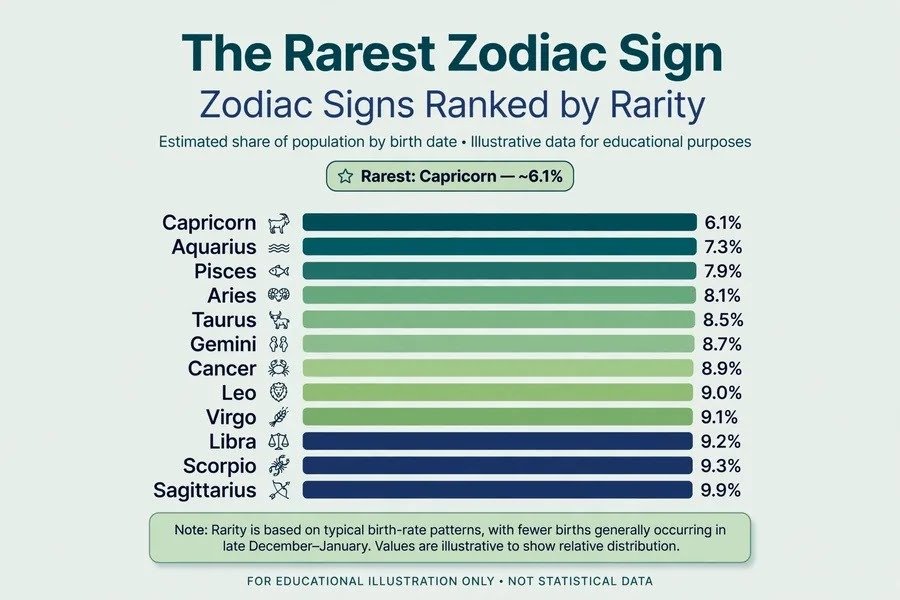
How Zodiac Sign Rarity Is Actually Calculated
There is no single official statistic called “zodiac sign rarity.” A zodiac-frequency ranking has to be calculated from birth records.
A basic calculation works like this:
- Choose a population. For example, U.S. births.
- Choose the years. A single year and a 20-year period can produce different results.
- Choose the zodiac system. This article uses the Western tropical zodiac.
- Assign each birth to a zodiac sign. This requires a defined set of sign boundaries.
- Count the births assigned to each sign.
- Calculate each sign’s percentage of total births.
- Rank the twelve signs from highest to lowest.
The calculation can be represented simply as:
Zodiac sign share = births assigned to that sign ÷ total births × 100
This is why the phrase “rarest zodiac sign” should always be accompanied by some context. A ranking based on U.S. births from one period does not automatically apply to every country, every decade, or every astrology system.
Why Monthly Birth Data Alone Isn’t Enough
Monthly birth totals are useful for showing seasonal patterns, but they are not enough to produce an exact zodiac ranking.
Consider a simplified example. Aquarius overlaps part of January and most of February. Capricorn overlaps part of December and January. If December, January, and February have different birth patterns, the final ranking depends on the daily distribution of births across those months.
Holiday effects can also matter. Planned inductions and cesarean deliveries may be less common on certain holidays, creating unusually low birth counts on specific dates. Those individual-date differences can influence a zodiac sign that includes those dates.
Therefore, a rigorous zodiac-frequency calculation should use birth dates at the daily level whenever possible rather than simply comparing monthly totals.
Why Capricorn Can Rank as the Rarest Zodiac Sign
The most interesting part of the debate is that Capricorn can rank below Aquarius when a longer U.S. birth dataset is used.
A published secondary compilation covering U.S. births from 1994 through 2014 reports Capricorn at 7.50% of births, compared with 8.05% for Aquarius. In that compilation, Capricorn ranks twelfth and Aquarius ranks tenth.
The result does not mean the popular Aquarius answer is automatically wrong. It means the two claims are answering slightly different questions.
The popular answer is based largely on the observation that Aquarius overlaps a relatively low-birth period in late January and February. The long-term compilation, by contrast, counts births across a defined period and assigns them to zodiac signs.
Capricorn’s position is particularly interesting because its traditional date range crosses the December-January holiday period. Some individual dates around major holidays have unusually low numbers of births, partly because scheduled deliveries are less common on those days. Those date-level patterns can affect the total number of births assigned to Capricorn. Capricorn is also one of the four cardinal signs in astrology.
The broader lesson is simple: zodiac rarity depends on the actual birth distribution used in the calculation.
U.S. Zodiac Frequency: One Published Long-Term Comparison
The following table reproduces the ranking reported by the cited 1994–2014 U.S. birth-data compilation. It should be treated as a secondary published calculation, not as an official CDC or NCHS zodiac ranking.
| Rank | Zodiac sign | Share of U.S. births | Frequency |
|---|---|---|---|
| 1 | Cancer | 9.01% | Most common in this compilation |
| 2 | Virgo | 8.95% | Very common |
| 3 | Leo | 8.88% | Very common |
| 4 | Gemini | 8.48% | Above average |
| 5 | Libra | 8.41% | Above average |
| 6 | Taurus | 8.33% | Near average |
| 7 | Scorpio | 8.19% | Near average |
| 8 | Pisces | 8.13% | Below average |
| 9 | Sagittarius | 8.06% | Below average |
| 10 | Aquarius | 8.05% | Less common |
| 11 | Aries | 8.02% | Less common |
| 12 | Capricorn | 7.50% | Rarest in this compilation |
The difference between the most common sign in this table, Cancer at 9.01%, and the least common, Capricorn at 7.50%, is 1.51 percentage points.
That is a relatively narrow spread. In other words, Capricorn is “rare” only in the statistical sense that it represents the smallest share of births in this particular dataset. It is not rare in the everyday sense of being scarce or exceptionally unusual.
Important Source Limitation
The table above should not be presented as an official government ranking.
The National Center for Health Statistics, part of the CDC, collects and publishes U.S. natality statistics. Its datasets include information about births, and certain public-use datasets provide the exact date of birth. But CDC/NCHS does not publish an official table saying “Capricorn is the rarest zodiac sign.”
That distinction matters for accuracy.
The percentages above come from a secondary compilation that combines U.S. birth information from multiple sources for 1994–2014. It is useful as a published comparison, but it should not be described as a CDC zodiac ranking.
Why Some Zodiac Signs Are More Common Than Others
The twelve tropical zodiac signs occupy equal 30-degree sections, but human births do not occur in equal numbers on every date.
U.S. birth data show meaningful variation by month and day. Some periods of the year have substantially more births than others, and individual dates can also differ significantly.
Several factors can contribute to these patterns:
- Seasonal conception patterns: Births can reflect seasonal differences in conception.
- Month length: February has fewer calendar days than the other months.
- Holiday scheduling: Planned inductions and cesarean deliveries may be less common on major holidays.
- Weekday effects: Scheduled births can vary between weekdays and weekends.
- Calendar effects: Leap years add February 29, while different months contain different numbers of days.
- Year-to-year variation: Birth patterns can change across decades.
- Zodiac boundaries: Each sign covers a specific angular section of the tropical zodiac rather than a fixed number of calendar days.
These factors explain why zodiac signs can have slightly different population frequencies.
Why Late Summer Signs Often Rank Highly
Late summer and early fall contain many dates with relatively high U.S. birth counts. This helps explain why signs such as Cancer, Leo, and Virgo frequently appear near the top of published U.S. zodiac-frequency lists.
But it is important not to oversimplify the relationship.
A sign does not correspond exactly to one calendar month. Cancer includes dates from late June into late July. Leo spans late July into late August, and Virgo spans late August into late September.
Therefore, saying “September has many births, so Virgo must be the most common sign” is not a complete statistical calculation. The correct approach is to count individual birth dates according to defined zodiac boundaries.
Does the Zodiac System Change the Result?
Potentially, yes.
This article uses the Western tropical zodiac, which divides the zodiac into twelve equal 30-degree signs.
That system is different from the astronomical constellations that lie along the ecliptic. The constellations have unequal boundaries, while the twelve astrological signs are equal divisions.
This distinction matters when discussing zodiac dates because a person’s tropical Sun sign is not simply the same thing as the modern astronomical constellation behind the Sun.
The calculation should therefore always state which system is being used.
Tropical Zodiac vs. Astronomical Constellations
In the tropical system, the twelve signs are tied to the seasonal zodiac and each occupies 30 degrees.
Astronomical constellations are different. Their boundaries are not equal, and the Sun can spend different amounts of time in front of different constellations.
For a birth-frequency article, mixing those systems would create an inconsistent ranking. The calculations in this article refer to the traditional twelve-sign Western tropical zodiac.
Is Ophiuchus the Rarest Zodiac Sign?
No, not in the traditional Western tropical zodiac.
Ophiuchus is a real astronomical constellation located along the ecliptic, the apparent path the Sun follows across the sky during the year. Because the Sun passes through the constellation Ophiuchus, it is sometimes described online as a “13th zodiac sign.”
That description mixes two different systems.
The traditional Western tropical zodiac consists of twelve equal 30-degree signs. Astronomical constellations, on the other hand, have unequal boundaries. Ophiuchus is therefore relevant to astronomy and to discussions about the constellations along the ecliptic, but it is not an additional sign in the twelve-sign tropical zodiac used for the ranking in this article.
For that reason, Ophiuchus is not included in the twelve-sign birth-frequency table.
Is a Rare Zodiac Sign Actually Rare?
Not in the everyday meaning of the word.
Even the least common sign in the cited U.S. compilation represents 7.50% of births. That means millions of people can share the same sign.
The word “rare” simply means that one category has a smaller share of births than another within a particular population and dataset.
It does not mean: – unusual in personality – more intelligent – more talented – more attractive – more powerful – more mysterious – more successful – more destined for something special
Birth-frequency statistics describe when people were born, not who they are.
Does Having a Rare Zodiac Sign Make You Special?
No scientific conclusion about personality or destiny can be drawn from the statistical frequency of a Sun sign.
In astrology, practitioners traditionally interpret many parts of a birth chart rather than relying only on the Sun sign. Depending on the astrological system, that can include the Moon, Ascendant or rising sign, planets, houses, degrees, and aspects.
Two people can therefore share an Aquarius Sun or Capricorn Sun while having very different astrological charts.
From a statistical perspective, adding more characteristics also creates more possible combinations. But that does not mean every specific birth chart combination is literally unique or that its frequency has been calculated.
The safest way to describe the difference is this:
A Sun sign gives you one broad astrological category. A full birth chart contains many more variables.
Why Your Full Birth Chart Is More Individualized Than Your Sun Sign
If you’re interested in what makes your chart different from someone else’s, looking only at the rarest Sun sign is a limited approach.
Your birth date, time, and location can be used in astrology to calculate additional placements such as:
- Sun sign
- Moon sign
- rising sign
- Mercury
- Venus
- Mars
- Jupiter
- Saturn
- outer planets
- houses
- degrees
- aspects
A particular combination of Sun, Moon, and rising signs will generally occur less often than any one of those signs considered by itself. However, the exact frequency of a combination depends on the population, time period, precision of the birth information, and how the combination is defined.
So if the goal is individuality, a full birth chart is more informative than simply asking whether Aquarius or Capricorn is statistically less common.
The Clearest Answer for U.S. Readers
If someone asks, “What is the rarest zodiac sign?”, the clearest answer is:
Aquarius is the conventional popular-astrology answer, while Capricorn ranks as the rarest sign in the specific 1994–2014 U.S. birth compilation discussed here.
Those statements are not necessarily contradictory.
They refer to different ways of answering the question.
If you’re looking for the answer commonly repeated in popular astrology, Aquarius is the expected answer.
If you’re asking for the lowest percentage in the cited long-term U.S. compilation, Capricorn is the answer at 7.50%.
If you’re asking whether the U.S. government officially recognizes one sign as the rarest, no such official CDC/NCHS ranking exists.
That last distinction is especially important. Government birth statistics provide the underlying population data, but the zodiac ranking is a calculation made by applying an astrological classification to those birth dates.
What Is the Most Common Zodiac Sign?
There is no universal most-common zodiac sign for every country, year, or dataset.
In the cited 1994–2014 U.S. compilation, Cancer ranks first at 9.01%, followed by Virgo at 8.95% and Leo at 8.88%.
Those results should be understood as findings from that particular compilation rather than a permanent rule about all U.S. births.
Birth patterns change over time. A ranking based on a different group of years could produce a different order.
The same principle applies to the rarest sign.
A zodiac-frequency ranking is a population statistic, not an eternal property of a zodiac sign.
What Does U.S. Birth Data Actually Tell Us?
The CDC’s National Center for Health Statistics collects U.S. birth information through the National Vital Statistics System. Birth certificates form the foundation of these national statistics, and NCHS provides public-use birth datasets and documentation.
Some NCHS data products include the exact date of birth, making it possible for researchers to analyze birth patterns at a more detailed level than simply comparing months.
This creates an important distinction:
- Official birth data: the underlying information about when births occurred.
- Zodiac-frequency calculation: a separate analysis that assigns those birth dates to astrological signs.
The first is a government statistical product. The second is an interpretation or calculation performed using a defined zodiac system.
That is why an article can legitimately use CDC/NCHS birth data as evidence about seasonal birth patterns without claiming that the CDC itself has declared Aquarius or Capricorn the rarest sign.
Why the Rarest Sign Can Change From One Dataset to Another
Imagine two researchers using different datasets.
Researcher A examines one year of U.S. births.
Researcher B examines twenty years of U.S. births.
Even if both researchers use the same zodiac boundaries, their rankings can differ because individual birth patterns change from year to year.
Now imagine that one researcher uses the United States while another uses another country.
The result can change again because birth patterns are affected by local population characteristics, holidays, medical scheduling practices, cultural patterns, and other factors.
Finally, imagine that researchers use different methods for assigning births near zodiac boundaries.
That can introduce another source of variation.
So the phrase “the rarest zodiac sign” should always be interpreted as:
The least common sign within a specified population, time period, zodiac system, and calculation method.
That is the most statistically responsible way to answer the question.
Rarest Zodiac Sign: Aquarius vs. Capricorn
Here is the simplest comparison:
| Question | Answer |
|---|---|
| Popular astrology answer | Aquarius |
| Rarest in the cited 1994–2014 U.S. compilation | Capricorn |
| Capricorn share in that compilation | 7.50% |
| Aquarius share in that compilation | 8.05% |
| Official CDC “rarest sign” ranking | None |
| Zodiac system used in this article | Western tropical zodiac |
| Why rankings differ | Dataset, years, population, and methodology |
This table captures the central point of the article without pretending there is one universal statistic.
Frequently Asked Questions
What is the rarest zodiac sign?
Aquarius is the conventional answer in popular astrology, but Capricorn ranks as the least common sign in the cited 1994–2014 U.S. birth compilation. That compilation reports Capricorn at 7.50% of births and Aquarius at 8.05%.
There is no official CDC or NCHS “rarest zodiac sign” ranking. The result depends on the dataset, years studied, population, and method used to assign birth dates to zodiac signs.
Is Aquarius really the rarest zodiac sign?
Aquarius is often presented as the rarest zodiac sign in popular U.S. astrology content because it overlaps late January and much of February, including a period when U.S. births tend to be relatively low.
However, Aquarius is not officially classified by the U.S. government as the rarest sign. A long-term U.S. birth compilation can produce a different result, with Capricorn ranking lower.
Is Capricorn rarer than Aquarius?
It can be, depending on the dataset.
In the published 1994–2014 U.S. compilation discussed in this article, Capricorn accounts for 7.50% of births, while Aquarius accounts for 8.05%.
Therefore, Capricorn is statistically rarer in that particular compilation.
That does not establish Capricorn as universally rarer than Aquarius in every population or every period.
Why are some zodiac signs rarer than others?
Births are not evenly distributed across every date of the year.
U.S. birth counts vary by month and by individual date. Seasonal patterns, month length, holidays, scheduling of planned deliveries, and other factors can affect how many births occur during particular periods.
When those birth patterns overlap the calendar dates associated with different zodiac signs, the signs can end up with different population shares.
How is zodiac sign rarity calculated from birth data?
A basic calculation involves collecting birth dates for a defined population and time period, assigning each birth to one of the twelve zodiac signs using a specified system, counting the births in each sign, and dividing each sign’s total by the number of births in the dataset.
The calculation is:
Sign frequency = births assigned to the sign ÷ total births × 100
The researcher should also document the country, years, zodiac system, and sign-boundary method so the result can be reproduced or compared with other datasets.
Can monthly birth data prove which zodiac sign is rarest?
No.
Monthly birth data can show seasonal patterns, such as whether February has fewer births than August, but zodiac signs do not correspond exactly to calendar months.
Each sign covers part of two calendar months in most cases. Therefore, an exact zodiac ranking requires birth-date data and a defined method for assigning those dates to signs.
Why does Capricorn sometimes rank rarer than Aquarius?
Capricorn’s traditional date range overlaps the December-January period, including major holidays and individual dates with unusually low birth counts.
Scheduled inductions and cesarean deliveries can be less common on holidays, which can contribute to unusually low numbers of births on particular dates.
When a long-term dataset includes those date-level patterns, Capricorn can end up with a smaller total share of births than Aquarius.
What is the most common zodiac sign?
There is no universal winner across every dataset.
In the cited 1994–2014 U.S. compilation, Cancer ranks first at 9.01%, followed by Virgo at 8.95% and Leo at 8.88%.
A different country or time period can produce a different ranking.
Are zodiac signs equally common?
No, not in terms of the number of people born under each sign.
The twelve tropical zodiac signs occupy equal 30-degree sections, but births are not evenly distributed across the calendar.
Equal angular size does not mean equal numbers of people are born during each sign’s calendar period.
Is Ophiuchus the rarest zodiac sign?
No, not in the traditional Western tropical zodiac.
Ophiuchus is an astronomical constellation along the ecliptic, but the traditional Western tropical zodiac consists of twelve equal 30-degree signs.
Because Ophiuchus is not one of those twelve tropical signs, it is not included in the zodiac-frequency ranking used in this article.
Is Ophiuchus the 13th zodiac sign?
Not in the traditional Western tropical zodiac.
Ophiuchus is a recognized astronomical constellation through which the Sun appears to pass from Earth’s perspective. The confusion comes from treating astronomical constellations and astrological signs as if they were the same system.
They are not.
The tropical zodiac uses twelve equal 30-degree signs, while astronomical constellations have unequal boundaries.
Does having a rare zodiac sign make you special?
No.
A rare Sun sign only means that fewer people were born within that sign’s calendar or zodiac period in a particular population.
It does not scientifically demonstrate greater intelligence, attractiveness, talent, personality, success, or destiny.
Within astrology, a person’s chart is traditionally interpreted using many placements rather than the Sun sign alone.
What is the smartest zodiac sign?
There is no scientifically established smartest zodiac sign.
Astrology does not provide a validated method for measuring intelligence or IQ from a person’s birth date.
Popular astrology lists may favor signs such as Aquarius, Virgo, or Gemini for different symbolic reasons, but those are astrological interpretations rather than scientific measurements.
What is the strongest zodiac sign?
There is no objective strongest zodiac sign.
Different astrology traditions associate different signs with different forms of strength. Taurus and Leo may be described through physical or persistent strength, while Scorpio and Capricorn are often associated with resilience, endurance, or determination.
These are symbolic interpretations, not scientifically measured traits.
Why is Sagittarius considered lucky?
In traditional astrology, Sagittarius is ruled by Jupiter.
Classical astrology describes Jupiter as a benefic associated with expansion, abundance, growth, and good fortune. That association is one reason Sagittarius is traditionally connected with luck.
It is an astrological tradition, not a scientific prediction that people born under Sagittarius will be luckier.
What is the rarest zodiac sign by country?
There is no single worldwide answer.
Birth patterns differ between countries, so the least common zodiac sign in the United States may not be the least common sign in another country.
A meaningful international comparison would require comparable birth-date data from each country and the same zodiac-sign assignment method.
Can the rarest zodiac sign change over time?
Yes.
Birth patterns change from year to year and across longer periods. If the distribution of births changes, the percentage of people assigned to each zodiac sign can change as well.
This is why a one-year ranking should not automatically be treated as a permanent ranking.
What is the rarest Sun sign?
If “Sun sign” means the twelve-sign Western tropical zodiac, the answer depends on the dataset.
Aquarius is the conventional popular answer, while Capricorn ranks lowest in the specific 1994–2014 U.S. compilation used in this article.
The most accurate answer is therefore not a universal one-word label but a qualified statistical answer.
Sources and Methodology
This article separates official population data from secondary astrology calculations.
U.S. birth statistics: The National Center for Health Statistics, part of the CDC, publishes U.S. natality data through the National Vital Statistics System. NCHS datasets include birth information and, in relevant public-use files, exact dates of birth.
Zodiac framework: This article uses the Western tropical zodiac, in which the twelve signs are equal 30-degree divisions. Astronomical constellations are separate and have unequal boundaries.
Long-term zodiac comparison: The 1994–2014 percentages in this article are reported from a secondary published compilation that combines U.S. birth information and assigns births to zodiac signs. They are not an official CDC/NCHS zodiac ranking.
Because the statistical ranking depends on the underlying dataset and methodology, the 1994–2014 table should be interpreted as a historical published comparison rather than a permanent or universal measurement of zodiac rarity.
The Bottom Line
So, what is the rarest zodiac sign?
The most accurate answer is Aquarius in popular astrology, but Capricorn in the specific 1994–2014 U.S. birth compilation discussed here.
Aquarius is commonly associated with rarity because its traditional date range overlaps late January and much of February, a period that includes relatively low U.S. birth totals. Capricorn can rank lower when a longer birth dataset is analyzed at the date level, particularly because its period includes dates around the December-January holidays that can have unusually low numbers of scheduled births.
There is no official government declaration that one zodiac sign is the rarest.
The key is to define what “rarest” means.
If you’re talking about the conventional popular-astrology answer, Aquarius is the straightforward choice. If you’re referring specifically to the cited long-term U.S. compilation, Capricorn is the statistical winner for rarity.
Either way, rarity describes a birth-frequency pattern, not a person’s personality, value, intelligence, or destiny.

Jack Harrison is a contributor at Square Root Signs, sharing creative ideas, useful information, and engaging content to help readers discover something valuable with every visit.