
Crossroads Sign: Meaning, Rules & What to Do (2026 Guide)
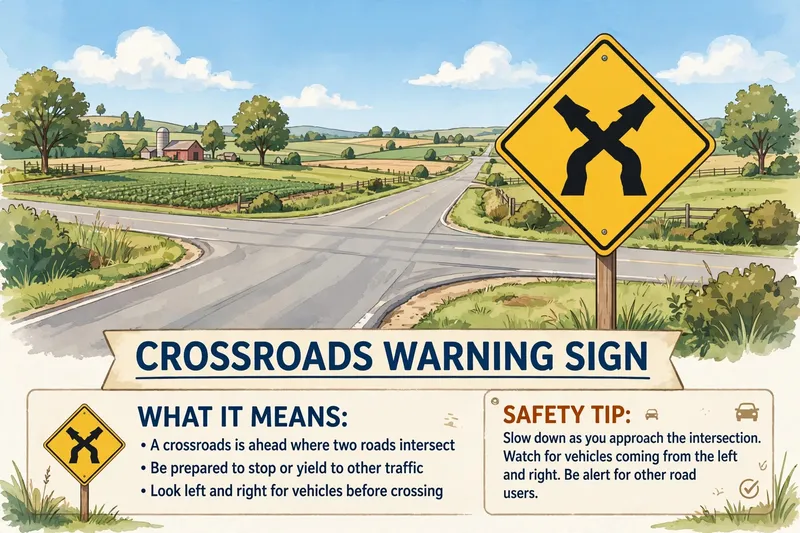
A crossroads sign is one of the most common warning signs on American roads, yet many drivers only half-understand what it is really telling them. You have probably seen it: a yellow diamond with a bold black plus symbol, standing quietly on the shoulder before an intersection. It looks simple, but it carries an important message, another road crosses your road ahead, and traffic could be coming from any direction.
In this guide, you will learn exactly what a crossroads sign means, what it looks like, where it is placed, how it differs from similar intersection signs, what the MUTCD (Manual on Uniform Traffic Control Devices) says about it, who has the right-of-way at a crossroads, and what you should do the moment you see one. By the end, you will understand this sign better than most licensed drivers.
What Is a Crossroads Sign?
A crossroads sign is a warning sign that alerts drivers to an upcoming intersection where another road crosses the road they are traveling on. In the MUTCD, it is officially designated W2-1 (Cross Road) and described in Section 2C.19.
Its job is advance warning. Unlike a stop sign or traffic signal, which tells you exactly what to do, a crossroads sign tells you to be ready: an intersection is coming, cross traffic may appear from the left or right, and vehicles ahead of you may slow down, stop, or turn. The sign buys you time, time to ease off the accelerator, scan the road, and prepare for whatever the intersection requires.
This is especially important on rural highways and suburban arterials, where intersections can appear suddenly after a curve or hill, and where drivers may be traveling at 45–55 mph with little expectation of cross traffic. The crossroads sign bridges that gap between expectation and reality.
It is worth knowing that a crossroads sign does not change the rules of the road. It does not grant anyone the right-of-way, and it does not require you to stop. The actual control at the intersection, stop signs, yield signs, traffic signals, or nothing at all, decides who goes first. The crossroads sign simply makes sure you are paying attention when you get there.
What Does a Crossroads Sign Look Like?
The American crossroads sign is easy to recognize once you know its features:
- Shape: Diamond (square rotated 45 degrees), the standard shape for warning signs in the United States
- Color: Yellow background with a black border and black symbol
- Symbol: A bold black cross (plus sign) centered on the diamond, representing two roads crossing at roughly right angles
- Type: Warning sign, it warns of a condition, it does not regulate behavior
The MUTCD specifies standard sizes for the W2-1 sign depending on the road:
| Road type | Minimum sign size |
|---|---|
| Conventional roads | 36 × 36 inches |
| High-speed, multi-lane, or expressways | 48 × 48 inches |
| Low-speed urban streets (minimum) | 30 × 30 inches |
Like other warning signs, the crossroads sign uses retroreflective sheeting, so headlights make it glow at night. The MUTCD requires agencies to maintain minimum retroreflectivity levels so the sign stays visible in rain, fog, and darkness, exactly the conditions when an unexpected intersection is most dangerous.
You may occasionally see the sign with a supplemental plaque underneath showing the distance to the intersection (for example, “500 FT”) or an advisory speed. These plaques give you even more precise information about what is coming.
Crossroads Sign vs. Similar Intersection Warning Signs
The crossroads sign is one member of a family of intersection warning signs in the MUTCD’s W2 series. Drivers often confuse them, so here is how they differ:
| Sign | MUTCD code | Symbol | Meaning |
|---|---|---|---|
| Cross Road | W2-1 | Plus/cross | Another road crosses your road ahead (four-way intersection) |
| Side Road | W2-2 | T rotated (left or right) | A side road joins from the left or right (three-way intersection) |
| T-Symbol | W2-3 | T shape | A T-intersection ahead where your road ends or is crossed perpendicularly |
| Y-Symbol | W2-4 | Y shape | A Y-intersection ahead where the road splits |
| Circular Intersection | W2-5 / W2-6 | Circular arrows | A roundabout ahead (one-lane or two-lane) |
The key difference is geometry. A crossroads sign (W2-1) means a road crosses all the way through, traffic can come from both the left and the right. A side road sign (W2-2) means a road joins from only one side. This matters because at a true crossroads, you must scan in both directions and expect turning movements from more approaches.
If you are studying for a permit test, learn this distinction cold, examiners love to test it.
Where Are Crossroads Signs Placed?
Placement is not random. The MUTCD gives engineers detailed guidance on advance placement distance, how far before the intersection the sign should stand. The distance depends mainly on speed, because faster drivers need more time to perceive, react, and slow down.
Typical advance placement distances for warning signs (approximate, per MUTCD Table 2C-4):
| Posted or 85th-percentile speed | Approximate advance distance |
|---|---|
| 25 mph | 100 feet |
| 35 mph | 250 feet |
| 45 mph | 400 feet |
| 55 mph | 550 feet |
| 65 mph | 700 feet |
These distances assume average conditions; engineers adjust them for grades, curves, sight obstructions, and crash history. That is why you will sometimes see a crossroads sign surprisingly far from the intersection on a fast rural highway, the sign is positioned for the speed of traffic, not for how the intersection looks to a pedestrian.
Crossroads signs are most commonly installed where:
- A minor road crosses a higher-speed highway and the intersection is not obvious (hidden by a curve, hill, or vegetation)
- Crash data shows drivers are being surprised by cross traffic
- An intersection has no traffic signal and limited sight distance
- A new development or road connection has changed traffic patterns
They are generally not needed at signalized intersections in urban areas, where traffic lights already command full attention, though you will still see them on higher-speed suburban arterials approaching signalized crossroads.
Why Crossroads Signs Matter: The Crash Numbers
Intersections are where the danger concentrates. According to the Federal Highway Administration (FHWA), roughly one-quarter of traffic fatalities and about half of all traffic injuries in the United States happen at or near intersections. That is a staggering share for locations that make up a small fraction of total road mileage.
The reasons are straightforward: intersections are the only places where vehicle paths legally cross each other. Every crossing path is a potential conflict point. A four-way crossroads has 32 vehicle conflict points, places where two vehicles’ paths can collide, compared to far fewer at a simple merge or curve.
A crossroads sign attacks the single biggest factor in intersection crashes: surprise. Many intersection collisions happen because a driver did not expect cross traffic, did not see the intersection in time, or misjudged another driver’s intentions. An advance warning sign directly reduces that surprise by putting the intersection on the driver’s mental radar hundreds of feet early.
This is also why agencies pair crossroads signs with other countermeasures at high-crash locations: bigger signs, flashing beacons, intersection lighting, rumble strips, or upgraded pavement markings. The sign is often the first and cheapest layer of defense.
What to Do When You See a Crossroads Sign
Seeing a crossroads sign is not an emergency, it is a prompt. Here is a calm, step-by-step response that works every time:
Ease off the accelerator. You do not need to brake hard, but reduce speed so you arrive at the intersection under full control. On a highway, dropping 5–10 mph makes a real difference in stopping distance.
Cover the brake. Slide your foot from the accelerator to hover over the brake pedal. This cuts your reaction time if something unexpected happens.
Scan left, right, and ahead. Start looking for the intersection itself, then check both cross directions for approaching vehicles. Look twice, a second glance catches the motorcycle or cyclist the first glance missed.
Watch for turning vehicles. Cars ahead of you may slow or stop to turn; cars on the cross road may pull out. Keep a generous following distance.
Identify the traffic control. As you get closer, look for the actual control devices: stop signs, yield signs, traffic signals, or pavement markings. These, not the warning sign, tell you who has the right-of-way.
Check for vulnerable road users. Intersections are where pedestrians cross and cyclists turn. A quick check of sidewalks and bike lanes is part of a complete scan.
Be ready at night and in bad weather. Rain, fog, and darkness shrink sight distance. If the crossroads sign appears, assume the intersection will be harder to read than it looks, and slow a little more.
Defensive drivers treat every crossroads sign as a reminder of one rule: expect someone to do the unexpected, the rolling stop, the sudden left turn, the car emerging from a hidden driveway just past the intersection.
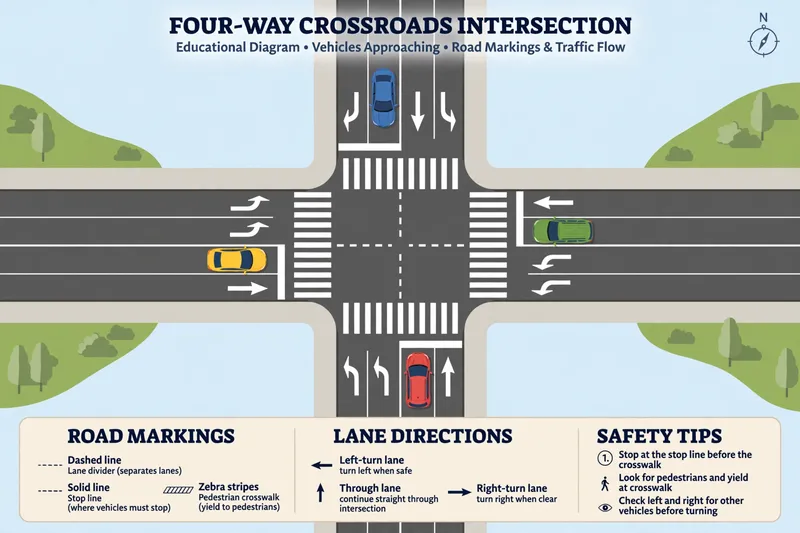
Right-of-Way Rules at Crossroads
The crossroads sign warns you an intersection is coming, but the right-of-way rules depend on what controls the intersection. Here are the three situations you will encounter:
At uncontrolled crossroads (no signs or signals)
When no stop signs, yield signs, or signals control the intersection, the standard rule applies: yield to the vehicle on your right. If you and another driver arrive at roughly the same time, the driver on the left yields to the driver on the right. If you arrive clearly first, proceed, but cautiously, because the other driver may not know the rule.
Uncontrolled crossroads are common in quiet residential areas and rural roads. They demand the most judgment, so slow down more than you think you need to and make eye contact with other drivers when possible.
At stop- or yield-controlled crossroads
Most crossroads have stop or yield signs on the minor road (the cross street), while the main road keeps moving. If you face the stop sign, you must stop fully and yield to all traffic on the through road, and to anyone who arrived at a four-way stop before you.
At a four-way stop, the rule is first to arrive, first to go. If two vehicles arrive simultaneously, yield to the one on your right. Hesitation causes confusion, so once it is your turn, go decisively.
At signalized crossroads
When traffic lights control the intersection, the signal governs everything. A green light means go, but still scan: red-light runners are one of the leading causes of serious intersection crashes. Never assume a green light guarantees a clear intersection.
One universal principle: the crossroads warning sign never overrides a regulatory sign or signal. Warning signs inform; regulatory signs command. If a warning sign and a stop sign seem to tell you different things, obey the stop sign.
Crossroads Signs Around the World
The plus-symbol concept is used internationally, but the design changes by country:
United States (MUTCD): Yellow diamond with a black cross, the W2-1 described in this guide.
United Kingdom: A red-bordered white triangle with a black cross. The vertical bar (the major road) is drawn thicker than the horizontal bar (the minor road). Often paired with a distance plate in yards.
Europe (Vienna Convention): Similar triangular warning sign with a black cross on white, red border, used across most of continental Europe.
Australia and New Zealand: Yellow diamond with a black cross, closely following the American style.
If you drive abroad, learn the local warning-sign shapes before you go: in the US, diamond means warning; in the UK and Europe, triangle means warning. The cross symbol itself, though, is nearly universal, two lines crossing means an intersection in every driving culture.
Common Driver Mistakes at Crossroads
Even experienced drivers make these errors. Check yourself against the list:
Treating the warning sign as a stop sign, or ignoring it entirely. Both are wrong. It means “be ready,” not “stop” and not “nothing.”
Scanning only one direction. At a true crossroads, traffic comes from both sides. Drivers who check left but not right (or vice versa) miss half the threat.
Following too closely through the intersection. If the car ahead brakes suddenly for cross traffic, tailgating turns their emergency into yours.
Assuming the cross street has a stop sign. On some crossroads, the side street has no control at all. Never assume another driver will stop.
Blocking the intersection. In heavy traffic, do not enter the crossroads unless you can clear it. Getting stuck sideways across traffic lanes is dangerous and, in many states, illegal.
Forgetting about pedestrians. Drivers focus so hard on cars that they miss the pedestrian stepping off the curb. Intersections are the most common place for vehicle-pedestrian collisions.
Crossroads Sign FAQs
What is the MUTCD code for the crossroads sign?
The crossroads sign is designated W2-1 (Cross Road) in the Manual on Uniform Traffic Control Devices (MUTCD), covered in Section 2C.19. The “W” stands for warning, “2” is the intersection series, and “1” identifies the cross-road variant specifically. You can read the official standards at mutcd.fhwa.dot.gov.
Is a crossroads sign a regulatory sign?
No. A crossroads sign is a warning sign, not a regulatory sign. Warning signs (yellow diamonds in the US) alert you to conditions ahead; regulatory signs (like stop signs and speed limits) tell you what you must do. You are not legally required to stop for a crossroads sign, but you are expected to drive with heightened caution.
What is the difference between a crossroads sign and an intersection sign?
The terms are often used interchangeably, but technically the crossroads sign (W2-1) shows a specific geometry: two roads crossing at roughly right angles. “Intersection sign” is a broader, informal term that can refer to any sign warning of a junction, including side-road (W2-2), T-intersection (W2-3), Y-intersection (W2-4), or roundabout (W2-5/W2-6) signs.
Do I have to stop at a crossroads sign?
No. The crossroads sign itself never requires a stop. Whether you must stop depends on the traffic control at the intersection, a stop sign, red light, or the need to yield to traffic with the right-of-way. Treat the warning sign as advance notice, then obey whatever control devices you find at the crossroads.
Why are crossroads considered dangerous?
Because they concentrate conflict points, places where vehicle paths cross. A four-way crossroads has 32 vehicle conflict points, and the FHWA reports that roughly a quarter of US traffic fatalities occur at or near intersections. Limited sight distance, high speeds, and driver inattention turn that geometry into real crashes, which is exactly why advance warning signs exist.
What should I do if the crossroads has no stop signs or signals?
Slow down significantly, cover your brake, and apply the uncontrolled-intersection rule: yield to traffic on your right. Make eye contact with other drivers when possible, scan both directions twice, and never assume the other driver will yield. In residential areas, expect pedestrians and children near the intersection as well.
How far before the intersection is a crossroads sign placed?
It depends on speed. Under MUTCD guidance, advance placement ranges from roughly 100 feet on 25-mph streets to about 700 feet on 65-mph highways, with engineers adjusting for curves, grades, and sight distance. If the sign seems far from the intersection, that usually means traffic is fast and drivers need the extra warning distance.
Conclusion
The crossroads sign is a small sign with a big job: eliminating surprise at the most conflict-heavy locations on the road. Now you know it is MUTCD sign W2-1, a yellow diamond warning of a four-way crossing ahead, not a command to stop, but a command to pay attention.
Remember the essentials: ease off the gas, scan both directions, identify the actual traffic control at the intersection, and never assume the other driver sees you or will yield. Intersections reward the alert and punish the distracted. With the crossroads sign as your early warning, you will arrive at every crossing prepared, which is exactly what the sign was designed to do.

Jack Harrison is a contributor at Square Root Signs, sharing creative ideas, useful information, and engaging content to help readers discover something valuable with every visit.