Dollar Sign ($): Meaning, History, Copy & Type Guide
The dollar sign ($) is the written symbol for the dollar, the official currency of the United States and more than twenty other countries. It looks like a capital S crossed by a single vertical line, though you will also meet a twin version with two strokes. From price tags and bank statements to code editors and spreadsheets, this tiny mark carries enormous weight in daily life.
I have spent years untangling the stories behind everyday symbols, and the dollar sign’s journey surprised me more than most. In this guide you will learn exactly what the dollar sign means, where it really came from, how to type it on any device, and how to use it correctly, plus a copy-paste table you can grab in seconds.
The Dollar Sign’s Spanish Peso Origins
The most widely supported origin of the dollar sign begins not in America but in the counting houses of the Spanish Empire. In the 1700s, merchants across the Americas abbreviated the Spanish peso, the dominant trade coin of the era, by writing a P with an S layered over it. Repeated by hand thousands of times, the mark simplified until the P’s curve vanished and only the $ remained.
When the young United States designed its own money, it copied the trusted Spanish milled dollar almost coin for coin. The Coinage Act of 1792 defined the US dollar to match the peso’s silver weight, so adopting the peso’s familiar handwritten mark was the natural choice. The dollar sign first appeared in American business documents around 1788 and in print shortly after 1800.
Dollar Sign Theories: Pillars of Hercules and the U Over S
A romantic rival theory says the dollar sign descends from the Pillars of Hercules stamped on Spanish colonial coins. Those coins showed two columns wrapped in a banner reading “Plus Ultra”, and some historians argue the twin columns plus the S-shaped ribbon merged into the $ over time. It is a beautiful story, and it explains the double-stroke variant elegantly.
You may also hear that the dollar sign stacks a U over an S for “United States.” This one is provably false: researcher Florian Cajori documented $ marks referring to pesos in papers that predate both the United States’ name and its dollar. The honest answer is that the peso abbreviation theory carries the strongest documentary evidence, while the pillars theory remains a respected runner-up.
How to Type the Dollar Sign on Any Keyboard
Typing the dollar sign is simple on almost every device, and the method barely changes across platforms. On a standard US keyboard layout, hold Shift and press 4, this works identically on Windows and Mac. On most European layouts, look for $ on the 4 key as well, sometimes requiring AltGr instead of Shift.
On phones and tablets, switch to the numbers-and-symbols keyboard: on iPhone, tap 123 then #+= to reveal $; on Android, tap ?123 and you will usually find it on the first symbols page. In HTML, type $ or $; in most programming contexts, the plain $ character works as-is.
These same shortcut patterns apply to other symbols, see how to type math symbols on any device.
| Device / Context | How to Type the Dollar Sign |
|---|---|
| Windows (US layout) | Shift + 4 |
| Mac (US layout) | Shift + 4 |
| iPhone / iPad | 123 → #+= → $ |
| Android | ?123 → $ |
| HTML entity | $ or $ |
| Windows Alt code | Alt + 36 (numeric keypad) |
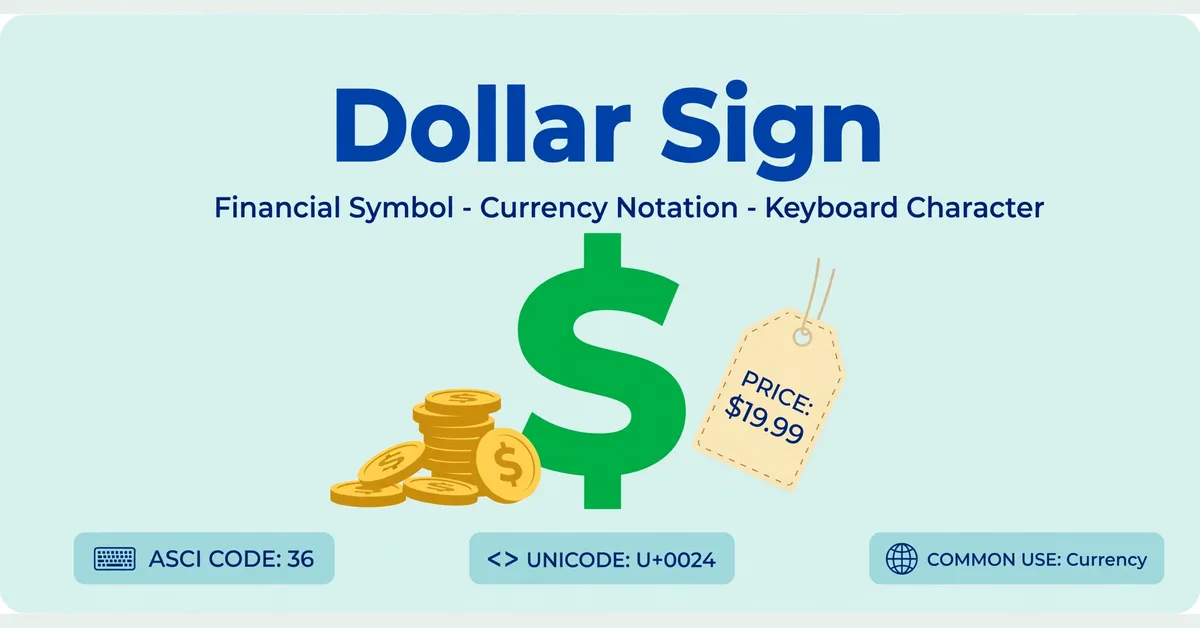
| Unicode | U+0024 |
Dollar Sign Unicode, HTML Code, and Copy-Paste Table
The standard dollar sign lives at Unicode code point U+0024, in the Basic Latin block, one of the first characters ever encoded, which tells you how fundamental it is to computing. Copy it here: $. Because the mark appears in so many writing systems, Unicode also defines several stylistic cousins worth knowing.
Use the table below to copy the exact dollar sign variant you need. For nearly all everyday writing, the plain U+0024 version is correct; the others exist for compatibility with East Asian typography and decorative contexts.
| Symbol | Name | Unicode | HTML |
|---|---|---|---|
| $ | Dollar sign | U+0024 | $ |
| $ | Fullwidth dollar sign | U+FF04 | $ |
| ﹩ | Small dollar sign | U+FE69 | ﹩ |
| 💲 | Heavy dollar sign emoji | U+1F4B2 | 💲 |
We keep similar copy-and-paste references for other symbols, like the radius sign.
Which Countries Use the Dollar Sign Today
More than twenty countries use a currency called the dollar, and most write it with the $ mark. To avoid confusion, writers usually add a prefix: US$ for American dollars, C$ or CA$ for Canadian dollars, and A$ for Australian dollars. The bare $ alone conventionally means US dollars in international writing.
The table below lists the major dollar sign currencies and how each is normally distinguished in print. If you write about money for a global audience, these prefixes are not optional, they are the difference between clarity and an expensive misunderstanding.
| Country | Currency | Common Written Form |
|---|---|---|
| United States | US dollar (USD) | $ or US$ |
| Canada | Canadian dollar (CAD) | C$ or CA$ |
| Australia | Australian dollar (AUD) | A$ |
| New Zealand | New Zealand dollar (NZD) | NZ$ |
| Singapore | Singapore dollar (SGD) | S$ |
| Hong Kong | Hong Kong dollar (HKD) | HK$ |
| Mexico | Mexican peso (MXN) | $ (same mark, different currency) |
The Dollar Sign in Programming and Spreadsheets
Programmers meet the dollar sign constantly, often with meanings far from money. In JavaScript, $ famously prefixes jQuery and marks template literals like Total: ${price}. In regular expressions, $ anchors a match to the end of a line, while in PHP every variable name begins with $.
In spreadsheets, the dollar sign locks cell references: $A$1 never shifts when you copy a formula, while A$1 locks only the row. Excel’s currency format adds $ automatically. One caution: in shells like Bash, an unquoted $ triggers variable expansion, so quote it when you mean a literal mark.
Dollar Sign Placement Rules and Common Mistakes
In American English, the dollar sign always precedes the number with no space: $50, never 50$ and never $ 50. This “symbol first” habit came from English-American colonial bookkeeping, unlike the Spanish custom of writing the mark after the figure. Keep the $ glued to the digits for clean, professional formatting.
The most common mistakes are doubling the mark ($$50), mixing currencies without a prefix ($ for Canadian prices in a US document), and writing $50 dollars, the symbol already says “dollars,” so the word is redundant. In formal writing, spell out “50 dollars” or use “$50”; never combine both.
Why the Dollar Sign Still Matters in a Digital World
Cryptocurrencies and cashless payments have not dented the dollar sign’s cultural power, if anything, they amplified it. The $ now anchors stock tickers, e-commerce prices, and meme culture alike, instantly signaling value in any context. Designers fight over its curves; economists track what follows it.
What fascinates me most is the mark’s quiet durability. Born as a merchant’s scribble on Spanish trade ledgers, the dollar sign survived empires, crossed oceans, and now lives inside every phone on earth. Few symbols can claim three centuries of continuous daily use, and fewer still do it with a single elegant stroke.
Dollar Sign FAQs
Why does the dollar sign sometimes have two vertical lines?
The double-stroke dollar sign is simply an older stylistic variant, not a different symbol. Early handwritten and printed forms often used two lines to make the mark stand out from surrounding letters; the single-line version became the American standard, while some typefaces and countries still prefer two.
What does the $ symbol mean before a number?
A $ placed before a number indicates an amount in dollars, most commonly US dollars, so $75 reads as “seventy-five dollars.” Always keep the symbol directly before the digits with no space, following American formatting convention.
Is the dollar sign only used for US dollars?
No. The dollar sign represents over twenty currencies, including the Canadian, Australian, and Singapore dollars, plus the Mexican peso. Writers distinguish them with prefixes like US$, C$, or A$; a bare $ internationally implies US dollars.
How do I type the dollar sign on a phone keyboard?
On iPhone, tap 123, then #+=, and select $. On Android, tap ?123 to open symbols where $ appears on the first page. Both methods work in any app, from messages to spreadsheets.
What is the Unicode for the dollar sign?
The standard dollar sign is Unicode U+0024, located in the Basic Latin block. Its HTML entity is $ (or $ in HTML5), and on Windows you can type it with Alt + 36 on the numeric keypad.
When was the dollar sign first used?
The $ mark appeared in American merchants’ handwritten ledgers around 1788, evolved from the Spanish peso abbreviation. The United States officially adopted the dollar as currency in 1792, and the symbol appeared in print shortly after 1800.

Jack Harrison is a contributor at Square Root Signs, sharing creative ideas, useful information, and engaging content to help readers discover something valuable with every visit.