Yield Sign: Meaning, Rules, Shape & DMV Tips
Written by: [ Arsalan Qureshi ]
Last updated: October 3, 2026
Based on the FHWA MUTCD 11th Edition with Revision 1, effective March 5, 2026.
A yield sign tells you to slow down, give the right-of-way to conflicting traffic, and stop when necessary. In the United States, the standard R1-2 sign is a downward-pointing triangle with a red border, white background, and red “YIELD” legend. It is used where drivers need to give way before proceeding.
This guide explains when to stop, who has priority, how the sign differs from a stop sign, and how yield rules work at intersections, merges, and roundabouts. You will also find common DMV test points, a copy-paste symbol reference, related signs, and practical examples that make the rule easier to understand.
What Does a Yield Sign Mean?
A yield sign requires road users to give the right-of-way to other traffic in the situations covered by the sign. Under Section 2B.05 of the MUTCD 11th Edition, drivers controlled by an R1-2 sign should slow to a speed reasonable for the conditions or stop when necessary to avoid interfering with conflicting traffic.
In simple terms, other traffic goes first when there is a conflict. You should approach slowly enough to evaluate vehicles, pedestrians, bicyclists, and available gaps. If another road user has priority, wait. If the way is clear and you can proceed without creating a conflict, a complete stop may not be necessary.
What does a yield sign mean in everyday driving?
Think of it as a right-of-way instruction rather than a simple command to stop. Slow down, look for traffic and people crossing your path, determine who has priority, and continue only when your movement is safe. State laws and the exact road layout can affect how right-of-way applies.
What Does a Yield Sign Look Like?
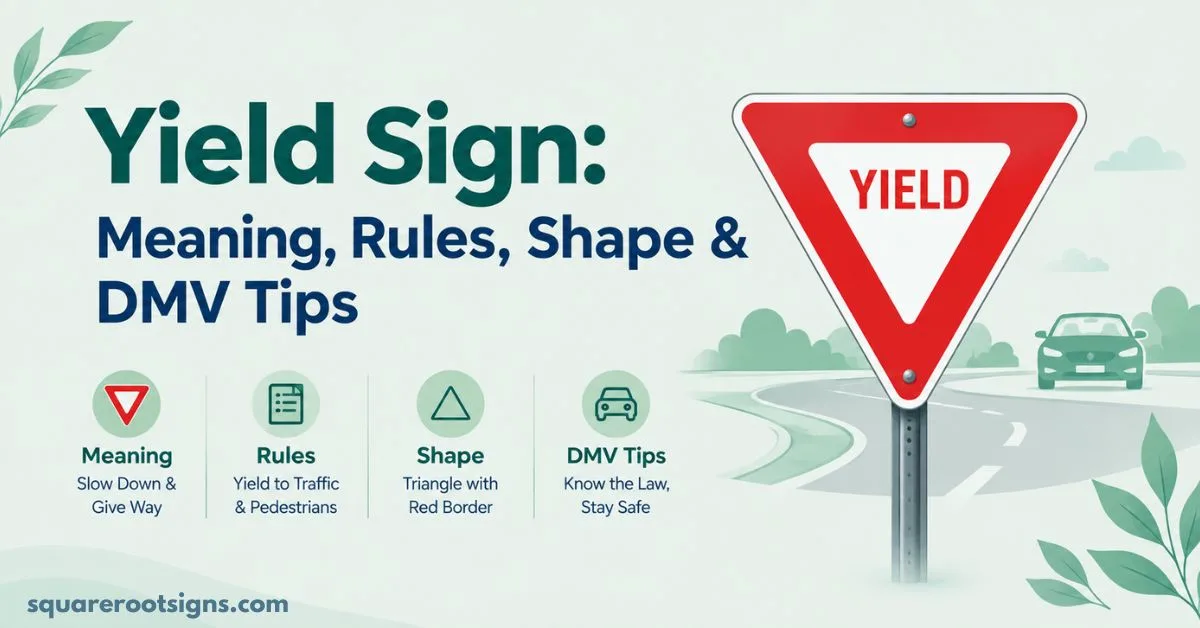
The standard U.S. R1-2 sign is an equilateral triangle pointing downward. It has a wide red border, a white background, and the word “YIELD” in red. The unusual inverted-triangle shape makes it easy to distinguish from other regulatory and warning signs.
The design is especially useful for quick recognition. A stop sign is an octagon, while many warning signs use a diamond shape. A Yield Ahead sign is also visually different because it warns that a yield point is approaching rather than controlling the exact point itself.
| Sign | Shape | Main purpose |
| Yield | Downward-pointing triangle | Give right-of-way |
| Stop | Octagon | Make a complete stop |
| Yield Ahead | Diamond | Warn of an upcoming yield |
| Merge | Diamond | Warn that traffic lanes are joining |
The Federal Highway Administration identifies the standard yield sign as R1-2 in the MUTCD.
When Should You Stop at a Yield Sign?
You should stop when stopping is necessary to give the right-of-way safely. For example, if another vehicle is approaching your path closely or a pedestrian is crossing where you must yield, continuing could interfere with that road user. The MUTCD specifically requires slowing or stopping as necessary to avoid interfering with conflicting traffic.
The safest approach is to reduce speed early, check the complete conflict area, and decide whether you have enough space to proceed. Do not treat every yield location as an automatic stop, but do not roll through it simply because you have already slowed down.
Do you always have to stop at a yield sign?
No. A yield sign does not automatically require a full stop every time. You must give way and stop when necessary to avoid interfering with conflicting traffic. New York’s Driver’s Manual gives the same practical instruction: slow down, prepare to stop, and stop if traffic conditions require it.
Yield Sign vs Stop Sign
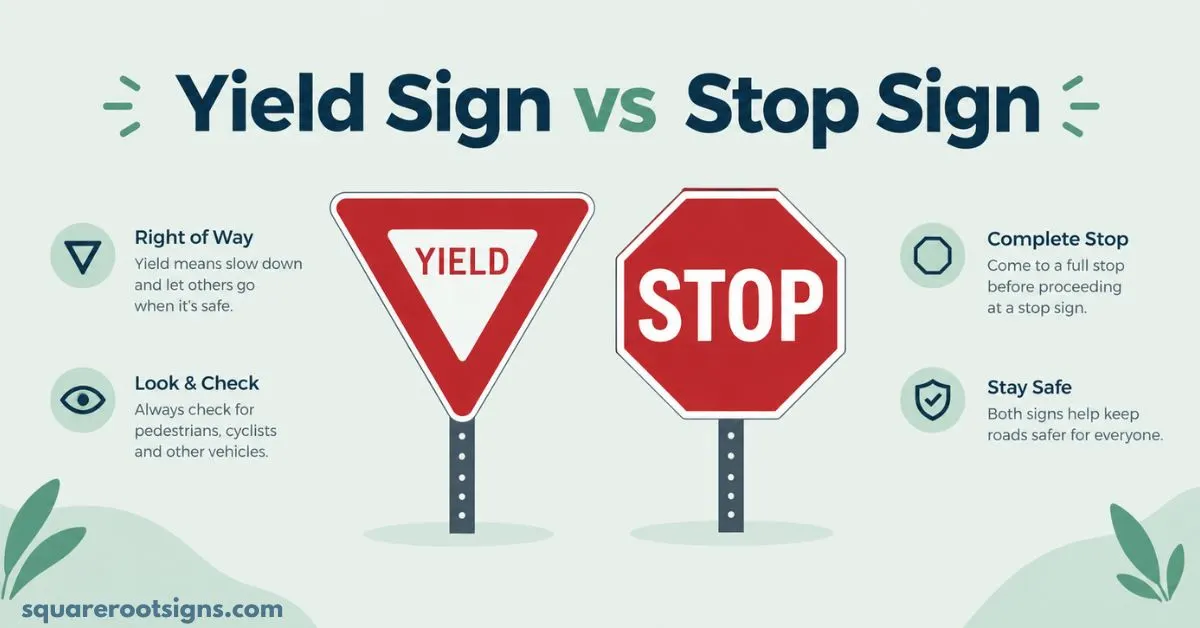
The key difference is that a stop sign requires a complete stop, while a yield sign requires you to give way and stop when necessary. This distinction matters because the signs control traffic differently even though both are regulatory devices.
For a stop sign, the driver must stop before proceeding. With a yield sign, the driver first reduces speed and evaluates the traffic situation. If another road user has priority, the driver waits; if there is no conflict, the driver may proceed without an unnecessary full stop.
| Feature | Yield Sign | Stop Sign |
| Standard shape | Inverted triangle | Octagon |
| Main instruction | Give right-of-way | Stop completely |
| Full stop | When necessary | Required |
| Traffic assessment | Before proceeding | After stopping |
| Common use | Intersections, roundabouts, some merges | Controlled intersections and approaches |
California DMV’s driving-performance criteria also distinguishes yielding from stopping: drivers should yield when necessary for safety and avoid an unnecessary stop.
Where Are Yield Signs Commonly Used?
Yield signs can be used at certain intersection approaches, at two-way approaches to one-way roadway sections, and in other locations where right-of-way needs to be assigned. The MUTCD also specifically requires a yield sign at the entrance to a roundabout.
You may therefore encounter them at intersections, roundabouts, channelized movements, narrow roadway sections, and some merge-type locations. The exact installation depends on roadway design, traffic conditions, engineering decisions, and applicable state or local requirements.
How to Merge at a Highway Yield Sign
When entering a highway, traffic already traveling in the lane generally has priority over entering traffic. If a ramp or entrance is controlled by a yield sign, do not force your vehicle into an occupied lane. Slow down, identify a safe gap, and merge without making another driver brake or swerve unnecessarily.
State handbooks can provide more detailed procedures for highway merging. California DMV, for example, advises drivers entering highways to use the entrance ramp, get near the speed of traffic, find a safe gap, and merge when safe.
Common Mistakes Drivers Make
The most common problems are usually misunderstandings about priority, speed, and stopping. A driver can know the sign’s shape but still mishandle the situation.
Watch for these mistakes:
- Treating a yield sign as an automatic stop every time.
- Assuming slowing down means you no longer need to give way.
- Looking only to one side before entering an intersection.
- Ignoring pedestrians or bicyclists who have priority.
- Entering a merge when the available gap is too small.
- Following another vehicle through without making your own traffic check.
The goal is not simply to stop or continue. The goal is to give priority correctly and avoid creating a conflict.
DMV Test Tips for Yield Signs
For a DMV knowledge test, remember the relationship between shape and instruction. The inverted triangle identifies YIELD, while the octagon identifies STOP. A yield question may then test whether you understand when a complete stop is actually necessary.
Pay particular attention to questions involving intersections, pedestrians, roundabouts, and merging. These questions often test your understanding of right-of-way rather than your ability to memorize the appearance of a sign.
How can I recognize a yield sign quickly?
Look for the downward-pointing triangle. The standard U.S. design has a red border, white center, and red “YIELD” legend. Because its shape is distinctive, recognizing the triangle can help you identify the sign before you have time to read the entire message.
Is a yield sign the same as a stop sign on the DMV test?
No. The two signs have different instructions. A stop sign requires a complete stop, while a yield sign requires you to give the right-of-way and stop when necessary. A test question may describe a clear roadway specifically to see whether you understand that distinction.
Yield Sign Emoji & Symbol Copy-Paste
There is no dedicated Unicode character for the official U.S. yield traffic sign. However, several geometric characters can represent its basic downward-triangle shape.
| Symbol | Unicode name | Code point | HTML entity |
| ▽ | White Down-Pointing Triangle | U+25BD | ▽ |
| ▼ | Black Down-Pointing Triangle | U+25BC | ▼ |
| 🔻 | Down-Pointing Red Triangle | U+1F53B | 🔻 |
Unicode identifies 🔻 as DOWN-POINTING RED TRIANGLE, while ▼ is BLACK DOWN-POINTING TRIANGLE.
Copy a yield sign symbol
▽
▼
🔻
For a simple text representation, ▽ most closely communicates the outline of an inverted triangle. However, none of these characters reproduces the official R1-2 road sign.
One-tap copy: You can place a small copy button next to each character on the live page using JavaScript. Keep the actual symbol visible in HTML so search engines and accessibility tools can identify the content.
Example HTML:
<button type=”button” onclick=”navigator.clipboard.writeText(‘▽’)”>Copy ▽</button>
<button type=”button” onclick=”navigator.clipboard.writeText(‘▼’)”>Copy ▼</button>
<button type=”button” onclick=”navigator.clipboard.writeText(‘🔻’)”>Copy 🔻</button>
Yield Ahead, Yield Lines & Related Signs
Yield Ahead is an advance warning that tells drivers a yield point is coming. It is different from the R1-2 yield sign itself, which controls the location where drivers must give way.
A yield line is a roadway marking associated with a yield requirement. The MUTCD specifies that a yield line pavement marking must be used with an appropriate yield traffic-control device and should not be used where drivers are required to stop.
| Related item | What it does |
| Yield sign R1-2 | Assigns right-of-way |
| Yield Ahead W3-2 | Warns of a yield ahead |
| Yield line | Marks a roadway location associated with yielding |
| Yield Here to Pedestrians | Establishes a pedestrian-yield location |
| Roundabout yield | Controls entering traffic |
These distinctions are useful because a warning sign, regulatory sign, and pavement marking do not perform exactly the same function.
A Simple Yield Sign Scenario
Imagine you approach a yield-controlled entrance and see a vehicle already traveling across your path. If you enter immediately, that driver would have to brake or change direction to avoid you.
You slow down and wait. Once the vehicle passes and a safe gap appears, you proceed. If the roadway is already clear, you may not need a complete stop.
That simple situation captures the central rule: when there is a conflict, the traffic with priority goes first.
Why Giving Way Matters
Yielding is not just a test question; it is an important part of road-user safety. NHTSA identifies failure to yield as a recurring factor in pedestrian and bicycle crash contexts. In one NHTSA-cited crash analysis, failure to yield was the primary motorist action in 48% of pedestrian crashes where the motorist action was known. That figure comes from a specific crash study, not a nationwide estimate for all U.S. crashes, so it should not be treated as a national yield-crash rate.
NHTSA also describes driver yielding as an important safety measure when evaluating pedestrian-safety programs and roadway behavior. The practical lesson is straightforward: recognizing who has priority and allowing them to proceed can help prevent conflicts before they become crashes.
Yield Signs in Different Countries
In the United States, the familiar wording is YIELD. In many other countries, the equivalent instruction is commonly expressed as Give Way. The general concept is similar—allow traffic with priority to proceed—but sign designs, wording, and local right-of-way rules can differ.
| Region/example | Common wording | General concept |
| United States | YIELD | Give right-of-way |
| United Kingdom | GIVE WAY | Give priority to other traffic |
| Other countries | Often local-language equivalent | Rules depend on local law |
If you are studying for a U.S. DMV test, use the U.S. MUTCD design and your state’s driver handbook rather than assuming another country’s rules apply.
Yield Sign FAQ
What does a yield sign mean?
A yield sign means you must give the right-of-way to conflicting traffic and proceed only when it is safe. You should slow to a reasonable speed and stop when necessary to avoid interfering with other road users. The standard U.S. sign is identified as R1-2 in the MUTCD.
Do you have to stop at a yield sign?
Not automatically. You must stop when a complete stop is necessary to give the right-of-way safely. If the roadway is clear and you can proceed without interfering with conflicting traffic, you may continue after slowing and checking the situation. State rules can provide additional requirements.
Who has the right-of-way at a yield sign?
The road user with priority under the applicable right-of-way rules goes first. At a typical yield-controlled approach, traffic already using the roadway may have priority over entering traffic. Pedestrians and bicyclists may also have priority depending on the situation and state law.
Is a yield sign required at a roundabout?
The MUTCD requires a YIELD sign to assign right-of-way at the entrance to a roundabout. The sign controls approaching traffic rather than vehicles already circulating inside the roundabout.
What is the difference between Yield Ahead and Yield?
Yield Ahead warns that a yield point is coming. The actual R1-2 YIELD sign assigns right-of-way at the controlled location. They therefore serve different purposes: one provides advance warning and the other provides the regulatory instruction.
What is a yield line?
A yield line is a roadway marking used with a yield requirement. The MUTCD states that a yield line should not be installed without an applicable yield sign or another traffic-control device requiring drivers to yield.
Can you be cited for failing to yield without a crash?
Potentially, yes, but the specific offense and penalty depend on the state and circumstances. A collision is not necessarily required for a driver to violate a failure-to-yield law. For a specific legal consequence, check the traffic code or official driver guidance for the state involved.
Final Takeaway
A U.S. yield sign tells drivers to slow down, give the right-of-way, and stop when necessary. The standard R1-2 design is an inverted triangle with a red border, white background, and red “YIELD” legend. The current FHWA MUTCD identifies the sign in Section 2B.05.
For a DMV test or everyday driving, remember the simplest rule: when your movement conflicts with traffic that has priority, let that traffic go first. Check the signs, pavement markings, pedestrians, bicyclists, and roadway conditions before proceeding.

Jack Harrison is a contributor at Square Root Signs, sharing creative ideas, useful information, and engaging content to help readers discover something valuable with every visit.