Mayan Zodiac Sign Calculator: Find Your Day Sign
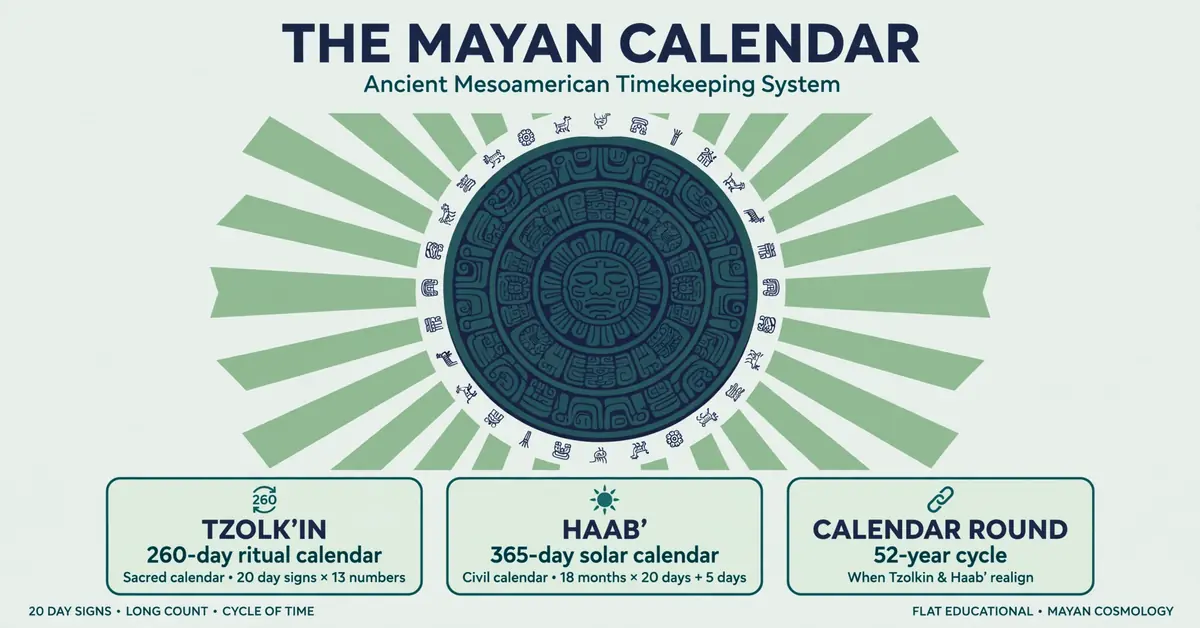
A Mayan zodiac sign calculator helps you find the day sign and number associated with your birth date in the Maya sacred calendar known as the Tzolk’in. This 260-day calendar combines 20 day names with 13 numbers to create 260 unique combinations.
Enter your birth date into a calculator that identifies its calendar system to discover your corresponding day sign. Your result may include a day name, a number, and additional calendar information, depending on the tool you use.
If different websites give you different Mayan zodiac signs, the reason may be that they follow different calendar conventions. The traditional Tzolk’in count and the modern Dreamspell system are not interchangeable. Understanding this distinction helps you interpret your result accurately.
[Calculator insertion point: Place the working birth-date calculator here, above the main explanatory sections.]
What Is the Tzolk’in Calendar?
The Tzolk’in is a 260-day sacred calendar associated with Maya communities and traditions. It combines two repeating sequences: 20 named days and 13 numbers. Together, these sequences create 260 unique day combinations before the pattern repeats.
The calendar is also known as the Chol Q’ij in K’iche’, a Maya language spoken in Guatemala. The name Tzolk’in is associated with Yucatec Maya usage.
The Tzolk’in is one part of a broader Maya calendrical tradition. Other important systems include the Haab, a 365-day calendar, and the Long Count, which records elapsed days and longer chronological periods.
Why does the Tzolk’in have 260 days?
The calendar pairs 20 day names with 13 numbers. Since 13 and 20 have no common factor greater than one, every number-and-name combination appears before the full sequence repeats.
The least common multiple of 13 and 20 is 260. Therefore, the complete cycle contains 260 unique combinations.
How to Calculate Your Mayan Zodiac Sign
To find your Maya day sign, you need your Gregorian birth date and a calculator that explains which calendar convention it follows.
- Enter your birth date. Select the month, day, and year using the calculator’s date fields.
- Identify the calendar system. Check whether the tool uses the traditional Tzolk’in count, Dreamspell, or another modern adaptation.
- Convert the date. The tool maps your Gregorian date to a position in its selected calendar system.
- Read your result. A traditional-count calculator may display a day name and a number from 1 to 13.
- Review the methodology. Check the tool’s documentation if you want to compare your result with another calendar converter.
What is the GMT correlation?
Many Maya calendar converters use the Goodman–Martínez–Thompson (GMT) correlation, commonly associated with the constant 584,283.
This constant connects Maya Long Count dates with Julian Day Numbers in a widely used conversion convention.
Do you need your birth time?
Most online birth-sign calculators require only a birth date. However, you should check the specific tool’s rules if you were born close to midnight.
The 20 Maya Day Signs
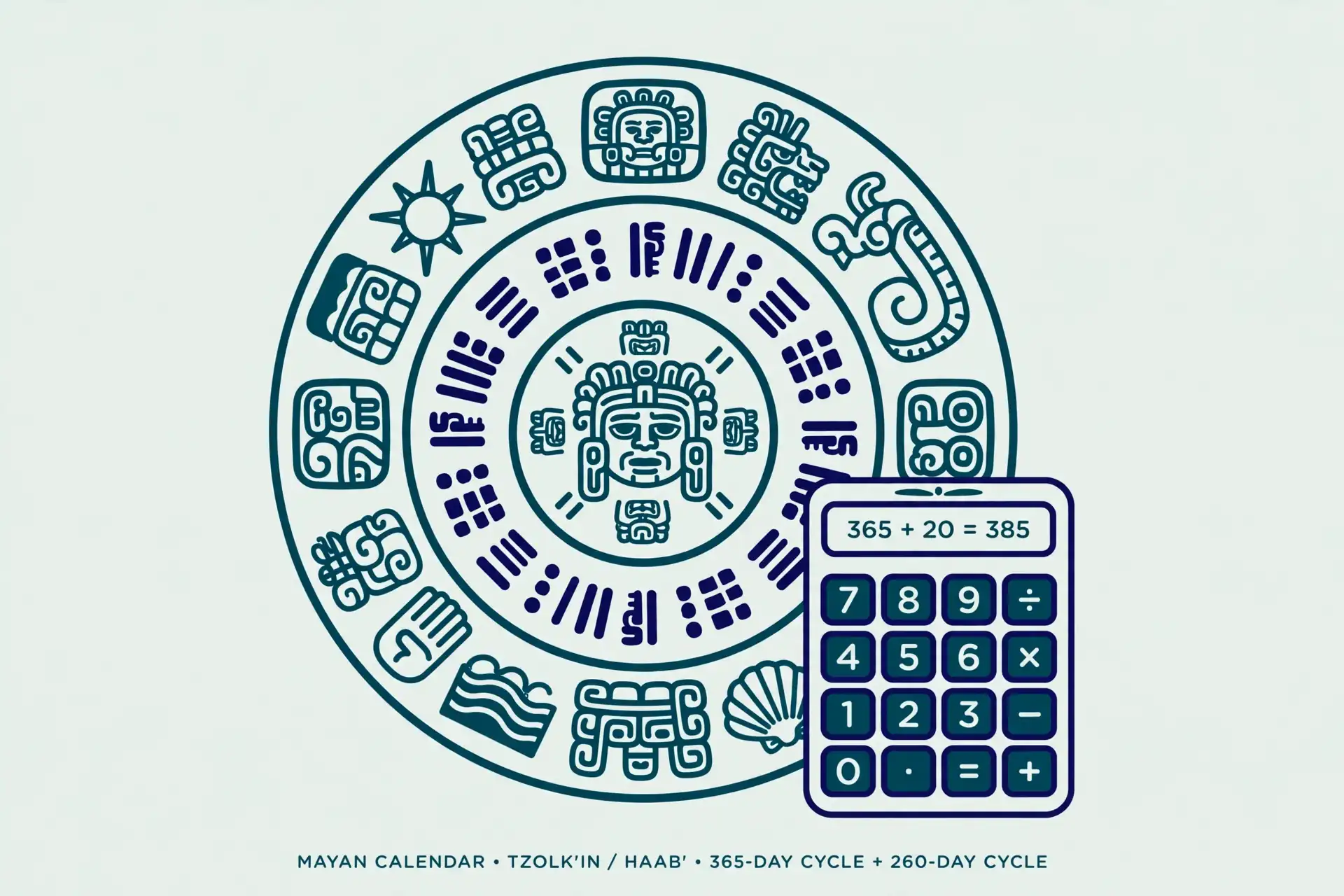
The Tzolk’in includes 20 named day signs. Names and spellings vary between Maya languages and transcription systems. The following table shows commonly used Yucatec forms alongside corresponding K’iche’ forms.
| Yucatec day name | K’iche’ counterpart |
|---|---|
| Imix’ | Imox |
| Ik’ | Iq’ |
| Ak’b’al | Aq’ab’al |
| K’an | K’at |
| Chikchan | Kan |
| Kimi | Kame |
| Manik’ | Kej |
| Lamat | Q’anil |
| Muluk | Toj |
| Ok | Tz’i’ |
| Chuwen | B’atz’ |
| Eb’ | E |
| B’en | Aj |
| Ix | I’x |
| Men | Tz’ikin |
| K’ib’ | Ajmaq |
| Kab’an | No’j |
| Etz’nab’ | Tijax |
| Kawak | Kawoq |
| Ajaw | Ajpu’ |
What do the day signs mean?
A day sign’s significance depends on the cultural, linguistic, and interpretive context in which it is used.
What Are the 13 Numbers or Tones?
Every Tzolk’in date combines a day name with a number from 1 through 13. Together, the sequences produce the calendar’s 260 unique combinations.
How the numbers and day names work together
The number sequence returns to its beginning after 13 days, while the sequence of 20 day names returns to its beginning after 20 days. The same complete pairing does not return until 260 days have passed.
The Haab’ Calendar: The 365-Day Year That Completes the Calendar Round
The Tzolk’in is only half of a full Maya date. The other half is the Haab’, the 365-day solar calendar the Maya used for farming, festivals and the civil year. It has 18 months of 20 days each, 360 days, plus 5 extra days called the Wayeb’ at the end of the year, giving 365 days in total. Unlike our Gregorian calendar, the Haab’ has no leap days, so it slowly drifts against the seasons, by about one day every four years.
The 18 Haab’ months are Pop, Wo, Sip, Sotz’, Sek, Xul, Yaxk’in, Mol, Ch’en, Yax, Sak, Keh, Mak, K’ank’in, Muwan, Pax, K’ayab and Kumk’u, followed by the 5 Wayeb’ days. In Maya tradition the Wayeb’ days were treated as a careful, in-between time, when the old year had ended and the new one had not yet begun.
Run together, the 260-day Tzolk’in and the 365-day Haab’ form the Calendar Round: a full date names both counts, for example 4 Ajaw 3 K’ank’in. Because 260 and 365 share only the factor 5, any exact combination comes back only after 18,980 days, about 52 years, which is 73 Tzolk’in cycles. The most famous Calendar Round date of modern times is 4 Ajaw 3 K’ank’in, the Long Count date 13.0.0.0.0, which fell on December 21, 2012. It marked the end of a 13-baktun cycle of about 5,125 years, not the end of the world, as the Smithsonian’s Maya programme explains.
How to Understand Your Calculator Results
| Result | What it generally represents |
|---|---|
| Day sign | One of the 20 named days in the Tzolk’in |
| Number | A coefficient from 1 through 13 paired with the day name |
| Tzolk’in date | The complete number-and-day-name combination |
| Haab date | A date in the separate 365-day calendar |
| Long Count | A representation of elapsed time |
| Kin number | A term used by some modern systems; meaning depends on the system |
What does a kin number mean?
The word kin is associated with a day in Maya calendrical terminology. Some modern spiritual systems use kin number to identify a position in their own sequence.
Can your day sign describe your personality?
Some modern interpretations connect day signs with character traits, but they are not scientifically established personality tests.
Traditional Tzolk’in vs. Dreamspell
The traditional Tzolk’in count and Dreamspell are distinct systems. Dreamspell is a modern system developed by José Argüelles in the late twentieth century.
Why do calculators disagree?
- Different calendar systems
- Different conversion conventions
- Different date-handling rules
- Different naming systems
- Unclear methodology
How the Maya Calendar Differs From Western Astrology
Western astrology uses 12 zodiac signs. The Tzolk’in uses 20 day names and 13 numbers in a repeating 260-day cycle.
Can you have both a Western and a Maya day sign?
Yes. You can identify a Western zodiac sign and a Tzolk’in day designation for the same birthday because the two systems use different frameworks.
Maya Calendar History and Living Traditions
Maya civilization has a long history, but Maya culture is not confined to the past. Maya peoples continue to live throughout Mesoamerica and in communities elsewhere.
Where can you learn more?
The Smithsonian National Museum of the American Indian provides educational resources about Maya timekeeping through Living Maya Time.
Frequently Asked Questions
1. How do I find my Mayan zodiac sign?
Enter your birth date into a calculator that identifies its calendar system.
2. What is a Mayan zodiac sign calculator?
It is a tool that converts a birth date into a day sign using a specified Maya calendar or modern adaptation.
3. What is the Tzolk’in calendar?
The Tzolk’in is a 260-day sacred calendar that combines 20 named days with 13 numbers.
4. Why do different Mayan zodiac calculators give different results?
They may use different calendar systems, correlations, date conventions, or naming systems.
5. Do I need my birth time to calculate my Maya day sign?
Many online tools require only the birth date.
6. What are the 20 Maya day signs?
The Tzolk’in contains 20 day names, including Imix’, Ik’, Ak’b’al, K’an, Chikchan, Kimi, Manik’, Lamat, Muluk, Ok, Chuwen, Eb’, B’en, Ix, Men, K’ib’, Kab’an, Etz’nab’, Kawak, and Ajaw.
7. What do the 13 numbers mean?
The numbers from 1 through 13 form a repeating sequence that combines with the 20 day names.
8. Is Dreamspell the same as the traditional Tzolk’in?
No. Dreamspell is a modern system with its own calendar conventions.
9. Is Maya astrology scientifically proven to determine personality?
No. Claims that a day sign determines personality are not scientifically established.
10. Where can I verify a Maya calendar date?
The Smithsonian National Museum of the American Indian provides a Maya Calendar Converter.
What is the Haab’ calendar?
The Haab’ is the Maya 365-day solar calendar: 18 months of 20 days plus the 5 Wayeb’ days. Paired with the 260-day Tzolk’in, it forms the Calendar Round, which repeats every 52 years.
Conclusion
A Mayan zodiac sign calculator can help you explore your birth date within the 260-day Tzolk’in calendar. The most important step is to understand which calendar method your calculator uses.
Keep exploring your Mayan zodiac sign calculator results: compare Western sun and moon signs, try our moon sign calculator, or read the encyclopedia overview of the Maya calendar.

Jack Harrison is a contributor at Square Root Signs, sharing creative ideas, useful information, and engaging content to help readers discover something valuable with every visit.