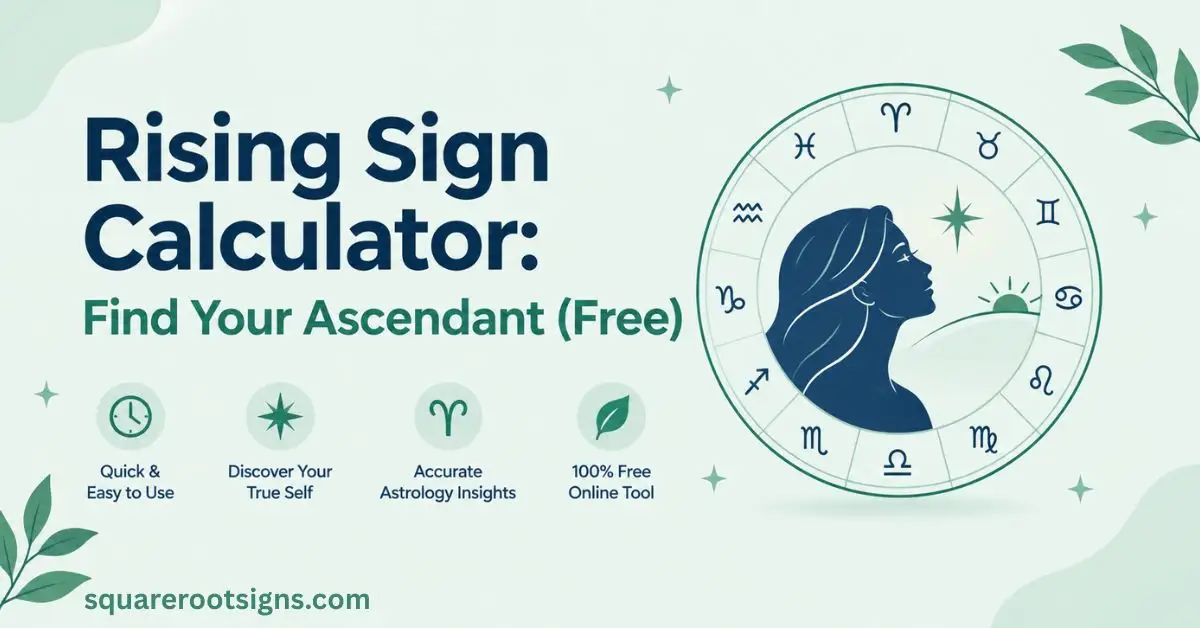
Rising Sign Calculator: Find Your Ascendant (Free)
By Muhammad Arsalan Qureshi
Last updated: October 4, 2026
Use the rising sign calculator above to find your Ascendant using your birth date, exact birth time, and birthplace. Your rising sign is the zodiac sign rising on the eastern horizon at the moment of birth, and even a relatively small time difference can matter when your birth falls near a sign boundary.
[Place the live Rising Sign Calculator here — above the main explanatory content]
If you are trying to understand why your Sun sign does not seem to describe you completely, your rising sign, Ascendant, birth chart, first house, and Big Three can provide another layer of context. This guide explains how a rising sign calculator works, why birth time and location matter, why two calculators can disagree, what to do without a recorded birth time, and how each of the 12 rising signs is traditionally interpreted.
How Does a Rising Sign Calculator Work
A rising sign calculator uses your birth date, local birth time, and birthplace to determine which zodiac sign was crossing the eastern horizon at that moment. The calculation depends on the location as well as time because the eastern horizon changes according to where you were born. In astrology, this point is called the Ascendant or rising sign.
The calculator must also account for the relationship between local clock time and the astronomical time used in the calculation. That means the correct time zone, daylight saving time, geographic location, latitude, and longitude can affect the result. A calculator that converts these inputs incorrectly can return a different Ascendant even when the date and clock time look identical.
What information do you need?
| Birth information | Why it matters |
| Birth date | Establishes the calendar date used for the chart |
| Exact birth time | Determines the horizon position at the moment of birth |
| Birth city/location | Establishes geographic coordinates |
| Time zone | Converts local clock time correctly |
| Daylight saving time | Can change the effective UTC offset |
| Zodiac system | Tropical and sidereal systems can produce different sign positions |
For the most reliable result, enter the information exactly as it appears on your birth record rather than estimating from memory.
Why Do You Need Your Exact Birth Time?
The Ascendant moves through the zodiac much more quickly than the Sun sign. It changes, on average, about every two hours, although the actual amount of time a sign remains on the eastern horizon varies with geographic latitude. That is why a birth time that seems “close enough” can sometimes produce a different rising sign.
Birth time becomes especially important when your Ascendant is close to a sign boundary. In that situation, a difference of several minutes may potentially move the calculated degree toward another sign. This is also why serious birth-chart calculations treat the recorded birth time as an important input rather than simply using noon as a universal substitute.
How accurate does your birth time need to be?
The answer depends on where the Ascendant falls within the sign. If your recorded time is off by only a few minutes and the Ascendant is comfortably inside a sign, the sign itself may remain unchanged even though the degree moves. If the birth occurs near a sign boundary, however, a small time difference can become much more important.
If you do not know your birth time, do not assume that noon will give you a reliable rising sign. Some calculators use noon as a default, but that produces an assumed result rather than establishing the actual Ascendant. Astrology.com, for example, notes that noon may be used as a default when the exact time is unknown, while other calculators explicitly warn that the Ascendant is highly time-sensitive.
Why Do Two Rising Sign Calculators Give Different Results?
Two rising sign calculators can produce different answers when they use different assumptions about the birth data or zodiac framework. The most common issues involve the time zone, daylight saving time, historical time-zone rules, geographic coordinates, tropical versus sidereal zodiac, and the actual birth time entered.
The house system is another detail worth understanding, but it normally does not change the Ascendant sign itself. Different house systems can change house cusps and planetary house placements while leaving the Ascendant calculation based on the same horizon point. Cafe Astrology, for example, offers separate chart calculations using systems such as Placidus, Whole Sign, Equal, and Koch.
Tropical vs. sidereal zodiac
The tropical zodiac and sidereal zodiac use different reference frameworks. A calculator using tropical astrology can therefore give a different sign from one using a sidereal system, even when the birth date, time, and location are identical.
This does not necessarily mean one calculator has made a mathematical mistake. It may mean the two tools are answering the question under different astrological conventions. Cafe Astrology, for example, identifies Tropical Zodiac as its default while also providing a separate sidereal calculator using the Lahiri ayanamsha.
When comparing results, check the calculator’s zodiac setting before assuming that one result is wrong.
Time zone and daylight saving time
The time-zone conversion is one of the most important technical steps in calculating an Ascendant. A birth recorded as 3:00 PM local time must be converted according to the rules that applied at that location and date.
This becomes more complicated for historical births because daylight-saving rules and local time standards have changed over time. Cafe Astrology specifically warns that historical time-zone information can be less certain, particularly for births before 1970.
What Does Each Rising Sign Mean?
In traditional astrology, your rising sign is used to describe your outward approach to life, first impressions, instinctive responses, and the way you may appear to others. These interpretations are symbolic rather than scientifically established personality measurements, so they are best treated as an astrological framework for reflection rather than a diagnostic system.
The table below gives a quick starting point for all 12 Ascendant signs. For a complete interpretation, each sign can be expanded into its own dedicated page and connected to its chart ruler, first house, planets near the Ascendant, and aspects.
| Rising sign | Traditional astrology themes |
| Aries Rising ♈ | Direct, energetic, independent, quick to act |
| Taurus Rising ♉ | Steady, grounded, patient, comfort-oriented |
| Gemini Rising ♊ | Curious, communicative, adaptable, observant |
| Cancer Rising ♋ | Protective, receptive, caring, emotionally aware |
| Leo Rising ♌ | Expressive, confident, warm, noticeable |
| Virgo Rising ♍ | Practical, analytical, observant, detail-focused |
| Libra Rising ♎ | Diplomatic, social, balanced, relationship-aware |
| Scorpio Rising ♏ | Intense, private, perceptive, self-contained |
| Sagittarius Rising ♐ | Adventurous, open, optimistic, freedom-oriented |
| Capricorn Rising ♑ | Reserved, disciplined, responsible, goal-focused |
| Aquarius Rising ♒ | Independent, unconventional, intellectual, future-minded |
| Pisces Rising ♓ | Sensitive, imaginative, receptive, compassionate |
These are broad sign-level descriptions, not complete birth-chart readings. The Ascendant’s ruling planet, its aspects, planets near the Ascendant, and the rest of the natal chart can substantially change how an individual interpretation is expressed.
What Is the Difference Between Your Sun, Moon, and Rising Sign?

The Sun sign, Moon sign, and rising sign are commonly called the Big Three in astrology, but they represent different parts of a chart.
| Sign | Common astrological association | Main calculation factor |
| Sun sign | Core identity, vitality, self-expression | Birth date |
| Moon sign | Emotional patterns and inner responses | Birth date, time, and location can matter |
| Rising sign | Outward approach, first impression, chart orientation | Exact birth time and birthplace |
Your Sun sign can often be determined from the birth date alone, while the Ascendant is much more sensitive to the exact time and place of birth. The Moon moves through signs more quickly than the Sun but generally more slowly than the Ascendant.
This is why someone can be, for example, a Leo Sun, Pisces Moon, and Scorpio Rising. The three placements are not competing answers; they are different positions within the same natal chart.
What If You Don’t Know Your Birth Time?
If your birth time is unknown, you cannot reliably determine the exact rising sign from the birth date alone. The Ascendant depends directly on the eastern horizon at a particular location and moment, so removing the time removes one of the essential inputs.
You may still be able to narrow down the possibilities. A birth-time investigation can compare the signs that were rising during the relevant date and location, but that is different from claiming one sign as certain. Some astrologers also use birth-time rectification, which attempts to estimate a birth time by comparing important life events with possible charts. Rectification is an interpretive astrological practice, not a guaranteed recovery of a missing historical time.
How to find your birth time
Start with the most reliable records available in the country where you were born. Depending on the country and year, useful sources can include:
- Birth certificate or civil registration record
- Hospital or maternity records
- Family records
- Religious or community birth records
- Government vital-record offices
- Older family documents
- Records held by parents or close relatives
The exact availability of these records differs by country. In the United States, a birth certificate is often the first place to check, but requirements and record access vary by state.
If your record gives a time such as 2:35 PM, use that rather than rounding it to 3:00 PM.
What Does Your Rising Sign Tell You?
In astrology, the Ascendant is associated with the way a person initially meets the world: first impressions, spontaneous responses, personal presentation, and the approach taken toward unfamiliar situations. It is also an important structural point in a natal chart because it establishes the orientation from which houses are interpreted.
The rising sign should not be treated as a complete personality profile. Two people with the same Ascendant can have very different charts because the chart ruler, planetary aspects, Sun, Moon, and other placements modify the overall interpretation.
Why does the rising sign matter in a birth chart?
The Ascendant is one of the chart’s major angles. In many house systems it is closely tied to the beginning of the first house, while Whole Sign houses use a different house structure. This distinction matters because saying the Ascendant is automatically the first-house cusp in every house system would be inaccurate.
The Ascendant also determines the opposite Descendant point and helps establish the chart’s angular framework, including the relationship with the Midheaven and Imum Coeli.
How Can a Rising Sign Calculator Improve Accuracy?
A useful calculator should do more than match a birth date to a zodiac sign. It should correctly interpret the birth location, local time, UTC offset, daylight saving rules, geographic coordinates, and selected zodiac framework before calculating the Ascendant.
For a modern tool, accuracy also depends on the underlying astronomical/astrological calculation method and the quality of its location and time-zone data. If a calculator does not explain its methodology, users should be cautious when comparing it with another service that uses different settings.
What should a good calculator show?
A useful result can include:
- Rising sign / Ascendant
- Ascendant degree
- Birth data used
- Zodiac system
- House system, if relevant
- Chart ruler
- Midheaven
- Related natal-chart placements
- A clear explanation of how the result was obtained
Not every rising sign calculator needs to display all of these items, but transparency makes it easier to investigate conflicting results.
Can You Trust a Rising Sign Calculator?
A calculator can be useful when it clearly states its assumptions and uses accurate birth information, but users should not treat any astrology calculator as an independent scientific measurement of personality. Astrology is a symbolic belief system and interpretive practice rather than an established scientific method for predicting personality or life outcomes.
For accuracy within the astrological framework, the most important checks are straightforward: verify the birth time, select the correct birthplace, confirm the time-zone conversion, and check whether the calculator uses tropical or sidereal zodiac.
When two calculators disagree, compare their inputs and settings first rather than immediately choosing whichever answer sounds more familiar.
Common Questions About Rising Sign Calculators
Is the rising sign the same as the Ascendant?
Yes. Rising sign and Ascendant are two names for the same astrological point: the zodiac sign rising on the eastern horizon at the moment of birth.
Can I find my rising sign without a birth time?
Not reliably. The Ascendant is highly dependent on the exact birth time and location. Without a recorded time, you can compare possible Ascendants or explore birth-time rectification, but you should not present an assumed result as certain.
How often does the rising sign change?
The Ascendant changes at an average rate of roughly one zodiac sign every two hours, but the actual timing varies with latitude. Some signs can remain on the eastern horizon for considerably less or more time.
Why is my rising sign different on two websites?
Check your birth time, birthplace, time zone, daylight saving adjustment, tropical versus sidereal zodiac, and other calculation settings. Historical births can be particularly sensitive to time-zone data.
Does the house system change my rising sign?
Normally, changing the house system changes the house structure rather than the zodiac sign of the Ascendant itself. For example, calculators may offer Placidus, Whole Sign, Equal, or Koch houses while using the same Ascendant calculation.
What if my birth time is only approximate?
Use the closest documented time you have and check whether the Ascendant is near a sign boundary. If it is, the uncertainty may be important. If the time is significantly uncertain, consider comparing the possible results rather than treating one as definitive.
Can a birth certificate tell me my rising sign?
A birth certificate normally provides the birth information needed by a calculator rather than the rising sign itself. If it includes an accurate birth time and birthplace, those details can be entered into a rising sign calculator to calculate the Ascendant.
Is a rising sign calculator free?
Some calculators are free, while others offer free basic results and paid reports or additional chart features. Before entering personal information, check whether the tool requires an account, email address, or other registration.
How to Use Your Rising Sign Result
Once you have your Ascendant, do not stop at the sign name. For a richer astrological interpretation, look at the Ascendant degree, chart ruler, planets near the Ascendant, aspects to the Ascendant, Sun sign, Moon sign, and house placements.
For example, two people may both have Libra Rising but have very different interpretations because their chart rulers and planetary placements differ. The rising sign is therefore better understood as one important component of a natal chart rather than a complete description of someone’s personality.
A useful next step is to compare your Rising Sign with your Sun and Moon signs and then explore the full birth chart.
Related Astrology Tools
Continue exploring your chart with these related resources:
- Moon Sign Calculator — find the zodiac sign of your Moon.
- [Sun Sign Calculator] — identify your traditional zodiac Sun sign.
- [Big Three Calculator] — see your Sun, Moon, and Rising signs together.
- [Birth Chart Calculator] — explore planets, houses, angles, and aspects.
- [Zodiac Sign Compatibility] — compare traditional compatibility themes.
- [Aries Rising] through [Pisces Rising] — read the individual interpretation for each Ascendant sign.
These pages should be internally linked with descriptive anchor text rather than generic phrases such as “click here.”
Final Takeaway
A rising sign calculator needs three essential pieces of birth information: your date, exact birth time, and birthplace. The Ascendant is calculated from the zodiac sign crossing the eastern horizon at that location and moment, which is why the result is more time-sensitive than your Sun sign.
If two calculators give different answers, check the details before assuming there is an error—especially the time zone, daylight saving time, birthplace coordinates, and tropical versus sidereal zodiac. And if you do not know your birth time, treat any estimated rising sign as a possibility rather than a confirmed result.
Astrology can be useful to many people as a symbolic framework for self-reflection and exploring traditional interpretations. It should not, however, be presented as a scientifically validated method for determining personality or predicting life outcomes.

Jack Harrison is a contributor at Square Root Signs, sharing creative ideas, useful information, and engaging content to help readers discover something valuable with every visit.